

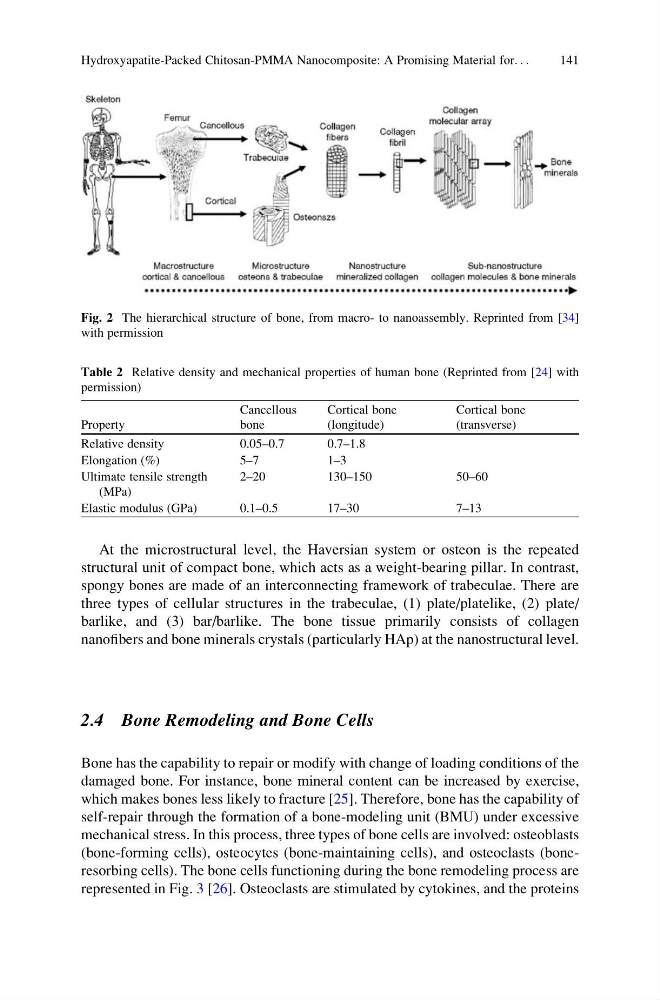
At the microstructural level, the Haversian system or osteon is the repeated
structural unit of compact bone, which acts as a weight-bearing pillar. In contrast,
spongy bones are made of an interconnecting framework of trabeculae. There are
three types of cellular structures in the trabeculae, (1) plate/platelike, (2) plate/
barlike, and (3) bar/barlike. The bone tissue primarily consists of collagen
nanofibers and bone minerals crystals (particularly HAp) at the nanostructural level.
2.4 Bone Remodeling and Bone Cells
Bone has the capability to repair or modify with change of loading conditions of the
damaged bone. For instance, bone mineral content can be increased by exercise,
which makes bones less likely to fracture [25]. Therefore, bone has the capability of
self-repair through the formation of a bone-modeling unit (BMU) under excessive
mechanical stress. In this process, three types of bone cells are involved: osteoblasts
(bone-forming cells), osteocytes (bone-maintaining cells), and osteoclasts (boneresorbing cells). The bone cells functioning during the bone remodeling process are
represented in Fig. 3 [26]. Osteoclasts are stimulated by cytokines, and the proteins
Fig. 2 The hierarchical structure of bone, from macro- to nanoassembly. Reprinted from [34]
with permission
Table 2 Relative density and mechanical properties of human bone (Reprinted from [24] with
permission)
Property
Cancellous
bone
Cortical bone
(longitude)
Cortical bone
(transverse)
Relative density
0.05–0.7
0.7–1.8
Elongation (%)
5–7
1–3
Ultimate tensile strength
(MPa)
2–20
130–150
50–60
Elastic modulus (GPa)
0.1–0.5
17–30
7–13
Hydroxyapatite-Packed Chitosan-PMMA Nanocomposite: A Promising Material for. . .
141
structural unit of compact bone, which acts as a weight-bearing pillar. In contrast,
spongy bones are made of an interconnecting framework of trabeculae. There are
three types of cellular structures in the trabeculae, (1) plate/platelike, (2) plate/
barlike, and (3) bar/barlike. The bone tissue primarily consists of collagen
nanofibers and bone minerals crystals (particularly HAp) at the nanostructural level.
2.4 Bone Remodeling and Bone Cells
Bone has the capability to repair or modify with change of loading conditions of the
damaged bone. For instance, bone mineral content can be increased by exercise,
which makes bones less likely to fracture [25]. Therefore, bone has the capability of
self-repair through the formation of a bone-modeling unit (BMU) under excessive
mechanical stress. In this process, three types of bone cells are involved: osteoblasts
(bone-forming cells), osteocytes (bone-maintaining cells), and osteoclasts (boneresorbing cells). The bone cells functioning during the bone remodeling process are
represented in Fig. 3 [26]. Osteoclasts are stimulated by cytokines, and the proteins
Fig. 2 The hierarchical structure of bone, from macro- to nanoassembly. Reprinted from [34]
with permission
Table 2 Relative density and mechanical properties of human bone (Reprinted from [24] with
permission)
Property
Cancellous
bone
Cortical bone
(longitude)
Cortical bone
(transverse)
Relative density
0.05–0.7
0.7–1.8
Elongation (%)
5–7
1–3
Ultimate tensile strength
(MPa)
2–20
130–150
50–60
Elastic modulus (GPa)
0.1–0.5
17–30
7–13
Hydroxyapatite-Packed Chitosan-PMMA Nanocomposite: A Promising Material for. . .
141