

crystals are parallel to the long axes of the collagen fibrils [20]. The average size of
plates is 50 Â 25 nm and the crystal thickness is 2–3 nm [21]. The mineralized
apatite contains small amounts of impurities, e.g., phosphate, Na, Mg, K, citrate,
and carbonate [20], which change certain physical properties (such as solubility)
and some important biological features of bone that are vital to normal bone
function. For instance, the presence of magnesium in the mineralized matrix may
improve cellular activity and promote growth of HAp crystals, followed by new
bone formation [22].
2.3 Physical and Mechanical Characteristics of Bone
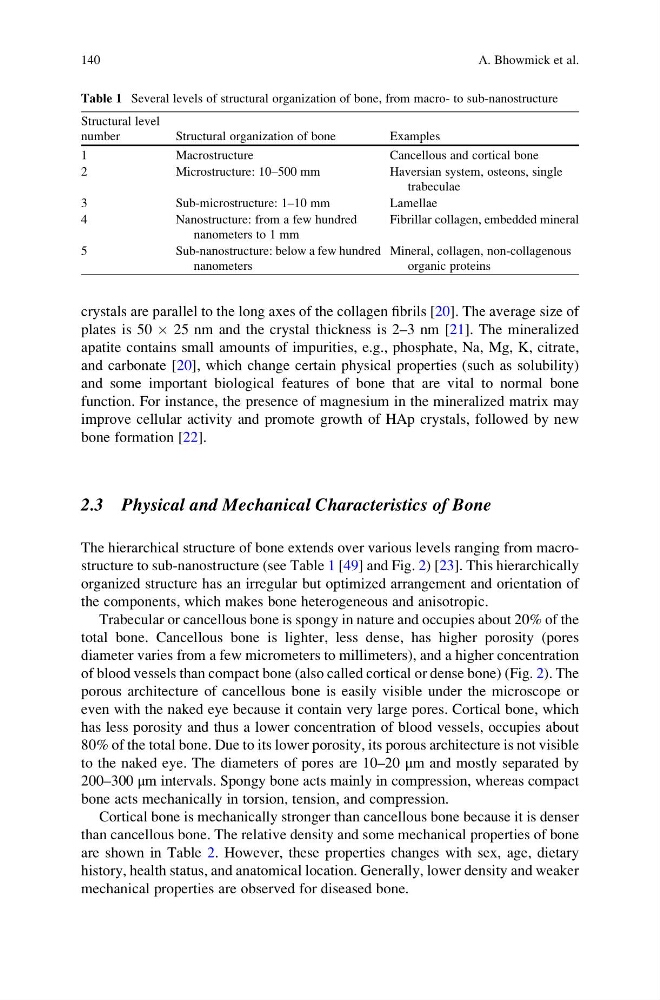
The hierarchical structure of bone extends over various levels ranging from macrostructure to sub-nanostructure (see Table 1 [49] and Fig. 2) [23]. This hierarchically
organized structure has an irregular but optimized arrangement and orientation of
the components, which makes bone heterogeneous and anisotropic.
Trabecular or cancellous bone is spongy in nature and occupies about 20% of the
total bone. Cancellous bone is lighter, less dense, has higher porosity (pores
diameter varies from a few micrometers to millimeters), and a higher concentration
of blood vessels than compact bone (also called cortical or dense bone) (Fig. 2). The
porous architecture of cancellous bone is easily visible under the microscope or
even with the naked eye because it contain very large pores. Cortical bone, which
has less porosity and thus a lower concentration of blood vessels, occupies about
80% of the total bone. Due to its lower porosity, its porous architecture is not visible
to the naked eye. The diameters of pores are 10–20 μm and mostly separated by
200–300 μm intervals. Spongy bone acts mainly in compression, whereas compact
bone acts mechanically in torsion, tension, and compression.
Cortical bone is mechanically stronger than cancellous bone because it is denser
than cancellous bone. The relative density and some mechanical properties of bone
are shown in Table 2. However, these properties changes with sex, age, dietary
history, health status, and anatomical location. Generally, lower density and weaker
mechanical properties are observed for diseased bone.
Table 1 Several levels of structural organization of bone, from macro- to sub-nanostructure
Structural level
number
Structural organization of bone
Examples
1
Macrostructure
Cancellous and cortical bone
2
Microstructure: 10–500 mm
Haversian system, osteons, single
trabeculae
3
Sub-microstructure: 1–10 mm
Lamellae
4
Nanostructure: from a few hundred
nanometers to 1 mm
Fibrillar collagen, embedded mineral
5
Sub-nanostructure: below a few hundred
nanometers
Mineral, collagen, non-collagenous
organic proteins
140
A. Bhowmick et al.
plates is 50 Â 25 nm and the crystal thickness is 2–3 nm [21]. The mineralized
apatite contains small amounts of impurities, e.g., phosphate, Na, Mg, K, citrate,
and carbonate [20], which change certain physical properties (such as solubility)
and some important biological features of bone that are vital to normal bone
function. For instance, the presence of magnesium in the mineralized matrix may
improve cellular activity and promote growth of HAp crystals, followed by new
bone formation [22].
2.3 Physical and Mechanical Characteristics of Bone
The hierarchical structure of bone extends over various levels ranging from macrostructure to sub-nanostructure (see Table 1 [49] and Fig. 2) [23]. This hierarchically
organized structure has an irregular but optimized arrangement and orientation of
the components, which makes bone heterogeneous and anisotropic.
Trabecular or cancellous bone is spongy in nature and occupies about 20% of the
total bone. Cancellous bone is lighter, less dense, has higher porosity (pores
diameter varies from a few micrometers to millimeters), and a higher concentration
of blood vessels than compact bone (also called cortical or dense bone) (Fig. 2). The
porous architecture of cancellous bone is easily visible under the microscope or
even with the naked eye because it contain very large pores. Cortical bone, which
has less porosity and thus a lower concentration of blood vessels, occupies about
80% of the total bone. Due to its lower porosity, its porous architecture is not visible
to the naked eye. The diameters of pores are 10–20 μm and mostly separated by
200–300 μm intervals. Spongy bone acts mainly in compression, whereas compact
bone acts mechanically in torsion, tension, and compression.
Cortical bone is mechanically stronger than cancellous bone because it is denser
than cancellous bone. The relative density and some mechanical properties of bone
are shown in Table 2. However, these properties changes with sex, age, dietary
history, health status, and anatomical location. Generally, lower density and weaker
mechanical properties are observed for diseased bone.
Table 1 Several levels of structural organization of bone, from macro- to sub-nanostructure
Structural level
number
Structural organization of bone
Examples
1
Macrostructure
Cancellous and cortical bone
2
Microstructure: 10–500 mm
Haversian system, osteons, single
trabeculae
3
Sub-microstructure: 1–10 mm
Lamellae
4
Nanostructure: from a few hundred
nanometers to 1 mm
Fibrillar collagen, embedded mineral
5
Sub-nanostructure: below a few hundred
nanometers
Mineral, collagen, non-collagenous
organic proteins
140
A. Bhowmick et al.