

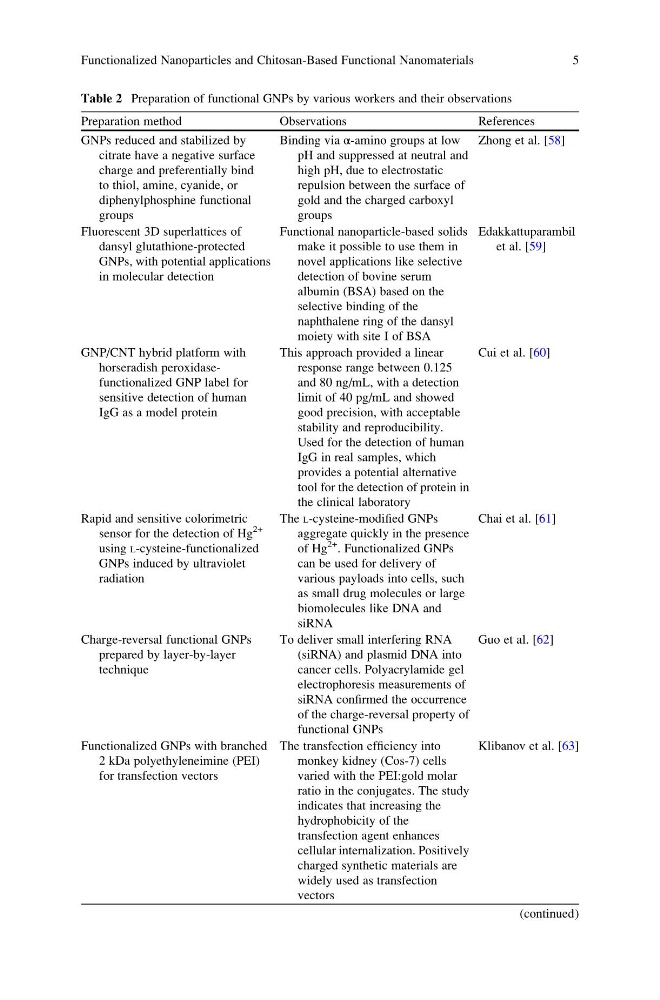
Table 2 Preparation of functional GNPs by various workers and their observations
Preparation method
Observations
References
GNPs reduced and stabilized by
citrate have a negative surface
charge and preferentially bind
to thiol, amine, cyanide, or
diphenylphosphine functional
groups
Binding via α-amino groups at low
pH and suppressed at neutral and
high pH, due to electrostatic
repulsion between the surface of
gold and the charged carboxyl
groups
Zhong et al. [58]
Fluorescent 3D superlattices of
dansyl glutathione-protected
GNPs, with potential applications
in molecular detection
Functional nanoparticle-based solids
make it possible to use them in
novel applications like selective
detection of bovine serum
albumin (BSA) based on the
selective binding of the
naphthalene ring of the dansyl
moiety with site I of BSA
Edakkattuparambil
et al. [59]
GNP/CNT hybrid platform with
horseradish peroxidasefunctionalized GNP label for
sensitive detection of human
IgG as a model protein
This approach provided a linear
response range between 0.125
and 80 ng/mL, with a detection
limit of 40 pg/mL and showed
good precision, with acceptable
stability and reproducibility.
Used for the detection of human
IgG in real samples, which
provides a potential alternative
tool for the detection of protein in
the clinical laboratory
Cui et al. [60]
Rapid and sensitive colorimetric
sensor for the detection of Hg
2+
using L-cysteine-functionalized
GNPs induced by ultraviolet
radiation
The L-cysteine-modified GNPs
aggregate quickly in the presence
of Hg
2+ . Functionalized GNPs
can be used for delivery of
various payloads into cells, such
as small drug molecules or large
biomolecules like DNA and
siRNA
Chai et al. [61]
Charge-reversal functional GNPs
prepared by layer-by-layer
technique
To deliver small interfering RNA
(siRNA) and plasmid DNA into
cancer cells. Polyacrylamide gel
electrophoresis measurements of
siRNA confirmed the occurrence
of the charge-reversal property of
functional GNPs
Guo et al. [62]
Functionalized GNPs with branched
2 kDa polyethyleneimine (PEI)
for transfection vectors
The transfection efficiency into
monkey kidney (Cos-7) cells
varied with the PEI:gold molar
ratio in the conjugates. The study
indicates that increasing the
hydrophobicity of the
transfection agent enhances
cellular internalization. Positively
charged synthetic materials are
widely used as transfection
vectors
Klibanov et al. [63]
(continued)
Functionalized Nanoparticles and Chitosan-Based Functional Nanomaterials
5
Preparation method
Observations
References
GNPs reduced and stabilized by
citrate have a negative surface
charge and preferentially bind
to thiol, amine, cyanide, or
diphenylphosphine functional
groups
Binding via α-amino groups at low
pH and suppressed at neutral and
high pH, due to electrostatic
repulsion between the surface of
gold and the charged carboxyl
groups
Zhong et al. [58]
Fluorescent 3D superlattices of
dansyl glutathione-protected
GNPs, with potential applications
in molecular detection
Functional nanoparticle-based solids
make it possible to use them in
novel applications like selective
detection of bovine serum
albumin (BSA) based on the
selective binding of the
naphthalene ring of the dansyl
moiety with site I of BSA
Edakkattuparambil
et al. [59]
GNP/CNT hybrid platform with
horseradish peroxidasefunctionalized GNP label for
sensitive detection of human
IgG as a model protein
This approach provided a linear
response range between 0.125
and 80 ng/mL, with a detection
limit of 40 pg/mL and showed
good precision, with acceptable
stability and reproducibility.
Used for the detection of human
IgG in real samples, which
provides a potential alternative
tool for the detection of protein in
the clinical laboratory
Cui et al. [60]
Rapid and sensitive colorimetric
sensor for the detection of Hg
2+
using L-cysteine-functionalized
GNPs induced by ultraviolet
radiation
The L-cysteine-modified GNPs
aggregate quickly in the presence
of Hg
2+ . Functionalized GNPs
can be used for delivery of
various payloads into cells, such
as small drug molecules or large
biomolecules like DNA and
siRNA
Chai et al. [61]
Charge-reversal functional GNPs
prepared by layer-by-layer
technique
To deliver small interfering RNA
(siRNA) and plasmid DNA into
cancer cells. Polyacrylamide gel
electrophoresis measurements of
siRNA confirmed the occurrence
of the charge-reversal property of
functional GNPs
Guo et al. [62]
Functionalized GNPs with branched
2 kDa polyethyleneimine (PEI)
for transfection vectors
The transfection efficiency into
monkey kidney (Cos-7) cells
varied with the PEI:gold molar
ratio in the conjugates. The study
indicates that increasing the
hydrophobicity of the
transfection agent enhances
cellular internalization. Positively
charged synthetic materials are
widely used as transfection
vectors
Klibanov et al. [63]
(continued)
Functionalized Nanoparticles and Chitosan-Based Functional Nanomaterials
5