

absorption bands [56], light scattering [57], etc. For biomedical applications, surfacefunctionalization of GNPs is essential in order to target them to specific disease areas
and allow them to selectively interact with cells or biological molecules. In general,
functionalization of GNPs can be performed by using either chemical functional
groups or biological molecules. Colloidal GNPs are normally stabilized against
aggregation by using long hydrocarbon ligand chains consisting of various functional
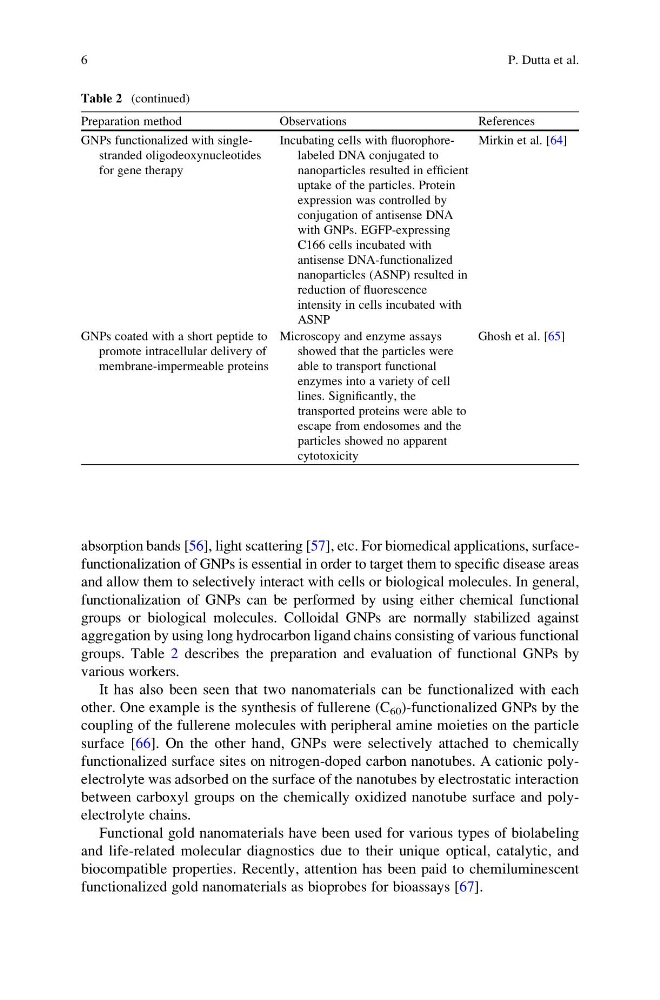
groups. Table 2 describes the preparation and evaluation of functional GNPs by
various workers.
It has also been seen that two nanomaterials can be functionalized with each
other. One example is the synthesis of fullerene (C 60 )-functionalized GNPs by the
coupling of the fullerene molecules with peripheral amine moieties on the particle
surface [66]. On the other hand, GNPs were selectively attached to chemically
functionalized surface sites on nitrogen-doped carbon nanotubes. A cationic polyelectrolyte was adsorbed on the surface of the nanotubes by electrostatic interaction
between carboxyl groups on the chemically oxidized nanotube surface and polyelectrolyte chains.
Functional gold nanomaterials have been used for various types of biolabeling
and life-related molecular diagnostics due to their unique optical, catalytic, and
biocompatible properties. Recently, attention has been paid to chemiluminescent
functionalized gold nanomaterials as bioprobes for bioassays [67].
Table 2 (continued)
Preparation method
Observations
References
GNPs functionalized with singlestranded oligodeoxynucleotides
for gene therapy
Incubating cells with fluorophorelabeled DNA conjugated to
nanoparticles resulted in efficient
uptake of the particles. Protein
expression was controlled by
conjugation of antisense DNA
with GNPs. EGFP-expressing
C166 cells incubated with
antisense DNA-functionalized
nanoparticles (ASNP) resulted in
reduction of fluorescence
intensity in cells incubated with
ASNP
Mirkin et al. [64]
GNPs coated with a short peptide to
promote intracellular delivery of
membrane-impermeable proteins
Microscopy and enzyme assays
showed that the particles were
able to transport functional
enzymes into a variety of cell
lines. Significantly, the
transported proteins were able to
escape from endosomes and the
particles showed no apparent
cytotoxicity
Ghosh et al. [65]
6
P. Dutta et al.
and allow them to selectively interact with cells or biological molecules. In general,
functionalization of GNPs can be performed by using either chemical functional
groups or biological molecules. Colloidal GNPs are normally stabilized against
aggregation by using long hydrocarbon ligand chains consisting of various functional
groups. Table 2 describes the preparation and evaluation of functional GNPs by
various workers.
It has also been seen that two nanomaterials can be functionalized with each
other. One example is the synthesis of fullerene (C 60 )-functionalized GNPs by the
coupling of the fullerene molecules with peripheral amine moieties on the particle
surface [66]. On the other hand, GNPs were selectively attached to chemically
functionalized surface sites on nitrogen-doped carbon nanotubes. A cationic polyelectrolyte was adsorbed on the surface of the nanotubes by electrostatic interaction
between carboxyl groups on the chemically oxidized nanotube surface and polyelectrolyte chains.
Functional gold nanomaterials have been used for various types of biolabeling
and life-related molecular diagnostics due to their unique optical, catalytic, and
biocompatible properties. Recently, attention has been paid to chemiluminescent
functionalized gold nanomaterials as bioprobes for bioassays [67].
Table 2 (continued)
Preparation method
Observations
References
GNPs functionalized with singlestranded oligodeoxynucleotides
for gene therapy
Incubating cells with fluorophorelabeled DNA conjugated to
nanoparticles resulted in efficient
uptake of the particles. Protein
expression was controlled by
conjugation of antisense DNA
with GNPs. EGFP-expressing
C166 cells incubated with
antisense DNA-functionalized
nanoparticles (ASNP) resulted in
reduction of fluorescence
intensity in cells incubated with
ASNP
Mirkin et al. [64]
GNPs coated with a short peptide to
promote intracellular delivery of
membrane-impermeable proteins
Microscopy and enzyme assays
showed that the particles were
able to transport functional
enzymes into a variety of cell
lines. Significantly, the
transported proteins were able to
escape from endosomes and the
particles showed no apparent
cytotoxicity
Ghosh et al. [65]
6
P. Dutta et al.