

structural characteristics and integrated functions will attract increasing research
interest and could lead to new opportunities in biomedical applications [20].
3 Metal Nanoparticles
Nanoparticles can be composed of any substance, including metals [21, 22],
semiconductors [23, 24], core–shell composite architectures [25–27], and organic
polymers [28]. These particles often display properties intermediate between
quantum and bulk materials because of their intermediate size [29] and large
surface area to volume ratio [30]. Nanoparticle of different sizes and shapes exhibit
different absorbance and fluorescence features and reveal polymerization effects
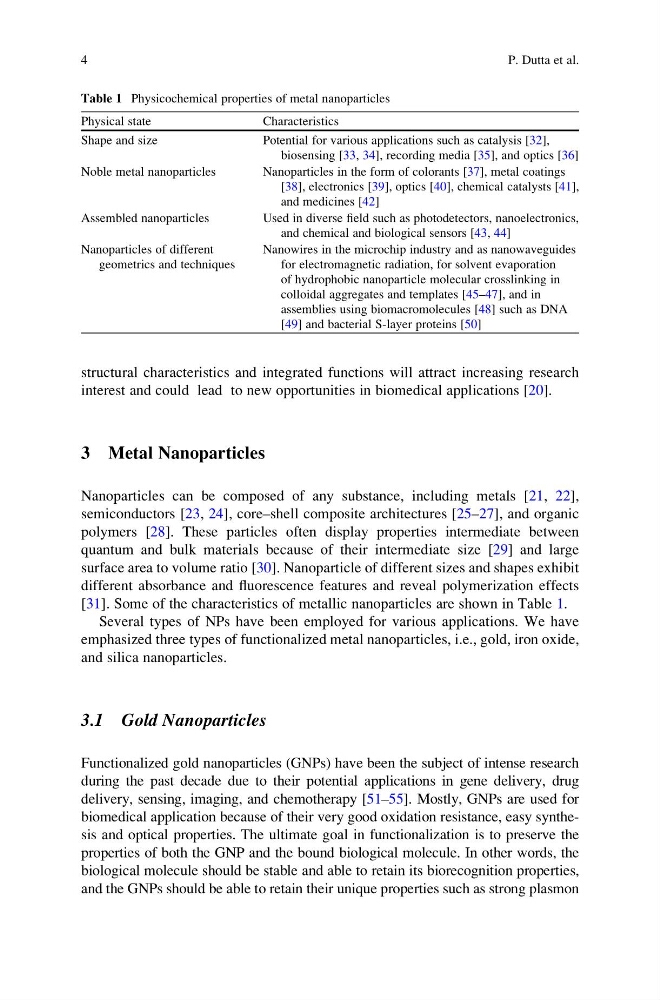
[31]. Some of the characteristics of metallic nanoparticles are shown in Table 1.
Several types of NPs have been employed for various applications. We have
emphasized three types of functionalized metal nanoparticles, i.e., gold, iron oxide,
and silica nanoparticles.
3.1 Gold Nanoparticles
Functionalized gold nanoparticles (GNPs) have been the subject of intense research
during the past decade due to their potential applications in gene delivery, drug
delivery, sensing, imaging, and chemotherapy [51–55]. Mostly, GNPs are used for
biomedical application because of their very good oxidation resistance, easy synthesis and optical properties. The ultimate goal in functionalization is to preserve the
properties of both the GNP and the bound biological molecule. In other words, the
biological molecule should be stable and able to retain its biorecognition properties,
and the GNPs should be able to retain their unique properties such as strong plasmon
Table 1 Physicochemical properties of metal nanoparticles
Physical state
Characteristics
Shape and size
Potential for various applications such as catalysis [32],
biosensing [33, 34], recording media [35], and optics [36]
Noble metal nanoparticles
Nanoparticles in the form of colorants [37], metal coatings
[38], electronics [39], optics [40], chemical catalysts [41],
and medicines [42]
Assembled nanoparticles
Used in diverse field such as photodetectors, nanoelectronics,
and chemical and biological sensors [43, 44]
Nanoparticles of different
geometrics and techniques
Nanowires in the microchip industry and as nanowaveguides
for electromagnetic radiation, for solvent evaporation
of hydrophobic nanoparticle molecular crosslinking in
colloidal aggregates and templates [45–47], and in
assemblies using biomacromolecules [48] such as DNA
[49] and bacterial S-layer proteins [50]
4
P. Dutta et al.
interest and could lead to new opportunities in biomedical applications [20].
3 Metal Nanoparticles
Nanoparticles can be composed of any substance, including metals [21, 22],
semiconductors [23, 24], core–shell composite architectures [25–27], and organic
polymers [28]. These particles often display properties intermediate between
quantum and bulk materials because of their intermediate size [29] and large
surface area to volume ratio [30]. Nanoparticle of different sizes and shapes exhibit
different absorbance and fluorescence features and reveal polymerization effects
[31]. Some of the characteristics of metallic nanoparticles are shown in Table 1.
Several types of NPs have been employed for various applications. We have
emphasized three types of functionalized metal nanoparticles, i.e., gold, iron oxide,
and silica nanoparticles.
3.1 Gold Nanoparticles
Functionalized gold nanoparticles (GNPs) have been the subject of intense research
during the past decade due to their potential applications in gene delivery, drug
delivery, sensing, imaging, and chemotherapy [51–55]. Mostly, GNPs are used for
biomedical application because of their very good oxidation resistance, easy synthesis and optical properties. The ultimate goal in functionalization is to preserve the
properties of both the GNP and the bound biological molecule. In other words, the
biological molecule should be stable and able to retain its biorecognition properties,
and the GNPs should be able to retain their unique properties such as strong plasmon
Table 1 Physicochemical properties of metal nanoparticles
Physical state
Characteristics
Shape and size
Potential for various applications such as catalysis [32],
biosensing [33, 34], recording media [35], and optics [36]
Noble metal nanoparticles
Nanoparticles in the form of colorants [37], metal coatings
[38], electronics [39], optics [40], chemical catalysts [41],
and medicines [42]
Assembled nanoparticles
Used in diverse field such as photodetectors, nanoelectronics,
and chemical and biological sensors [43, 44]
Nanoparticles of different
geometrics and techniques
Nanowires in the microchip industry and as nanowaveguides
for electromagnetic radiation, for solvent evaporation
of hydrophobic nanoparticle molecular crosslinking in
colloidal aggregates and templates [45–47], and in
assemblies using biomacromolecules [48] such as DNA
[49] and bacterial S-layer proteins [50]
4
P. Dutta et al.