

belongs to the genus Sanguibacter. The enzyme extracted from the bacterium was
able to degrade polymeric chitin from crab and shrimp shells, and from insect
puparium. The enzyme also displayed weak activity against chitosan. Bacterial
growth is faster than fungal growth and the chitosan deacetylase (CDA)-producing
capabilities of most fungal strains are low and their fermentation requirements are
complicated. Zhou et al. [71] reported the isolation of CDA-producing bacteria from
soil and optimized its fermentation process. Among 208 bacteria isolated from fresh
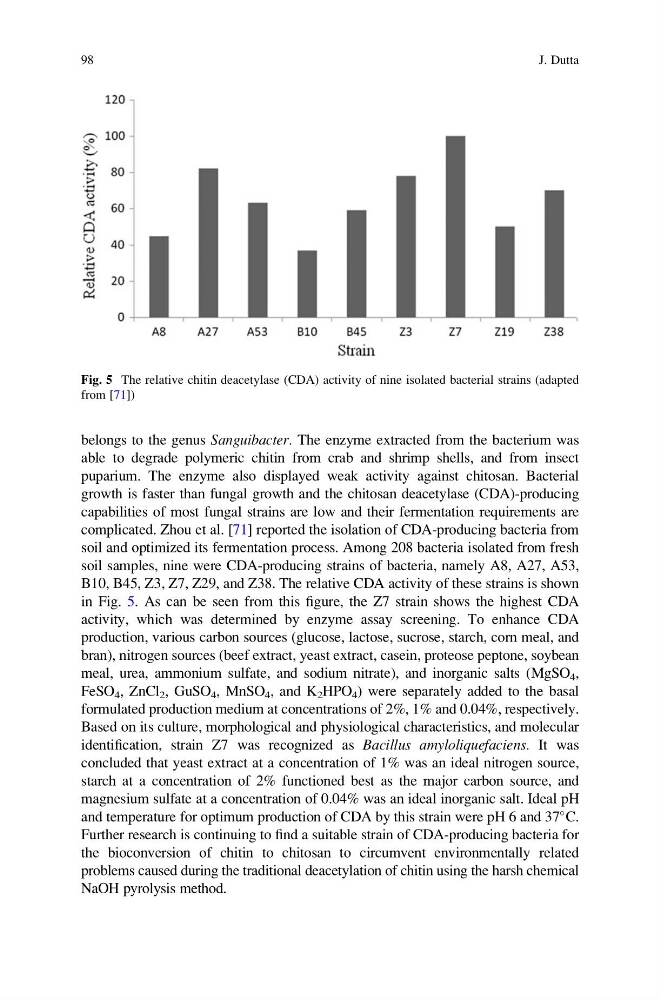
soil samples, nine were CDA-producing strains of bacteria, namely A8, A27, A53,
B10, B45, Z3, Z7, Z29, and Z38. The relative CDA activity of these strains is shown
in Fig. 5. As can be seen from this figure, the Z7 strain shows the highest CDA
activity, which was determined by enzyme assay screening. To enhance CDA
production, various carbon sources (glucose, lactose, sucrose, starch, corn meal, and
bran), nitrogen sources (beef extract, yeast extract, casein, proteose peptone, soybean
meal, urea, ammonium sulfate, and sodium nitrate), and inorganic salts (MgSO 4 ,
FeSO 4 , ZnCl 2 , GuSO 4 , MnSO 4 , and K 2 HPO 4 ) were separately added to the basal
formulated production medium at concentrations of 2%, 1% and 0.04%, respectively.
Based on its culture, morphological and physiological characteristics, and molecular
identification, strain Z7 was recognized as Bacillus amyloliquefaciens. It was
concluded that yeast extract at a concentration of 1% was an ideal nitrogen source,
starch at a concentration of 2% functioned best as the major carbon source, and
magnesium sulfate at a concentration of 0.04% was an ideal inorganic salt. Ideal pH
and temperature for optimum production of CDA by this strain were pH 6 and 37
C.
Further research is continuing to find a suitable strain of CDA-producing bacteria for
the bioconversion of chitin to chitosan to circumvent environmentally related
problems caused during the traditional deacetylation of chitin using the harsh chemical
NaOH pyrolysis method.
Fig. 5 The relative chitin deacetylase (CDA) activity of nine isolated bacterial strains (adapted
from [71])
98
J. Dutta
able to degrade polymeric chitin from crab and shrimp shells, and from insect
puparium. The enzyme also displayed weak activity against chitosan. Bacterial
growth is faster than fungal growth and the chitosan deacetylase (CDA)-producing
capabilities of most fungal strains are low and their fermentation requirements are
complicated. Zhou et al. [71] reported the isolation of CDA-producing bacteria from
soil and optimized its fermentation process. Among 208 bacteria isolated from fresh
soil samples, nine were CDA-producing strains of bacteria, namely A8, A27, A53,
B10, B45, Z3, Z7, Z29, and Z38. The relative CDA activity of these strains is shown
in Fig. 5. As can be seen from this figure, the Z7 strain shows the highest CDA
activity, which was determined by enzyme assay screening. To enhance CDA
production, various carbon sources (glucose, lactose, sucrose, starch, corn meal, and
bran), nitrogen sources (beef extract, yeast extract, casein, proteose peptone, soybean
meal, urea, ammonium sulfate, and sodium nitrate), and inorganic salts (MgSO 4 ,
FeSO 4 , ZnCl 2 , GuSO 4 , MnSO 4 , and K 2 HPO 4 ) were separately added to the basal
formulated production medium at concentrations of 2%, 1% and 0.04%, respectively.
Based on its culture, morphological and physiological characteristics, and molecular
identification, strain Z7 was recognized as Bacillus amyloliquefaciens. It was
concluded that yeast extract at a concentration of 1% was an ideal nitrogen source,
starch at a concentration of 2% functioned best as the major carbon source, and
magnesium sulfate at a concentration of 0.04% was an ideal inorganic salt. Ideal pH
and temperature for optimum production of CDA by this strain were pH 6 and 37
C.
Further research is continuing to find a suitable strain of CDA-producing bacteria for
the bioconversion of chitin to chitosan to circumvent environmentally related
problems caused during the traditional deacetylation of chitin using the harsh chemical
NaOH pyrolysis method.
Fig. 5 The relative chitin deacetylase (CDA) activity of nine isolated bacterial strains (adapted
from [71])
98
J. Dutta