

In another study, Kaur et al. [72] reported the isolation of 20 strains of bacteria
from soil samples collected from different beaches in Chennai, India. Of these 20
bacterial strains, only two strains (S3, S14) are potent degraders of chitin and they
are also good producers of the enzyme chitin deacetylase that catalyzes release of
chitosan.
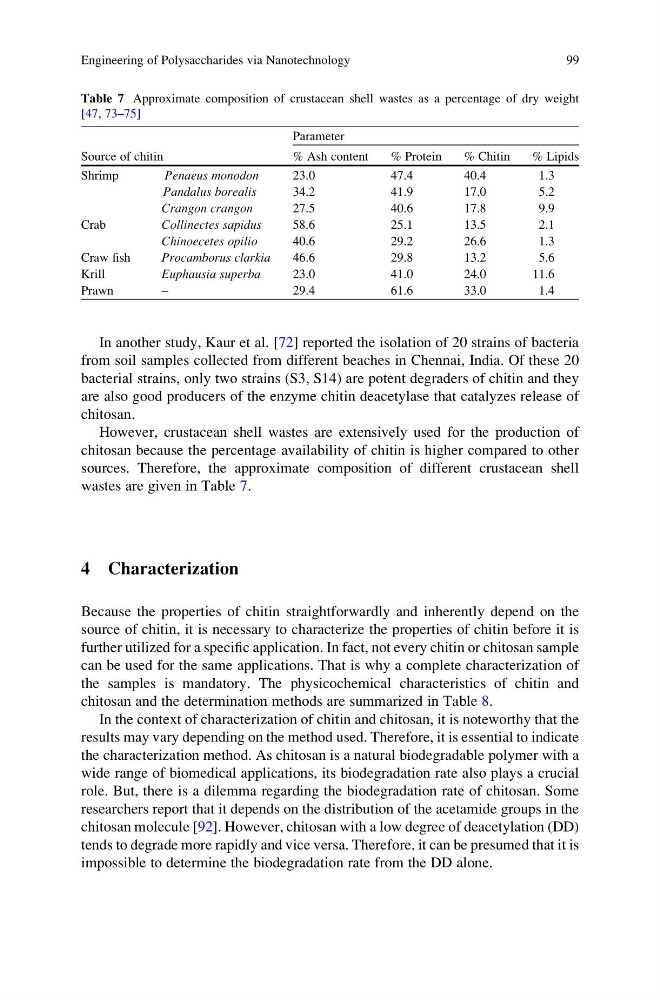
However, crustacean shell wastes are extensively used for the production of
chitosan because the percentage availability of chitin is higher compared to other
sources. Therefore, the approximate composition of different crustacean shell
wastes are given in Table 7.
4 Characterization
Because the properties of chitin straightforwardly and inherently depend on the
source of chitin, it is necessary to characterize the properties of chitin before it is
further utilized for a specific application. In fact, not every chitin or chitosan sample
can be used for the same applications. That is why a complete characterization of
the samples is mandatory. The physicochemical characteristics of chitin and
chitosan and the determination methods are summarized in Table 8.
In the context of characterization of chitin and chitosan, it is noteworthy that the
results may vary depending on the method used. Therefore, it is essential to indicate
the characterization method. As chitosan is a natural biodegradable polymer with a
wide range of biomedical applications, its biodegradation rate also plays a crucial
role. But, there is a dilemma regarding the biodegradation rate of chitosan. Some
researchers report that it depends on the distribution of the acetamide groups in the
chitosan molecule [92]. However, chitosan with a low degree of deacetylation (DD)
tends to degrade more rapidly and vice versa. Therefore, it can be presumed that it is
impossible to determine the biodegradation rate from the DD alone.
Table 7 Approximate composition of crustacean shell wastes as a percentage of dry weight
[47, 73–75]
Source of chitin
Parameter
% Ash content
% Protein
% Chitin
% Lipids
Shrimp
Penaeus monodon
23.0
47.4
40.4
1.3
Pandalus borealis
34.2
41.9
17.0
5.2
Crangon crangon
27.5
40.6
17.8
9.9
Crab
Collinectes sapidus
58.6
25.1
13.5
2.1
Chinoecetes opilio
40.6
29.2
26.6
1.3
Craw fish
Procamborus clarkia
46.6
29.8
13.2
5.6
Krill
Euphausia superba
23.0
41.0
24.0
11.6
Prawn
–
29.4
61.6
33.0
1.4
Engineering of Polysaccharides via Nanotechnology
99
from soil samples collected from different beaches in Chennai, India. Of these 20
bacterial strains, only two strains (S3, S14) are potent degraders of chitin and they
are also good producers of the enzyme chitin deacetylase that catalyzes release of
chitosan.
However, crustacean shell wastes are extensively used for the production of
chitosan because the percentage availability of chitin is higher compared to other
sources. Therefore, the approximate composition of different crustacean shell
wastes are given in Table 7.
4 Characterization
Because the properties of chitin straightforwardly and inherently depend on the
source of chitin, it is necessary to characterize the properties of chitin before it is
further utilized for a specific application. In fact, not every chitin or chitosan sample
can be used for the same applications. That is why a complete characterization of
the samples is mandatory. The physicochemical characteristics of chitin and
chitosan and the determination methods are summarized in Table 8.
In the context of characterization of chitin and chitosan, it is noteworthy that the
results may vary depending on the method used. Therefore, it is essential to indicate
the characterization method. As chitosan is a natural biodegradable polymer with a
wide range of biomedical applications, its biodegradation rate also plays a crucial
role. But, there is a dilemma regarding the biodegradation rate of chitosan. Some
researchers report that it depends on the distribution of the acetamide groups in the
chitosan molecule [92]. However, chitosan with a low degree of deacetylation (DD)
tends to degrade more rapidly and vice versa. Therefore, it can be presumed that it is
impossible to determine the biodegradation rate from the DD alone.
Table 7 Approximate composition of crustacean shell wastes as a percentage of dry weight
[47, 73–75]
Source of chitin
Parameter
% Ash content
% Protein
% Chitin
% Lipids
Shrimp
Penaeus monodon
23.0
47.4
40.4
1.3
Pandalus borealis
34.2
41.9
17.0
5.2
Crangon crangon
27.5
40.6
17.8
9.9
Crab
Collinectes sapidus
58.6
25.1
13.5
2.1
Chinoecetes opilio
40.6
29.2
26.6
1.3
Craw fish
Procamborus clarkia
46.6
29.8
13.2
5.6
Krill
Euphausia superba
23.0
41.0
24.0
11.6
Prawn
–
29.4
61.6
33.0
1.4
Engineering of Polysaccharides via Nanotechnology
99