

Indeed, the use of biological treatment instead of chemical treatment for the isolation
of chitin from crustacean shells as well as for production of chitosan will substantially reduce environmental pollution. The use of chitin deacetylase for the preparation of chitosan polymers and oligomers offers the possibility to develop an
enzymatic process that could potentially overcome most of the drawbacks discussed
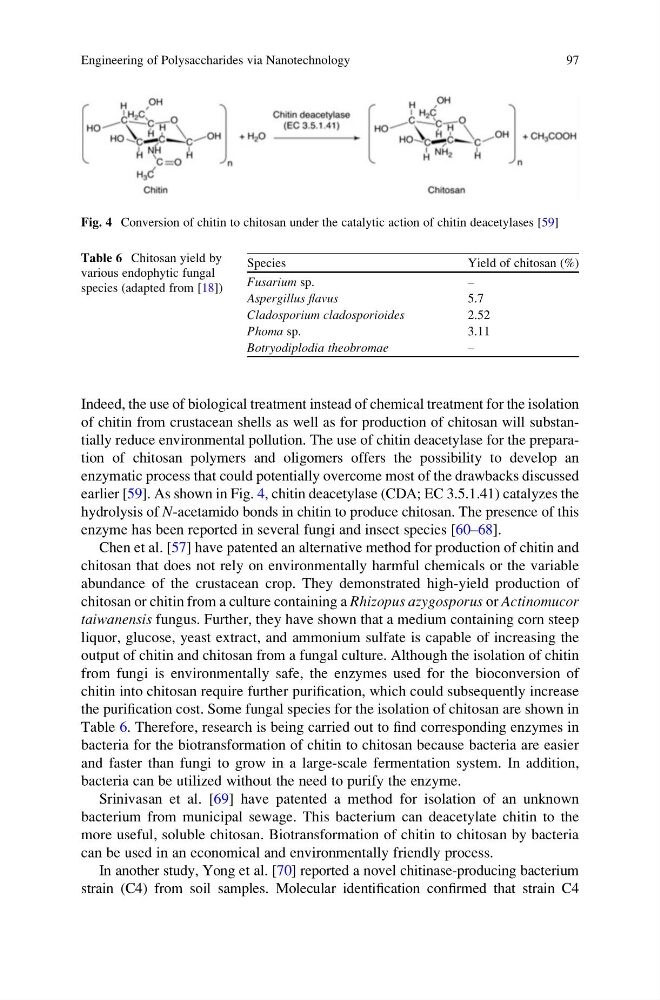
earlier [59]. As shown in Fig. 4, chitin deacetylase (CDA; EC 3.5.1.41) catalyzes the
hydrolysis of N-acetamido bonds in chitin to produce chitosan. The presence of this
enzyme has been reported in several fungi and insect species [60–68].
Chen et al. [57] have patented an alternative method for production of chitin and
chitosan that does not rely on environmentally harmful chemicals or the variable
abundance of the crustacean crop. They demonstrated high-yield production of
chitosan or chitin from a culture containing a Rhizopus azygosporus or Actinomucor
taiwanensis fungus. Further, they have shown that a medium containing corn steep
liquor, glucose, yeast extract, and ammonium sulfate is capable of increasing the
output of chitin and chitosan from a fungal culture. Although the isolation of chitin
from fungi is environmentally safe, the enzymes used for the bioconversion of
chitin into chitosan require further purification, which could subsequently increase
the purification cost. Some fungal species for the isolation of chitosan are shown in
Table 6. Therefore, research is being carried out to find corresponding enzymes in
bacteria for the biotransformation of chitin to chitosan because bacteria are easier
and faster than fungi to grow in a large-scale fermentation system. In addition,
bacteria can be utilized without the need to purify the enzyme.
Srinivasan et al. [69] have patented a method for isolation of an unknown
bacterium from municipal sewage. This bacterium can deacetylate chitin to the
more useful, soluble chitosan. Biotransformation of chitin to chitosan by bacteria
can be used in an economical and environmentally friendly process.
In another study, Yong et al. [70] reported a novel chitinase-producing bacterium
strain (C4) from soil samples. Molecular identification confirmed that strain C4
Table 6 Chitosan yield by
various endophytic fungal
species (adapted from [18])
Species
Yield of chitosan (%)
Fusarium sp.
–
Aspergillus flavus
5.7
Cladosporium cladosporioides
2.52
Phoma sp.
3.11
Botryodiplodia theobromae
–
Fig. 4 Conversion of chitin to chitosan under the catalytic action of chitin deacetylases [59]
Engineering of Polysaccharides via Nanotechnology
97
of chitin from crustacean shells as well as for production of chitosan will substantially reduce environmental pollution. The use of chitin deacetylase for the preparation of chitosan polymers and oligomers offers the possibility to develop an
enzymatic process that could potentially overcome most of the drawbacks discussed
earlier [59]. As shown in Fig. 4, chitin deacetylase (CDA; EC 3.5.1.41) catalyzes the
hydrolysis of N-acetamido bonds in chitin to produce chitosan. The presence of this
enzyme has been reported in several fungi and insect species [60–68].
Chen et al. [57] have patented an alternative method for production of chitin and
chitosan that does not rely on environmentally harmful chemicals or the variable
abundance of the crustacean crop. They demonstrated high-yield production of
chitosan or chitin from a culture containing a Rhizopus azygosporus or Actinomucor
taiwanensis fungus. Further, they have shown that a medium containing corn steep
liquor, glucose, yeast extract, and ammonium sulfate is capable of increasing the
output of chitin and chitosan from a fungal culture. Although the isolation of chitin
from fungi is environmentally safe, the enzymes used for the bioconversion of
chitin into chitosan require further purification, which could subsequently increase
the purification cost. Some fungal species for the isolation of chitosan are shown in
Table 6. Therefore, research is being carried out to find corresponding enzymes in
bacteria for the biotransformation of chitin to chitosan because bacteria are easier
and faster than fungi to grow in a large-scale fermentation system. In addition,
bacteria can be utilized without the need to purify the enzyme.
Srinivasan et al. [69] have patented a method for isolation of an unknown
bacterium from municipal sewage. This bacterium can deacetylate chitin to the
more useful, soluble chitosan. Biotransformation of chitin to chitosan by bacteria
can be used in an economical and environmentally friendly process.
In another study, Yong et al. [70] reported a novel chitinase-producing bacterium
strain (C4) from soil samples. Molecular identification confirmed that strain C4
Table 6 Chitosan yield by
various endophytic fungal
species (adapted from [18])
Species
Yield of chitosan (%)
Fusarium sp.
–
Aspergillus flavus
5.7
Cladosporium cladosporioides
2.52
Phoma sp.
3.11
Botryodiplodia theobromae
–
Fig. 4 Conversion of chitin to chitosan under the catalytic action of chitin deacetylases [59]
Engineering of Polysaccharides via Nanotechnology
97