

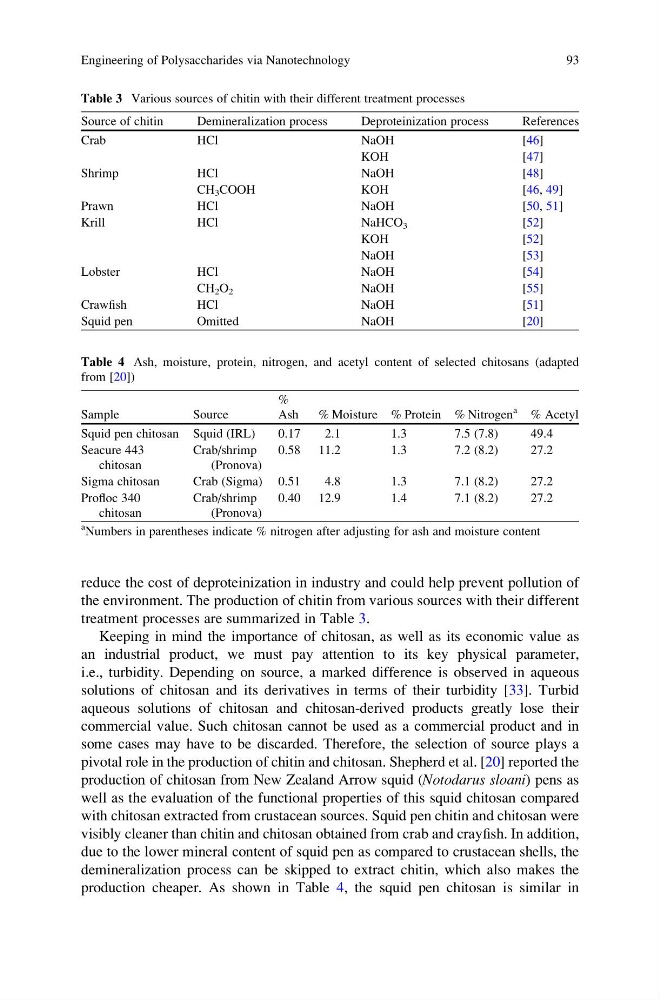
reduce the cost of deproteinization in industry and could help prevent pollution of
the environment. The production of chitin from various sources with their different
treatment processes are summarized in Table 3.
Keeping in mind the importance of chitosan, as well as its economic value as
an industrial product, we must pay attention to its key physical parameter,
i.e., turbidity. Depending on source, a marked difference is observed in aqueous
solutions of chitosan and its derivatives in terms of their turbidity [33]. Turbid
aqueous solutions of chitosan and chitosan-derived products greatly lose their
commercial value. Such chitosan cannot be used as a commercial product and in
some cases may have to be discarded. Therefore, the selection of source plays a
pivotal role in the production of chitin and chitosan. Shepherd et al. [20] reported the
production of chitosan from New Zealand Arrow squid (Notodarus sloani) pens as
well as the evaluation of the functional properties of this squid chitosan compared
with chitosan extracted from crustacean sources. Squid pen chitin and chitosan were
visibly cleaner than chitin and chitosan obtained from crab and crayfish. In addition,
due to the lower mineral content of squid pen as compared to crustacean shells, the
demineralization process can be skipped to extract chitin, which also makes the
production cheaper. As shown in Table 4, the squid pen chitosan is similar in
Table 4 Ash, moisture, protein, nitrogen, and acetyl content of selected chitosans (adapted
from [20])
Sample
Source
%
Ash
% Moisture % Protein % Nitrogen
a
% Acetyl
Squid pen chitosan Squid (IRL)
0.17
2.1
1.3
7.5 (7.8)
49.4
Seacure 443
chitosan
Crab/shrimp
(Pronova)
0.58 11.2
1.3
7.2 (8.2)
27.2
Sigma chitosan
Crab (Sigma) 0.51
4.8
1.3
7.1 (8.2)
27.2
Profloc 340
chitosan
Crab/shrimp
(Pronova)
0.40 12.9
1.4
7.1 (8.2)
27.2
a
Numbers in parentheses indicate % nitrogen after adjusting for ash and moisture content
Table 3 Various sources of chitin with their different treatment processes
Source of chitin
Demineralization process
Deproteinization process
References
Crab
HCl
NaOH
[46]
KOH
[47]
Shrimp
HCl
NaOH
[48]
CH 3 COOH
KOH
[46, 49]
Prawn
HCl
NaOH
[50, 51]
Krill
HCl
NaHCO 3
[52]
KOH
[52]
NaOH
[53]
Lobster
HCl
NaOH
[54]
CH 2 O 2
NaOH
[55]
Crawfish
HCl
NaOH
[51]
Squid pen
Omitted
NaOH
[20]
Engineering of Polysaccharides via Nanotechnology
93
the environment. The production of chitin from various sources with their different
treatment processes are summarized in Table 3.
Keeping in mind the importance of chitosan, as well as its economic value as
an industrial product, we must pay attention to its key physical parameter,
i.e., turbidity. Depending on source, a marked difference is observed in aqueous
solutions of chitosan and its derivatives in terms of their turbidity [33]. Turbid
aqueous solutions of chitosan and chitosan-derived products greatly lose their
commercial value. Such chitosan cannot be used as a commercial product and in
some cases may have to be discarded. Therefore, the selection of source plays a
pivotal role in the production of chitin and chitosan. Shepherd et al. [20] reported the
production of chitosan from New Zealand Arrow squid (Notodarus sloani) pens as
well as the evaluation of the functional properties of this squid chitosan compared
with chitosan extracted from crustacean sources. Squid pen chitin and chitosan were
visibly cleaner than chitin and chitosan obtained from crab and crayfish. In addition,
due to the lower mineral content of squid pen as compared to crustacean shells, the
demineralization process can be skipped to extract chitin, which also makes the
production cheaper. As shown in Table 4, the squid pen chitosan is similar in
Table 4 Ash, moisture, protein, nitrogen, and acetyl content of selected chitosans (adapted
from [20])
Sample
Source
%
Ash
% Moisture % Protein % Nitrogen
a
% Acetyl
Squid pen chitosan Squid (IRL)
0.17
2.1
1.3
7.5 (7.8)
49.4
Seacure 443
chitosan
Crab/shrimp
(Pronova)
0.58 11.2
1.3
7.2 (8.2)
27.2
Sigma chitosan
Crab (Sigma) 0.51
4.8
1.3
7.1 (8.2)
27.2
Profloc 340
chitosan
Crab/shrimp
(Pronova)
0.40 12.9
1.4
7.1 (8.2)
27.2
a
Numbers in parentheses indicate % nitrogen after adjusting for ash and moisture content
Table 3 Various sources of chitin with their different treatment processes
Source of chitin
Demineralization process
Deproteinization process
References
Crab
HCl
NaOH
[46]
KOH
[47]
Shrimp
HCl
NaOH
[48]
CH 3 COOH
KOH
[46, 49]
Prawn
HCl
NaOH
[50, 51]
Krill
HCl
NaHCO 3
[52]
KOH
[52]
NaOH
[53]
Lobster
HCl
NaOH
[54]
CH 2 O 2
NaOH
[55]
Crawfish
HCl
NaOH
[51]
Squid pen
Omitted
NaOH
[20]
Engineering of Polysaccharides via Nanotechnology
93