

has already been done on extraction of chitin and chitosan from various sources,
significant research is still required to improve the production process as well as the
quality of chitosan, especially from stored material sources. Toan [27] investigated
the effect of partial autolysis during storage of shrimp biowaste on the quality of
extracted chitin and chitosan. In this study, a modified method was used in which
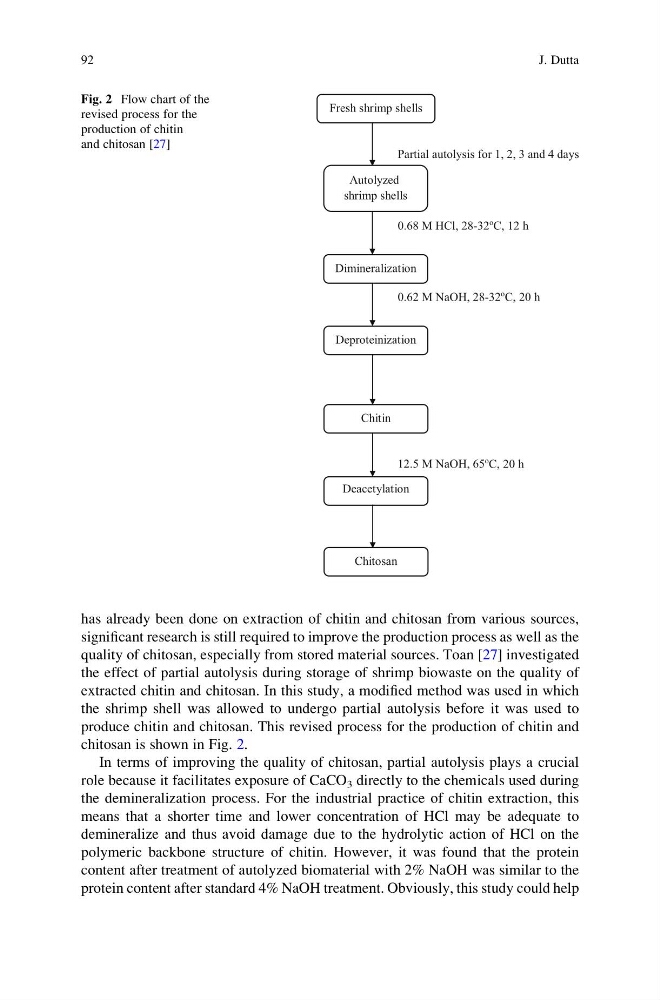
the shrimp shell was allowed to undergo partial autolysis before it was used to
produce chitin and chitosan. This revised process for the production of chitin and
chitosan is shown in Fig. 2.
In terms of improving the quality of chitosan, partial autolysis plays a crucial
role because it facilitates exposure of CaCO 3 directly to the chemicals used during
the demineralization process. For the industrial practice of chitin extraction, this
means that a shorter time and lower concentration of HCl may be adequate to
demineralize and thus avoid damage due to the hydrolytic action of HCl on the
polymeric backbone structure of chitin. However, it was found that the protein
content after treatment of autolyzed biomaterial with 2% NaOH was similar to the
protein content after standard 4% NaOH treatment. Obviously, this study could help
Partial autolysis for 1, 2, 3 and 4 days
0.68 M HCl, 28-32
o C, 12 h
0.62 M NaOH, 28-32
o C, 20 h
12.5 M NaOH, 65
o C, 20 h
Fresh shrimp shells
Autolyzed
shrimp shells
Dimineralization
Deproteinization
Chitin
Deacetylation
Chitosan
Fig. 2 Flow chart of the
revised process for the
production of chitin
and chitosan [27]
92
J. Dutta
significant research is still required to improve the production process as well as the
quality of chitosan, especially from stored material sources. Toan [27] investigated
the effect of partial autolysis during storage of shrimp biowaste on the quality of
extracted chitin and chitosan. In this study, a modified method was used in which
the shrimp shell was allowed to undergo partial autolysis before it was used to
produce chitin and chitosan. This revised process for the production of chitin and
chitosan is shown in Fig. 2.
In terms of improving the quality of chitosan, partial autolysis plays a crucial
role because it facilitates exposure of CaCO 3 directly to the chemicals used during
the demineralization process. For the industrial practice of chitin extraction, this
means that a shorter time and lower concentration of HCl may be adequate to
demineralize and thus avoid damage due to the hydrolytic action of HCl on the
polymeric backbone structure of chitin. However, it was found that the protein
content after treatment of autolyzed biomaterial with 2% NaOH was similar to the
protein content after standard 4% NaOH treatment. Obviously, this study could help
Partial autolysis for 1, 2, 3 and 4 days
0.68 M HCl, 28-32
o C, 12 h
0.62 M NaOH, 28-32
o C, 20 h
12.5 M NaOH, 65
o C, 20 h
Fresh shrimp shells
Autolyzed
shrimp shells
Dimineralization
Deproteinization
Chitin
Deacetylation
Chitosan
Fig. 2 Flow chart of the
revised process for the
production of chitin
and chitosan [27]
92
J. Dutta