

composition to commercial chitosan. Further, there is a substantially lower amount
of ash contained in squid chitosan that makes the aqueous solution noticeably cleaner
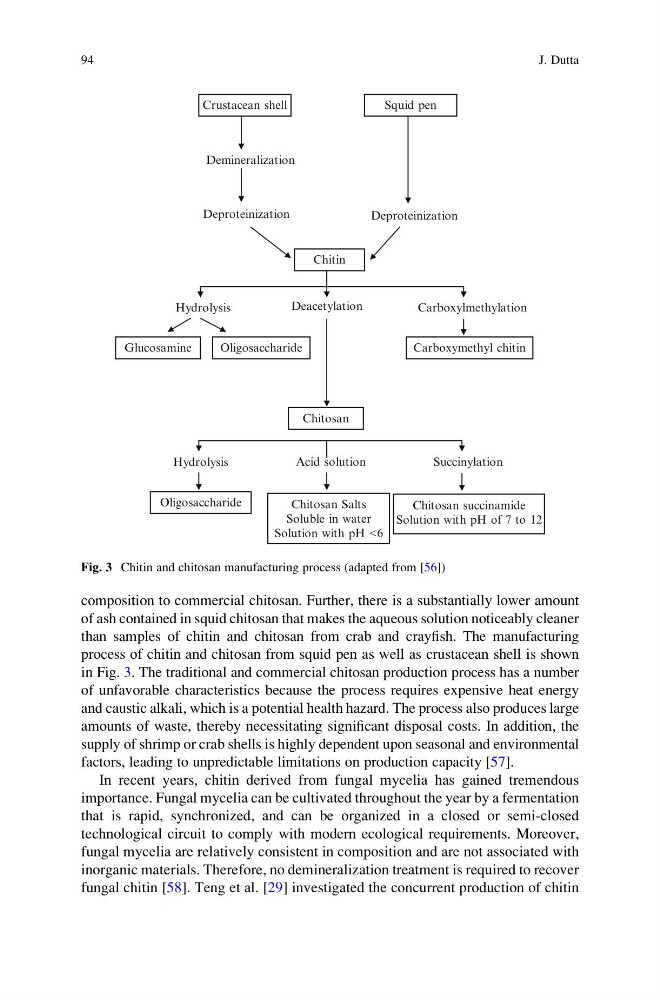
than samples of chitin and chitosan from crab and crayfish. The manufacturing
process of chitin and chitosan from squid pen as well as crustacean shell is shown
in Fig. 3. The traditional and commercial chitosan production process has a number
of unfavorable characteristics because the process requires expensive heat energy
and caustic alkali, which is a potential health hazard. The process also produces large
amounts of waste, thereby necessitating significant disposal costs. In addition, the
supply of shrimp or crab shells is highly dependent upon seasonal and environmental
factors, leading to unpredictable limitations on production capacity [57].
In recent years, chitin derived from fungal mycelia has gained tremendous
importance. Fungal mycelia can be cultivated throughout the year by a fermentation
that is rapid, synchronized, and can be organized in a closed or semi-closed
technological circuit to comply with modern ecological requirements. Moreover,
fungal mycelia are relatively consistent in composition and are not associated with
inorganic materials. Therefore, no demineralization treatment is required to recover
fungal chitin [58]. Teng et al. [29] investigated the concurrent production of chitin
Hydrolysis
Acid solution
Succinylation
Demineralization
Crustacean shell
Squid pen
Deproteinization
Deproteinization
Chitin
Hydrolysis
Deacetylation
Carboxylmethylation
Glucosamine
Oligosaccharide
Carboxymethyl chitin
Chitosan
Oligosaccharide
Chitosan Salts
Soluble in water
Solution with pH <6
Chitosan succinamide
Solution with pH of 7 to 12
Fig. 3 Chitin and chitosan manufacturing process (adapted from [56])
94
J. Dutta
of ash contained in squid chitosan that makes the aqueous solution noticeably cleaner
than samples of chitin and chitosan from crab and crayfish. The manufacturing
process of chitin and chitosan from squid pen as well as crustacean shell is shown
in Fig. 3. The traditional and commercial chitosan production process has a number
of unfavorable characteristics because the process requires expensive heat energy
and caustic alkali, which is a potential health hazard. The process also produces large
amounts of waste, thereby necessitating significant disposal costs. In addition, the
supply of shrimp or crab shells is highly dependent upon seasonal and environmental
factors, leading to unpredictable limitations on production capacity [57].
In recent years, chitin derived from fungal mycelia has gained tremendous
importance. Fungal mycelia can be cultivated throughout the year by a fermentation
that is rapid, synchronized, and can be organized in a closed or semi-closed
technological circuit to comply with modern ecological requirements. Moreover,
fungal mycelia are relatively consistent in composition and are not associated with
inorganic materials. Therefore, no demineralization treatment is required to recover
fungal chitin [58]. Teng et al. [29] investigated the concurrent production of chitin
Hydrolysis
Acid solution
Succinylation
Demineralization
Crustacean shell
Squid pen
Deproteinization
Deproteinization
Chitin
Hydrolysis
Deacetylation
Carboxylmethylation
Glucosamine
Oligosaccharide
Carboxymethyl chitin
Chitosan
Oligosaccharide
Chitosan Salts
Soluble in water
Solution with pH <6
Chitosan succinamide
Solution with pH of 7 to 12
Fig. 3 Chitin and chitosan manufacturing process (adapted from [56])
94
J. Dutta