

1 The Potential Energy Surface in Molecular Quantum Mechanics
25
weight factor F (b) is determined by appeal to the Rayleigh-Ritz quotient, although
part of its structure can be determined purely by symmetry arguments. In the GCM
the effective Schrödinger equation for the weight function becomes an integral equation (the Hill-Wheeler equation) [45]. Again the trial function may be improved, in
the sense of a variational calculation, by forming linear superpositions of the wavefunctions {Ψ GCM }; this has been done for diatomic molecules for which a fairly
complete GCM account has been developed [45, 58]. Usually however the dependence on the nuclear variables {t n } is not expressed through functions adapted to
nuclear permutation symmetry, and the GCM weight functions are determined by
molecular structure considerations.
It should be noted here that ϕ(b, t e ) as a solution to the Schrödinger equation
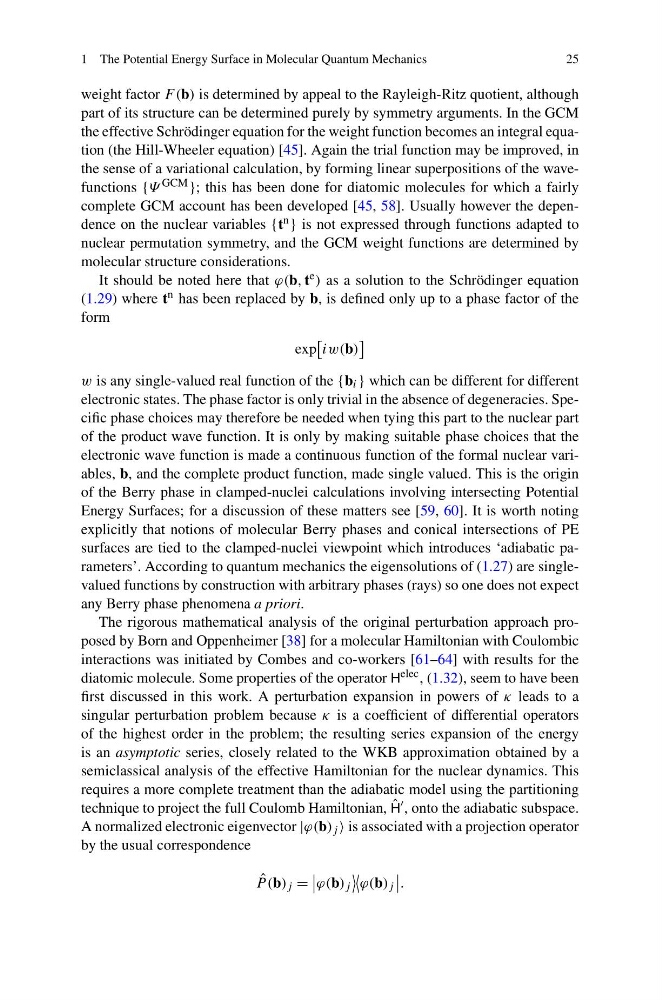
(1.29) where t n has been replaced by b, is defined only up to a phase factor of the
form
exp
iw(b)
w is any single-valued real function of the {b i } which can be different for different
electronic states. The phase factor is only trivial in the absence of degeneracies. Specific phase choices may therefore be needed when tying this part to the nuclear part
of the product wave function. It is only by making suitable phase choices that the
electronic wave function is made a continuous function of the formal nuclear variables, b, and the complete product function, made single valued. This is the origin
of the Berry phase in clamped-nuclei calculations involving intersecting Potential
Energy Surfaces; for a discussion of these matters see [59, 60]. It is worth noting
explicitly that notions of molecular Berry phases and conical intersections of PE
surfaces are tied to the clamped-nuclei viewpoint which introduces ‘adiabatic parameters’. According to quantum mechanics the eigensolutions of (1.27) are singlevalued functions by construction with arbitrary phases (rays) so one does not expect
any Berry phase phenomena a priori.
The rigorous mathematical analysis of the original perturbation approach proposed by Born and Oppenheimer [38] for a molecular Hamiltonian with Coulombic
interactions was initiated by Combes and co-workers [61–64] with results for the
diatomic molecule. Some properties of the operator H elec , (1.32), seem to have been
first discussed in this work. A perturbation expansion in powers of κ leads to a
singular perturbation problem because κ is a coefficient of differential operators
of the highest order in the problem; the resulting series expansion of the energy
is an asymptotic series, closely related to the WKB approximation obtained by a
semiclassical analysis of the effective Hamiltonian for the nuclear dynamics. This
requires a more complete treatment than the adiabatic model using the partitioning
technique to project the full Coulomb Hamiltonian, ˆ
H , onto the adiabatic subspace.
A normalized electronic eigenvector |ϕ(b) j is associated with a projection operator
by the usual correspondence
ˆ
P (b) j =
ϕ(b) j
ϕ(b) j
.
25
weight factor F (b) is determined by appeal to the Rayleigh-Ritz quotient, although
part of its structure can be determined purely by symmetry arguments. In the GCM
the effective Schrödinger equation for the weight function becomes an integral equation (the Hill-Wheeler equation) [45]. Again the trial function may be improved, in
the sense of a variational calculation, by forming linear superpositions of the wavefunctions {Ψ GCM }; this has been done for diatomic molecules for which a fairly
complete GCM account has been developed [45, 58]. Usually however the dependence on the nuclear variables {t n } is not expressed through functions adapted to
nuclear permutation symmetry, and the GCM weight functions are determined by
molecular structure considerations.
It should be noted here that ϕ(b, t e ) as a solution to the Schrödinger equation
(1.29) where t n has been replaced by b, is defined only up to a phase factor of the
form
exp
iw(b)
w is any single-valued real function of the {b i } which can be different for different
electronic states. The phase factor is only trivial in the absence of degeneracies. Specific phase choices may therefore be needed when tying this part to the nuclear part
of the product wave function. It is only by making suitable phase choices that the
electronic wave function is made a continuous function of the formal nuclear variables, b, and the complete product function, made single valued. This is the origin
of the Berry phase in clamped-nuclei calculations involving intersecting Potential
Energy Surfaces; for a discussion of these matters see [59, 60]. It is worth noting
explicitly that notions of molecular Berry phases and conical intersections of PE
surfaces are tied to the clamped-nuclei viewpoint which introduces ‘adiabatic parameters’. According to quantum mechanics the eigensolutions of (1.27) are singlevalued functions by construction with arbitrary phases (rays) so one does not expect
any Berry phase phenomena a priori.
The rigorous mathematical analysis of the original perturbation approach proposed by Born and Oppenheimer [38] for a molecular Hamiltonian with Coulombic
interactions was initiated by Combes and co-workers [61–64] with results for the
diatomic molecule. Some properties of the operator H elec , (1.32), seem to have been
first discussed in this work. A perturbation expansion in powers of κ leads to a
singular perturbation problem because κ is a coefficient of differential operators
of the highest order in the problem; the resulting series expansion of the energy
is an asymptotic series, closely related to the WKB approximation obtained by a
semiclassical analysis of the effective Hamiltonian for the nuclear dynamics. This
requires a more complete treatment than the adiabatic model using the partitioning
technique to project the full Coulomb Hamiltonian, ˆ
H , onto the adiabatic subspace.
A normalized electronic eigenvector |ϕ(b) j is associated with a projection operator
by the usual correspondence
ˆ
P (b) j =
ϕ(b) j
ϕ(b) j
.