

26
B. Sutcliffe and R.G. Woolley
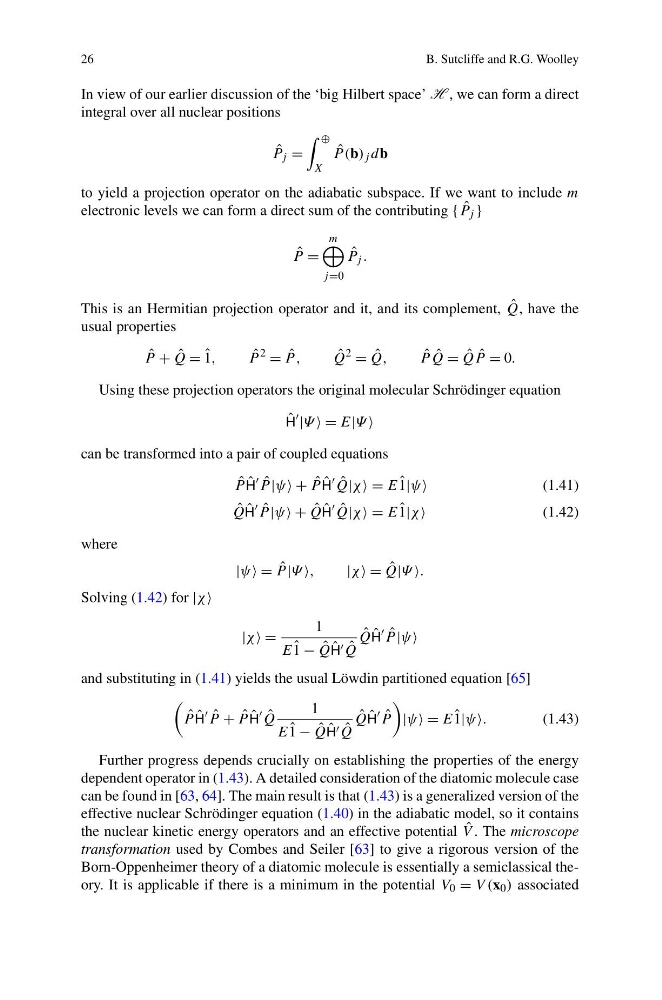
In view of our earlier discussion of the ‘big Hilbert space’ H , we can form a direct
integral over all nuclear positions
ˆ
P j =
⊕
X
ˆ
P (b) j db
to yield a projection operator on the adiabatic subspace. If we want to include m
electronic levels we can form a direct sum of the contributing { ˆ
P j }
ˆ
P =
m
j =0
ˆ
P j .
This is an Hermitian projection operator and it, and its complement, ˆ
Q, have the
usual properties
ˆ
P + ˆ
Q = ˆ
1,
ˆ
P
2
= ˆ
P ,
ˆ
Q
2
= ˆ
Q,
ˆ
P ˆ
Q = ˆ
Q ˆ
P = 0.
Using these projection operators the original molecular Schrödinger equation
ˆ
H
|Ψ = E|Ψ
can be transformed into a pair of coupled equations
ˆ
P ˆ
H
ˆ
P |ψ + ˆ
P ˆ
H
ˆ
Q|χ = E ˆ
1|ψ
(1.41)
ˆ
Q ˆ
H
ˆ
P |ψ + ˆ
Q ˆ
H
ˆ
Q|χ = E ˆ
1|χ
(1.42)
where
|ψ = ˆ
P |Ψ ,
|χ = ˆ
Q|Ψ .
Solving (1.42) for |χ
|χ =
1
E ˆ
1 − ˆ
Q ˆ
H ˆ
Q
ˆ
Q ˆ
H
ˆ
P |ψ
and substituting in (1.41) yields the usual Löwdin partitioned equation [65]
ˆ
P ˆ
H
ˆ
P + ˆ
P ˆ
H
ˆ
Q
1
E ˆ
1 − ˆ
Q ˆ
H ˆ
Q
ˆ
Q ˆ
H
ˆ
P
|ψ = E ˆ
1|ψ.
(1.43)
Further progress depends crucially on establishing the properties of the energy
dependent operator in (1.43). A detailed consideration of the diatomic molecule case
can be found in [63, 64]. The main result is that (1.43) is a generalized version of the
effective nuclear Schrödinger equation (1.40) in the adiabatic model, so it contains
the nuclear kinetic energy operators and an effective potential ˆ
V . The microscope
transformation used by Combes and Seiler [63] to give a rigorous version of the
Born-Oppenheimer theory of a diatomic molecule is essentially a semiclassical theory. It is applicable if there is a minimum in the potential V 0 = V (x 0 ) associated
B. Sutcliffe and R.G. Woolley
In view of our earlier discussion of the ‘big Hilbert space’ H , we can form a direct
integral over all nuclear positions
ˆ
P j =
⊕
X
ˆ
P (b) j db
to yield a projection operator on the adiabatic subspace. If we want to include m
electronic levels we can form a direct sum of the contributing { ˆ
P j }
ˆ
P =
m
j =0
ˆ
P j .
This is an Hermitian projection operator and it, and its complement, ˆ
Q, have the
usual properties
ˆ
P + ˆ
Q = ˆ
1,
ˆ
P
2
= ˆ
P ,
ˆ
Q
2
= ˆ
Q,
ˆ
P ˆ
Q = ˆ
Q ˆ
P = 0.
Using these projection operators the original molecular Schrödinger equation
ˆ
H
|Ψ = E|Ψ
can be transformed into a pair of coupled equations
ˆ
P ˆ
H
ˆ
P |ψ + ˆ
P ˆ
H
ˆ
Q|χ = E ˆ
1|ψ
(1.41)
ˆ
Q ˆ
H
ˆ
P |ψ + ˆ
Q ˆ
H
ˆ
Q|χ = E ˆ
1|χ
(1.42)
where
|ψ = ˆ
P |Ψ ,
|χ = ˆ
Q|Ψ .
Solving (1.42) for |χ
|χ =
1
E ˆ
1 − ˆ
Q ˆ
H ˆ
Q
ˆ
Q ˆ
H
ˆ
P |ψ
and substituting in (1.41) yields the usual Löwdin partitioned equation [65]
ˆ
P ˆ
H
ˆ
P + ˆ
P ˆ
H
ˆ
Q
1
E ˆ
1 − ˆ
Q ˆ
H ˆ
Q
ˆ
Q ˆ
H
ˆ
P
|ψ = E ˆ
1|ψ.
(1.43)
Further progress depends crucially on establishing the properties of the energy
dependent operator in (1.43). A detailed consideration of the diatomic molecule case
can be found in [63, 64]. The main result is that (1.43) is a generalized version of the
effective nuclear Schrödinger equation (1.40) in the adiabatic model, so it contains
the nuclear kinetic energy operators and an effective potential ˆ
V . The microscope
transformation used by Combes and Seiler [63] to give a rigorous version of the
Born-Oppenheimer theory of a diatomic molecule is essentially a semiclassical theory. It is applicable if there is a minimum in the potential V 0 = V (x 0 ) associated