

368
T. Simon et al.
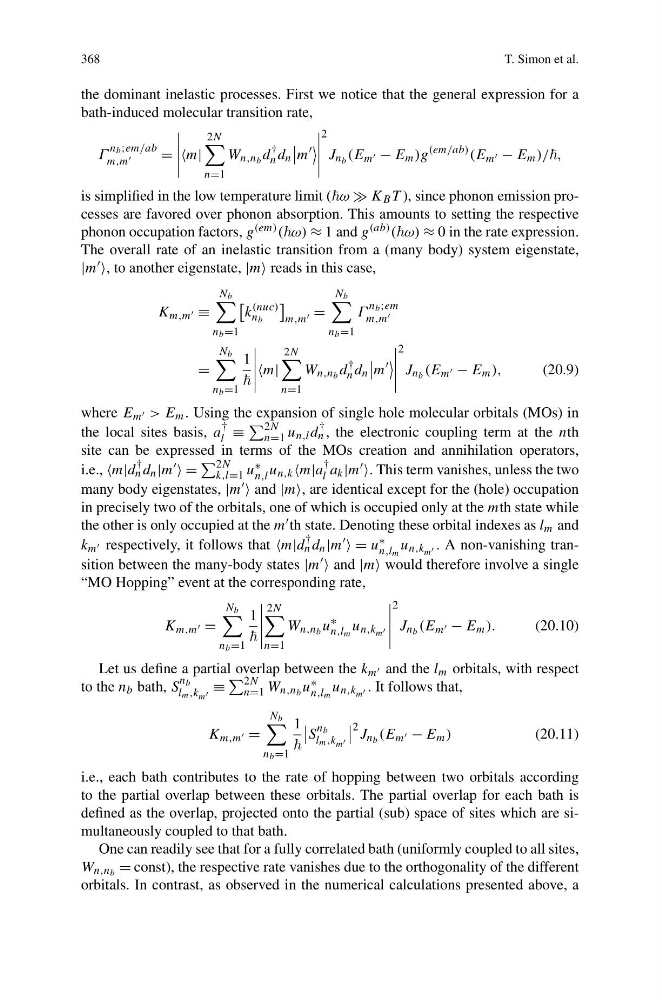
the dominant inelastic processes. First we notice that the general expression for a
bath-induced molecular transition rate,
Γ
n b ;em/ab
m,m
=
m|
2N
n=1
W n,n b d
†
n d n
m
2
J n b (E m − E m )g
(em/ab) (E m − E m )/,
is simplified in the low temperature limit (ω K B T ), since phonon emission processes are favored over phonon absorption. This amounts to setting the respective
phonon occupation factors, g (em) (ω) ≈ 1 and g (ab) (ω) ≈ 0 in the rate expression.
The overall rate of an inelastic transition from a (many body) system eigenstate,
|m , to another eigenstate, |m reads in this case,
K m,m ≡
N b
n b =1
k
(nuc)
n b
m,m =
N b
n b =1
Γ
n b ;em
m,m
=
N b
n b =1
1
m|
2N
n=1
W n,n b d
†
n d n
m
2
J n b (E m − E m ),
(20.9)
where E m > E m . Using the expansion of single hole molecular orbitals (MOs) in
the local sites basis, a
†
l ≡
2N
n=1 u n,l d
†
n , the electronic coupling term at the nth
site can be expressed in terms of the MOs creation and annihilation operators,
i.e., m|d
†
n d n |m =
2N
k,l=1 u ∗
n,l u n,k m|a
†
l a k |m . This term vanishes, unless the two
many body eigenstates, |m and |m, are identical except for the (hole) occupation
in precisely two of the orbitals, one of which is occupied only at the mth state while
the other is only occupied at the m th state. Denoting these orbital indexes as l m and
k m respectively, it follows that m|d
†
n d n |m = u ∗
n,l m
u n,k m . A non-vanishing transition between the many-body states |m and |m would therefore involve a single
“MO Hopping” event at the corresponding rate,
K m,m =
N b
n b =1
1
2N
n=1
W n,n b u
∗
n,l m
u n,k m
2
J n b (E m − E m ).
(20.10)
Let us define a partial overlap between the k m and the l m orbitals, with respect
to the n b bath, S
n b
l m ,k m ≡
2N
n=1 W n,n b u ∗
n,l m
u n,k m . It follows that,
K m,m =
N b
n b =1
1
S
n b
l m ,k m
2 J n b (E m − E m )
(20.11)
i.e., each bath contributes to the rate of hopping between two orbitals according
to the partial overlap between these orbitals. The partial overlap for each bath is
defined as the overlap, projected onto the partial (sub) space of sites which are simultaneously coupled to that bath.
One can readily see that for a fully correlated bath (uniformly coupled to all sites,
W n,n b = const), the respective rate vanishes due to the orthogonality of the different
orbitals. In contrast, as observed in the numerical calculations presented above, a
T. Simon et al.
the dominant inelastic processes. First we notice that the general expression for a
bath-induced molecular transition rate,
Γ
n b ;em/ab
m,m
=
m|
2N
n=1
W n,n b d
†
n d n
m
2
J n b (E m − E m )g
(em/ab) (E m − E m )/,
is simplified in the low temperature limit (ω K B T ), since phonon emission processes are favored over phonon absorption. This amounts to setting the respective
phonon occupation factors, g (em) (ω) ≈ 1 and g (ab) (ω) ≈ 0 in the rate expression.
The overall rate of an inelastic transition from a (many body) system eigenstate,
|m , to another eigenstate, |m reads in this case,
K m,m ≡
N b
n b =1
k
(nuc)
n b
m,m =
N b
n b =1
Γ
n b ;em
m,m
=
N b
n b =1
1
m|
2N
n=1
W n,n b d
†
n d n
m
2
J n b (E m − E m ),
(20.9)
where E m > E m . Using the expansion of single hole molecular orbitals (MOs) in
the local sites basis, a
†
l ≡
2N
n=1 u n,l d
†
n , the electronic coupling term at the nth
site can be expressed in terms of the MOs creation and annihilation operators,
i.e., m|d
†
n d n |m =
2N
k,l=1 u ∗
n,l u n,k m|a
†
l a k |m . This term vanishes, unless the two
many body eigenstates, |m and |m, are identical except for the (hole) occupation
in precisely two of the orbitals, one of which is occupied only at the mth state while
the other is only occupied at the m th state. Denoting these orbital indexes as l m and
k m respectively, it follows that m|d
†
n d n |m = u ∗
n,l m
u n,k m . A non-vanishing transition between the many-body states |m and |m would therefore involve a single
“MO Hopping” event at the corresponding rate,
K m,m =
N b
n b =1
1
2N
n=1
W n,n b u
∗
n,l m
u n,k m
2
J n b (E m − E m ).
(20.10)
Let us define a partial overlap between the k m and the l m orbitals, with respect
to the n b bath, S
n b
l m ,k m ≡
2N
n=1 W n,n b u ∗
n,l m
u n,k m . It follows that,
K m,m =
N b
n b =1
1
S
n b
l m ,k m
2 J n b (E m − E m )
(20.11)
i.e., each bath contributes to the rate of hopping between two orbitals according
to the partial overlap between these orbitals. The partial overlap for each bath is
defined as the overlap, projected onto the partial (sub) space of sites which are simultaneously coupled to that bath.
One can readily see that for a fully correlated bath (uniformly coupled to all sites,
W n,n b = const), the respective rate vanishes due to the orthogonality of the different
orbitals. In contrast, as observed in the numerical calculations presented above, a