

20 Bath Correlation Effects on Inelastic Charge Transport
369
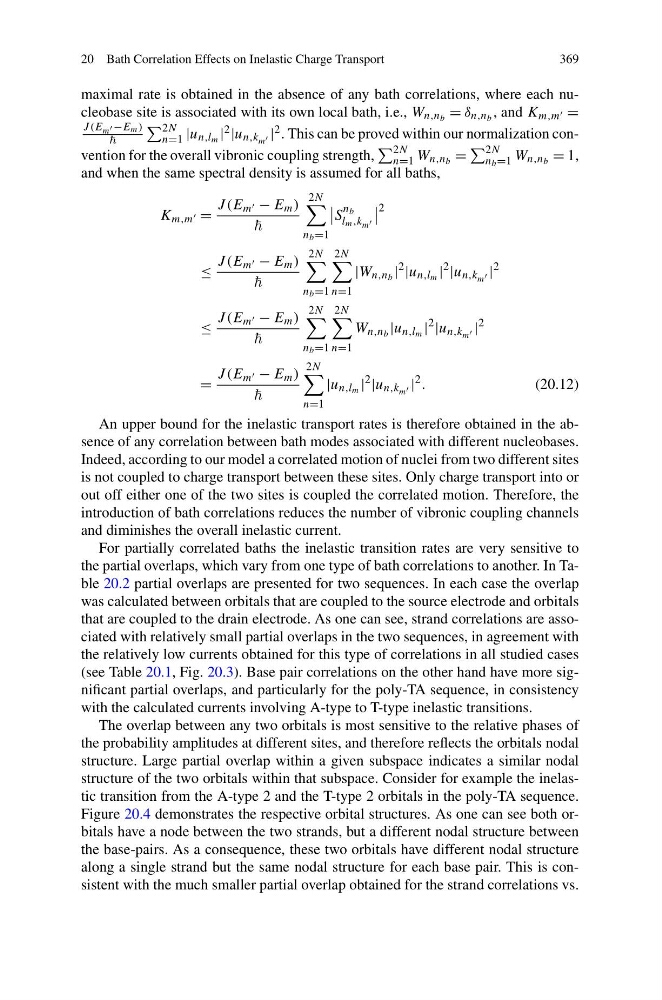
maximal rate is obtained in the absence of any bath correlations, where each nucleobase site is associated with its own local bath, i.e., W n,n b = δ n,n b , and K m,m =
J (E m −E m )
2N
n=1 |u n,l m | 2 |u n,k m | 2 . This can be proved within our normalization convention for the overall vibronic coupling strength,
2N
n=1 W n,n b =
2N
n b =1 W n,n b = 1,
and when the same spectral density is assumed for all baths,
K m,m =
J (E m − E m )
2N
n b =1
S
n b
l m ,k m
2
≤
J (E m − E m )
2N
n b =1
2N
n=1
|W n,n b |
2
|u n,l m |
2
|u n,k m |
2
≤
J (E m − E m )
2N
n b =1
2N
n=1
W n,n b |u n,l m |
2
|u n,k m |
2
=
J (E m − E m )
2N
n=1
|u n,l m |
2
|u n,k m |
2 .
(20.12)
An upper bound for the inelastic transport rates is therefore obtained in the absence of any correlation between bath modes associated with different nucleobases.
Indeed, according to our model a correlated motion of nuclei from two different sites
is not coupled to charge transport between these sites. Only charge transport into or
out off either one of the two sites is coupled the correlated motion. Therefore, the
introduction of bath correlations reduces the number of vibronic coupling channels
and diminishes the overall inelastic current.
For partially correlated baths the inelastic transition rates are very sensitive to
the partial overlaps, which vary from one type of bath correlations to another. In Table 20.2 partial overlaps are presented for two sequences. In each case the overlap
was calculated between orbitals that are coupled to the source electrode and orbitals
that are coupled to the drain electrode. As one can see, strand correlations are associated with relatively small partial overlaps in the two sequences, in agreement with
the relatively low currents obtained for this type of correlations in all studied cases
(see Table 20.1, Fig. 20.3). Base pair correlations on the other hand have more significant partial overlaps, and particularly for the poly-TA sequence, in consistency
with the calculated currents involving A-type to T-type inelastic transitions.
The overlap between any two orbitals is most sensitive to the relative phases of
the probability amplitudes at different sites, and therefore reflects the orbitals nodal
structure. Large partial overlap within a given subspace indicates a similar nodal
structure of the two orbitals within that subspace. Consider for example the inelastic transition from the A-type 2 and the T-type 2 orbitals in the poly-TA sequence.
Figure 20.4 demonstrates the respective orbital structures. As one can see both orbitals have a node between the two strands, but a different nodal structure between
the base-pairs. As a consequence, these two orbitals have different nodal structure
along a single strand but the same nodal structure for each base pair. This is consistent with the much smaller partial overlap obtained for the strand correlations vs.
369
maximal rate is obtained in the absence of any bath correlations, where each nucleobase site is associated with its own local bath, i.e., W n,n b = δ n,n b , and K m,m =
J (E m −E m )
2N
n=1 |u n,l m | 2 |u n,k m | 2 . This can be proved within our normalization convention for the overall vibronic coupling strength,
2N
n=1 W n,n b =
2N
n b =1 W n,n b = 1,
and when the same spectral density is assumed for all baths,
K m,m =
J (E m − E m )
2N
n b =1
S
n b
l m ,k m
2
≤
J (E m − E m )
2N
n b =1
2N
n=1
|W n,n b |
2
|u n,l m |
2
|u n,k m |
2
≤
J (E m − E m )
2N
n b =1
2N
n=1
W n,n b |u n,l m |
2
|u n,k m |
2
=
J (E m − E m )
2N
n=1
|u n,l m |
2
|u n,k m |
2 .
(20.12)
An upper bound for the inelastic transport rates is therefore obtained in the absence of any correlation between bath modes associated with different nucleobases.
Indeed, according to our model a correlated motion of nuclei from two different sites
is not coupled to charge transport between these sites. Only charge transport into or
out off either one of the two sites is coupled the correlated motion. Therefore, the
introduction of bath correlations reduces the number of vibronic coupling channels
and diminishes the overall inelastic current.
For partially correlated baths the inelastic transition rates are very sensitive to
the partial overlaps, which vary from one type of bath correlations to another. In Table 20.2 partial overlaps are presented for two sequences. In each case the overlap
was calculated between orbitals that are coupled to the source electrode and orbitals
that are coupled to the drain electrode. As one can see, strand correlations are associated with relatively small partial overlaps in the two sequences, in agreement with
the relatively low currents obtained for this type of correlations in all studied cases
(see Table 20.1, Fig. 20.3). Base pair correlations on the other hand have more significant partial overlaps, and particularly for the poly-TA sequence, in consistency
with the calculated currents involving A-type to T-type inelastic transitions.
The overlap between any two orbitals is most sensitive to the relative phases of
the probability amplitudes at different sites, and therefore reflects the orbitals nodal
structure. Large partial overlap within a given subspace indicates a similar nodal
structure of the two orbitals within that subspace. Consider for example the inelastic transition from the A-type 2 and the T-type 2 orbitals in the poly-TA sequence.
Figure 20.4 demonstrates the respective orbital structures. As one can see both orbitals have a node between the two strands, but a different nodal structure between
the base-pairs. As a consequence, these two orbitals have different nodal structure
along a single strand but the same nodal structure for each base pair. This is consistent with the much smaller partial overlap obtained for the strand correlations vs.