

20 Bath Correlation Effects on Inelastic Charge Transport
367
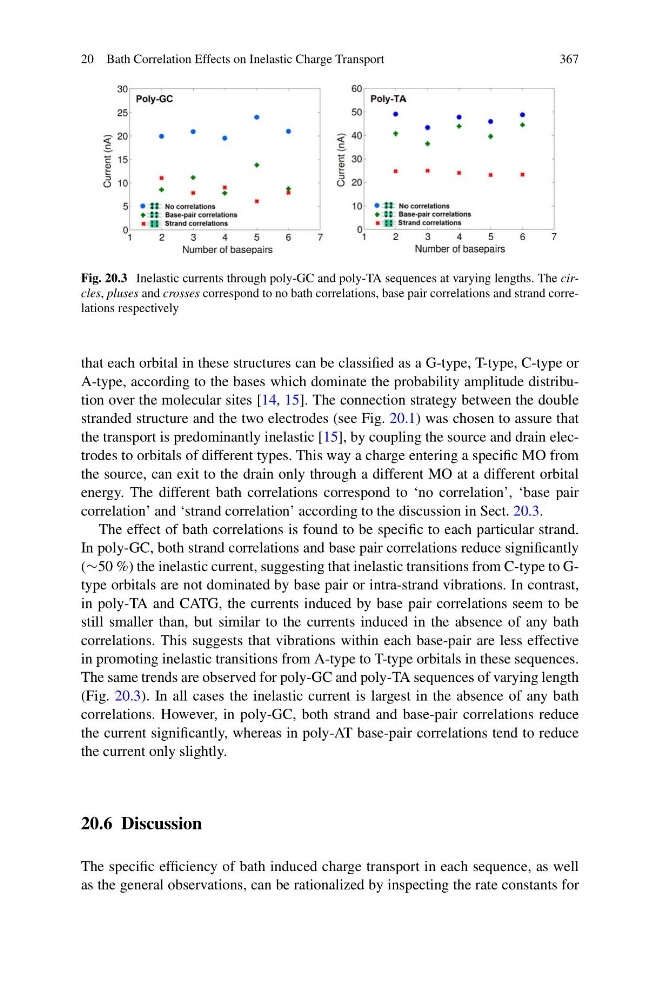
Fig. 20.3 Inelastic currents through poly-GC and poly-TA sequences at varying lengths. The circles, pluses and crosses correspond to no bath correlations, base pair correlations and strand correlations respectively
that each orbital in these structures can be classified as a G-type, T-type, C-type or
A-type, according to the bases which dominate the probability amplitude distribution over the molecular sites [14, 15]. The connection strategy between the double
stranded structure and the two electrodes (see Fig. 20.1) was chosen to assure that
the transport is predominantly inelastic [15], by coupling the source and drain electrodes to orbitals of different types. This way a charge entering a specific MO from
the source, can exit to the drain only through a different MO at a different orbital
energy. The different bath correlations correspond to ‘no correlation’, ‘base pair
correlation’ and ‘strand correlation’ according to the discussion in Sect. 20.3.
The effect of bath correlations is found to be specific to each particular strand.
In poly-GC, both strand correlations and base pair correlations reduce significantly
(∼50 %) the inelastic current, suggesting that inelastic transitions from C-type to Gtype orbitals are not dominated by base pair or intra-strand vibrations. In contrast,
in poly-TA and CATG, the currents induced by base pair correlations seem to be
still smaller than, but similar to the currents induced in the absence of any bath
correlations. This suggests that vibrations within each base-pair are less effective
in promoting inelastic transitions from A-type to T-type orbitals in these sequences.
The same trends are observed for poly-GC and poly-TA sequences of varying length
(Fig. 20.3). In all cases the inelastic current is largest in the absence of any bath
correlations. However, in poly-GC, both strand and base-pair correlations reduce
the current significantly, whereas in poly-AT base-pair correlations tend to reduce
the current only slightly.
20.6 Discussion
The specific efficiency of bath induced charge transport in each sequence, as well
as the general observations, can be rationalized by inspecting the rate constants for
367
Fig. 20.3 Inelastic currents through poly-GC and poly-TA sequences at varying lengths. The circles, pluses and crosses correspond to no bath correlations, base pair correlations and strand correlations respectively
that each orbital in these structures can be classified as a G-type, T-type, C-type or
A-type, according to the bases which dominate the probability amplitude distribution over the molecular sites [14, 15]. The connection strategy between the double
stranded structure and the two electrodes (see Fig. 20.1) was chosen to assure that
the transport is predominantly inelastic [15], by coupling the source and drain electrodes to orbitals of different types. This way a charge entering a specific MO from
the source, can exit to the drain only through a different MO at a different orbital
energy. The different bath correlations correspond to ‘no correlation’, ‘base pair
correlation’ and ‘strand correlation’ according to the discussion in Sect. 20.3.
The effect of bath correlations is found to be specific to each particular strand.
In poly-GC, both strand correlations and base pair correlations reduce significantly
(∼50 %) the inelastic current, suggesting that inelastic transitions from C-type to Gtype orbitals are not dominated by base pair or intra-strand vibrations. In contrast,
in poly-TA and CATG, the currents induced by base pair correlations seem to be
still smaller than, but similar to the currents induced in the absence of any bath
correlations. This suggests that vibrations within each base-pair are less effective
in promoting inelastic transitions from A-type to T-type orbitals in these sequences.
The same trends are observed for poly-GC and poly-TA sequences of varying length
(Fig. 20.3). In all cases the inelastic current is largest in the absence of any bath
correlations. However, in poly-GC, both strand and base-pair correlations reduce
the current significantly, whereas in poly-AT base-pair correlations tend to reduce
the current only slightly.
20.6 Discussion
The specific efficiency of bath induced charge transport in each sequence, as well
as the general observations, can be rationalized by inspecting the rate constants for