

364
T. Simon et al.
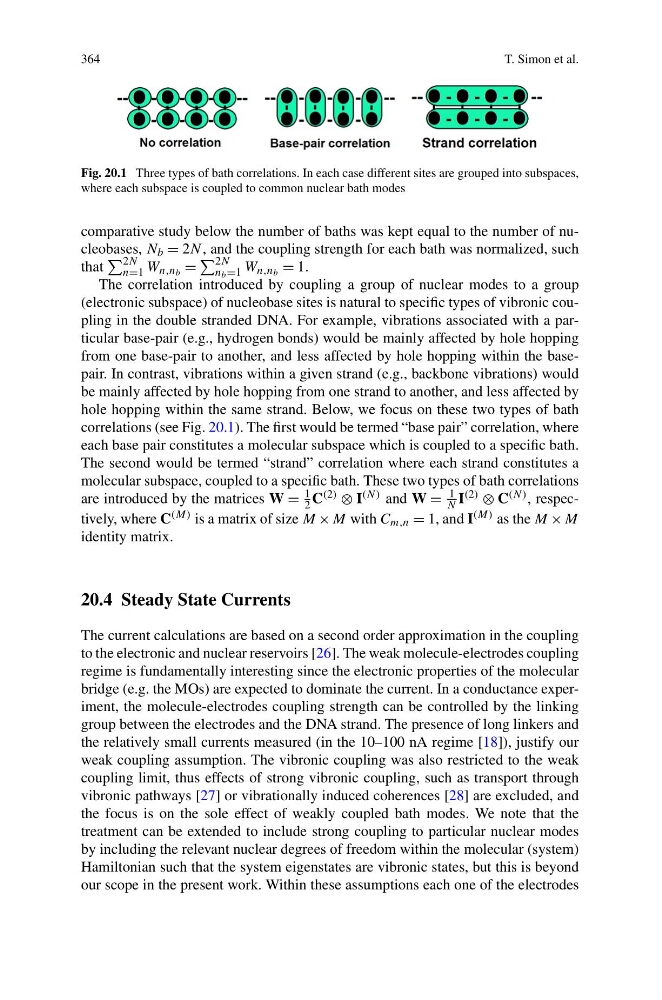
Fig. 20.1 Three types of bath correlations. In each case different sites are grouped into subspaces,
where each subspace is coupled to common nuclear bath modes
comparative study below the number of baths was kept equal to the number of nucleobases, N b = 2N , and the coupling strength for each bath was normalized, such
that
2N
n=1 W n,n b =
2N
n b =1 W n,n b = 1.
The correlation introduced by coupling a group of nuclear modes to a group
(electronic subspace) of nucleobase sites is natural to specific types of vibronic coupling in the double stranded DNA. For example, vibrations associated with a particular base-pair (e.g., hydrogen bonds) would be mainly affected by hole hopping
from one base-pair to another, and less affected by hole hopping within the basepair. In contrast, vibrations within a given strand (e.g., backbone vibrations) would
be mainly affected by hole hopping from one strand to another, and less affected by
hole hopping within the same strand. Below, we focus on these two types of bath
correlations (see Fig. 20.1). The first would be termed “base pair” correlation, where
each base pair constitutes a molecular subspace which is coupled to a specific bath.
The second would be termed “strand” correlation where each strand constitutes a
molecular subspace, coupled to a specific bath. These two types of bath correlations
are introduced by the matrices W =
1
2 C (2) ⊗ I (N ) and W =
1
N I (2) ⊗ C (N ) , respectively, where C (M) is a matrix of size M × M with C m,n = 1, and I (M) as the M × M
identity matrix.
20.4 Steady State Currents
The current calculations are based on a second order approximation in the coupling
to the electronic and nuclear reservoirs [26]. The weak molecule-electrodes coupling
regime is fundamentally interesting since the electronic properties of the molecular
bridge (e.g. the MOs) are expected to dominate the current. In a conductance experiment, the molecule-electrodes coupling strength can be controlled by the linking
group between the electrodes and the DNA strand. The presence of long linkers and
the relatively small currents measured (in the 10–100 nA regime [18]), justify our
weak coupling assumption. The vibronic coupling was also restricted to the weak
coupling limit, thus effects of strong vibronic coupling, such as transport through
vibronic pathways [27] or vibrationally induced coherences [28] are excluded, and
the focus is on the sole effect of weakly coupled bath modes. We note that the
treatment can be extended to include strong coupling to particular nuclear modes
by including the relevant nuclear degrees of freedom within the molecular (system)
Hamiltonian such that the system eigenstates are vibronic states, but this is beyond
our scope in the present work. Within these assumptions each one of the electrodes
T. Simon et al.
Fig. 20.1 Three types of bath correlations. In each case different sites are grouped into subspaces,
where each subspace is coupled to common nuclear bath modes
comparative study below the number of baths was kept equal to the number of nucleobases, N b = 2N , and the coupling strength for each bath was normalized, such
that
2N
n=1 W n,n b =
2N
n b =1 W n,n b = 1.
The correlation introduced by coupling a group of nuclear modes to a group
(electronic subspace) of nucleobase sites is natural to specific types of vibronic coupling in the double stranded DNA. For example, vibrations associated with a particular base-pair (e.g., hydrogen bonds) would be mainly affected by hole hopping
from one base-pair to another, and less affected by hole hopping within the basepair. In contrast, vibrations within a given strand (e.g., backbone vibrations) would
be mainly affected by hole hopping from one strand to another, and less affected by
hole hopping within the same strand. Below, we focus on these two types of bath
correlations (see Fig. 20.1). The first would be termed “base pair” correlation, where
each base pair constitutes a molecular subspace which is coupled to a specific bath.
The second would be termed “strand” correlation where each strand constitutes a
molecular subspace, coupled to a specific bath. These two types of bath correlations
are introduced by the matrices W =
1
2 C (2) ⊗ I (N ) and W =
1
N I (2) ⊗ C (N ) , respectively, where C (M) is a matrix of size M × M with C m,n = 1, and I (M) as the M × M
identity matrix.
20.4 Steady State Currents
The current calculations are based on a second order approximation in the coupling
to the electronic and nuclear reservoirs [26]. The weak molecule-electrodes coupling
regime is fundamentally interesting since the electronic properties of the molecular
bridge (e.g. the MOs) are expected to dominate the current. In a conductance experiment, the molecule-electrodes coupling strength can be controlled by the linking
group between the electrodes and the DNA strand. The presence of long linkers and
the relatively small currents measured (in the 10–100 nA regime [18]), justify our
weak coupling assumption. The vibronic coupling was also restricted to the weak
coupling limit, thus effects of strong vibronic coupling, such as transport through
vibronic pathways [27] or vibrationally induced coherences [28] are excluded, and
the focus is on the sole effect of weakly coupled bath modes. We note that the
treatment can be extended to include strong coupling to particular nuclear modes
by including the relevant nuclear degrees of freedom within the molecular (system)
Hamiltonian such that the system eigenstates are vibronic states, but this is beyond
our scope in the present work. Within these assumptions each one of the electrodes