

20 Bath Correlation Effects on Inelastic Charge Transport
363
creation (a
†
m ) and annihilation (a m ) operators of a single hole in Molecular Orbitals
(MOs), ˆ
H M =
2N
m=1 ε m a
†
m a m , where each MO is a superposition of the local nucleobases orbitals, a
†
m ≡
2N
n=1 u n,m d
†
n . Each (many body) molecular eigenvector is
then associated with a unique set of hole occupation numbers {n m } (n m ∈ 0, 1) in
the MOs.
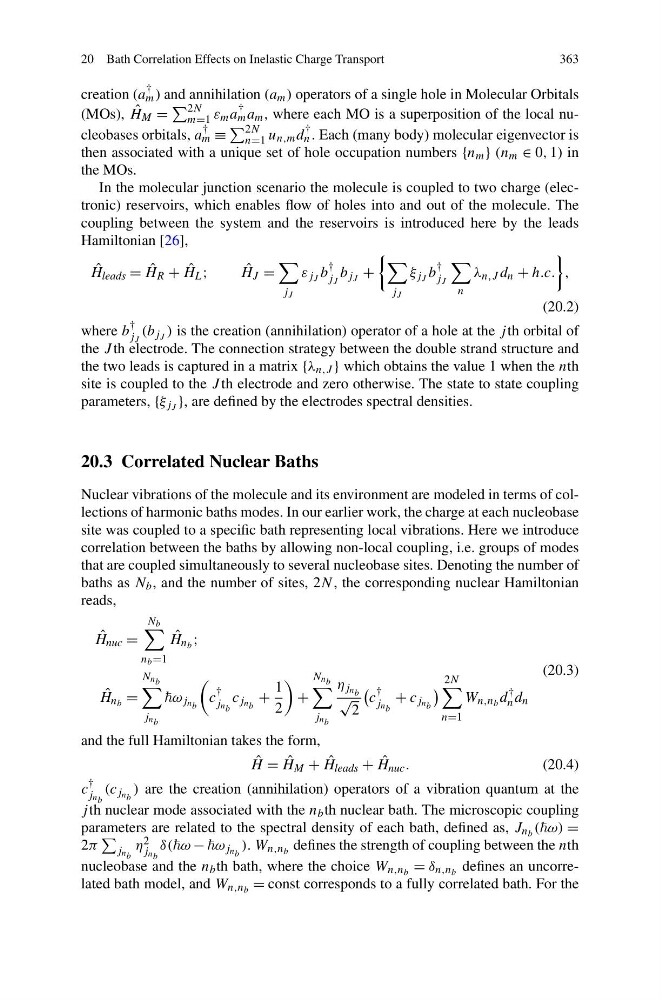
In the molecular junction scenario the molecule is coupled to two charge (electronic) reservoirs, which enables flow of holes into and out of the molecule. The
coupling between the system and the reservoirs is introduced here by the leads
Hamiltonian [26],
ˆ
H leads = ˆ
H R + ˆ
H L ;
ˆ
H J =
j J
ε j J b
†
j J
b j J +
j J
ξ j J b
†
j J
n
λ n,J d n + h.c.
,
(20.2)
where b
†
j J
(b j J ) is the creation (annihilation) operator of a hole at the j th orbital of
the J th electrode. The connection strategy between the double strand structure and
the two leads is captured in a matrix {λ n,J } which obtains the value 1 when the nth
site is coupled to the J th electrode and zero otherwise. The state to state coupling
parameters, {ξ j J }, are defined by the electrodes spectral densities.
20.3 Correlated Nuclear Baths
Nuclear vibrations of the molecule and its environment are modeled in terms of collections of harmonic baths modes. In our earlier work, the charge at each nucleobase
site was coupled to a specific bath representing local vibrations. Here we introduce
correlation between the baths by allowing non-local coupling, i.e. groups of modes
that are coupled simultaneously to several nucleobase sites. Denoting the number of
baths as N b , and the number of sites, 2N , the corresponding nuclear Hamiltonian
reads,
ˆ
H nuc =
N b
n b =1
ˆ
H n b ;
ˆ
H n b =
N n b
j n b
ω j n b
c
†
j n b
c j n b +
1
2
+
N n b
j n b
η j n b
√
2
c
†
j n b
+ c j n b
2N
n=1
W n,n b d
†
n d n
(20.3)
and the full Hamiltonian takes the form,
ˆ
H = ˆ
H M + ˆ
H leads + ˆ
H nuc .
(20.4)
c
†
j n b
(c j n b ) are the creation (annihilation) operators of a vibration quantum at the
j th nuclear mode associated with the n b th nuclear bath. The microscopic coupling
parameters are related to the spectral density of each bath, defined as, J n b (ω) =
2π
j n b
η 2
j n b
δ(ω − ω j n b ). W n,n b defines the strength of coupling between the nth
nucleobase and the n b th bath, where the choice W n,n b = δ n,n b defines an uncorrelated bath model, and W n,n b = const corresponds to a fully correlated bath. For the
363
creation (a
†
m ) and annihilation (a m ) operators of a single hole in Molecular Orbitals
(MOs), ˆ
H M =
2N
m=1 ε m a
†
m a m , where each MO is a superposition of the local nucleobases orbitals, a
†
m ≡
2N
n=1 u n,m d
†
n . Each (many body) molecular eigenvector is
then associated with a unique set of hole occupation numbers {n m } (n m ∈ 0, 1) in
the MOs.
In the molecular junction scenario the molecule is coupled to two charge (electronic) reservoirs, which enables flow of holes into and out of the molecule. The
coupling between the system and the reservoirs is introduced here by the leads
Hamiltonian [26],
ˆ
H leads = ˆ
H R + ˆ
H L ;
ˆ
H J =
j J
ε j J b
†
j J
b j J +
j J
ξ j J b
†
j J
n
λ n,J d n + h.c.
,
(20.2)
where b
†
j J
(b j J ) is the creation (annihilation) operator of a hole at the j th orbital of
the J th electrode. The connection strategy between the double strand structure and
the two leads is captured in a matrix {λ n,J } which obtains the value 1 when the nth
site is coupled to the J th electrode and zero otherwise. The state to state coupling
parameters, {ξ j J }, are defined by the electrodes spectral densities.
20.3 Correlated Nuclear Baths
Nuclear vibrations of the molecule and its environment are modeled in terms of collections of harmonic baths modes. In our earlier work, the charge at each nucleobase
site was coupled to a specific bath representing local vibrations. Here we introduce
correlation between the baths by allowing non-local coupling, i.e. groups of modes
that are coupled simultaneously to several nucleobase sites. Denoting the number of
baths as N b , and the number of sites, 2N , the corresponding nuclear Hamiltonian
reads,
ˆ
H nuc =
N b
n b =1
ˆ
H n b ;
ˆ
H n b =
N n b
j n b
ω j n b
c
†
j n b
c j n b +
1
2
+
N n b
j n b
η j n b
√
2
c
†
j n b
+ c j n b
2N
n=1
W n,n b d
†
n d n
(20.3)
and the full Hamiltonian takes the form,
ˆ
H = ˆ
H M + ˆ
H leads + ˆ
H nuc .
(20.4)
c
†
j n b
(c j n b ) are the creation (annihilation) operators of a vibration quantum at the
j th nuclear mode associated with the n b th nuclear bath. The microscopic coupling
parameters are related to the spectral density of each bath, defined as, J n b (ω) =
2π
j n b
η 2
j n b
δ(ω − ω j n b ). W n,n b defines the strength of coupling between the nth
nucleobase and the n b th bath, where the choice W n,n b = δ n,n b defines an uncorrelated bath model, and W n,n b = const corresponds to a fully correlated bath. For the