

362
T. Simon et al.
Our recent theoretical study focused on specific highly ordered DNA sequences
and proposed that for some connection strategies the transport may be dominated by
coherent ballistic charge transport, whereas for other connection strategies the transport is dominated by inelastic hopping between de-localized orbitals of the double
helix structure [14, 15]. The inelastic processes induced by the intra-molecular nuclear modes and/or the solvent environment were modeled by coupling the electronic transport Hamiltonian to a harmonic bath. In Ref. [15] each nucleobase was
coupled to a local environment (bath) of nuclear modes, and these local environments were uncorrelated.
In this work we examine the effect of correlations between nuclear baths on the
measured current through the molecule. Assigning physical meaning to the correlated bath modes, our theoretical study highlights the relative importance of different
nuclear motions to the inelastic transport. In particular, we demonstrate that intrastrand (e.g., backbone) modes and inter-strand (e.g., hydrogen bonds) modes have
different effects on the inelastic current.
The paper is organized as follows: In Sect. 20.2 we review the model for hole
transport through DNA, based on a tight-binding parameterization of a double helix
structure. In Sect. 20.3 our model of correlated baths is introduced and in Sect. 20.4
the current is formulated in terms of a reduced density matrix. Numerical results
that illustrate the effect of bath correlations on the inelastic current are given in
Sect. 20.5 and analyzed in Sect. 20.6. Conclusions and future perspectives are drawn
in Sect. 20.7.
20.2 The Rigid Double Helix Model
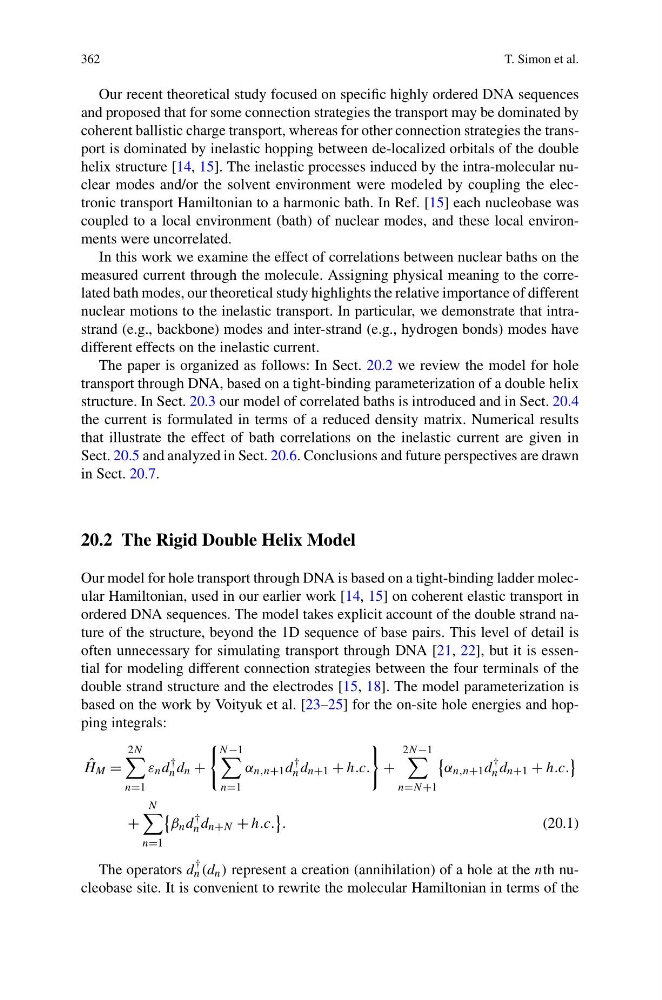
Our model for hole transport through DNA is based on a tight-binding ladder molecular Hamiltonian, used in our earlier work [14, 15] on coherent elastic transport in
ordered DNA sequences. The model takes explicit account of the double strand nature of the structure, beyond the 1D sequence of base pairs. This level of detail is
often unnecessary for simulating transport through DNA [21, 22], but it is essential for modeling different connection strategies between the four terminals of the
double strand structure and the electrodes [15, 18]. The model parameterization is
based on the work by Voityuk et al. [23–25] for the on-site hole energies and hopping integrals:
ˆ
H M =
2N
n=1
ε n d
†
n d n +
N −1
n=1
α n,n+1 d
†
n d n+1 + h.c.
+
2N −1
n=N +1
α n,n+1 d
†
n d n+1 + h.c.
+
N
n=1
β n d
†
n d n+N + h.c.
.
(20.1)
The operators d
†
n (d n ) represent a creation (annihilation) of a hole at the nth nucleobase site. It is convenient to rewrite the molecular Hamiltonian in terms of the
T. Simon et al.
Our recent theoretical study focused on specific highly ordered DNA sequences
and proposed that for some connection strategies the transport may be dominated by
coherent ballistic charge transport, whereas for other connection strategies the transport is dominated by inelastic hopping between de-localized orbitals of the double
helix structure [14, 15]. The inelastic processes induced by the intra-molecular nuclear modes and/or the solvent environment were modeled by coupling the electronic transport Hamiltonian to a harmonic bath. In Ref. [15] each nucleobase was
coupled to a local environment (bath) of nuclear modes, and these local environments were uncorrelated.
In this work we examine the effect of correlations between nuclear baths on the
measured current through the molecule. Assigning physical meaning to the correlated bath modes, our theoretical study highlights the relative importance of different
nuclear motions to the inelastic transport. In particular, we demonstrate that intrastrand (e.g., backbone) modes and inter-strand (e.g., hydrogen bonds) modes have
different effects on the inelastic current.
The paper is organized as follows: In Sect. 20.2 we review the model for hole
transport through DNA, based on a tight-binding parameterization of a double helix
structure. In Sect. 20.3 our model of correlated baths is introduced and in Sect. 20.4
the current is formulated in terms of a reduced density matrix. Numerical results
that illustrate the effect of bath correlations on the inelastic current are given in
Sect. 20.5 and analyzed in Sect. 20.6. Conclusions and future perspectives are drawn
in Sect. 20.7.
20.2 The Rigid Double Helix Model
Our model for hole transport through DNA is based on a tight-binding ladder molecular Hamiltonian, used in our earlier work [14, 15] on coherent elastic transport in
ordered DNA sequences. The model takes explicit account of the double strand nature of the structure, beyond the 1D sequence of base pairs. This level of detail is
often unnecessary for simulating transport through DNA [21, 22], but it is essential for modeling different connection strategies between the four terminals of the
double strand structure and the electrodes [15, 18]. The model parameterization is
based on the work by Voityuk et al. [23–25] for the on-site hole energies and hopping integrals:
ˆ
H M =
2N
n=1
ε n d
†
n d n +
N −1
n=1
α n,n+1 d
†
n d n+1 + h.c.
+
2N −1
n=N +1
α n,n+1 d
†
n d n+1 + h.c.
+
N
n=1
β n d
†
n d n+N + h.c.
.
(20.1)
The operators d
†
n (d n ) represent a creation (annihilation) of a hole at the nth nucleobase site. It is convenient to rewrite the molecular Hamiltonian in terms of the