

20 Bath Correlation Effects on Inelastic Charge Transport
365
(hole reservoirs) and the local nuclear environments (phonon reservoirs) maintains a
quasi equilibrium density. Invoking a Markovian second order approximation in the
system-reservoirs coupling, and accounting for rapid de-phasing (decay of coherences) between molecular eigenstates [26, 29], the time evolution of the molecular
(reduced) density matrix in the presence of interaction with the reservoirs is cast
into population transfer rates between the electronic eigenstates of the molecular
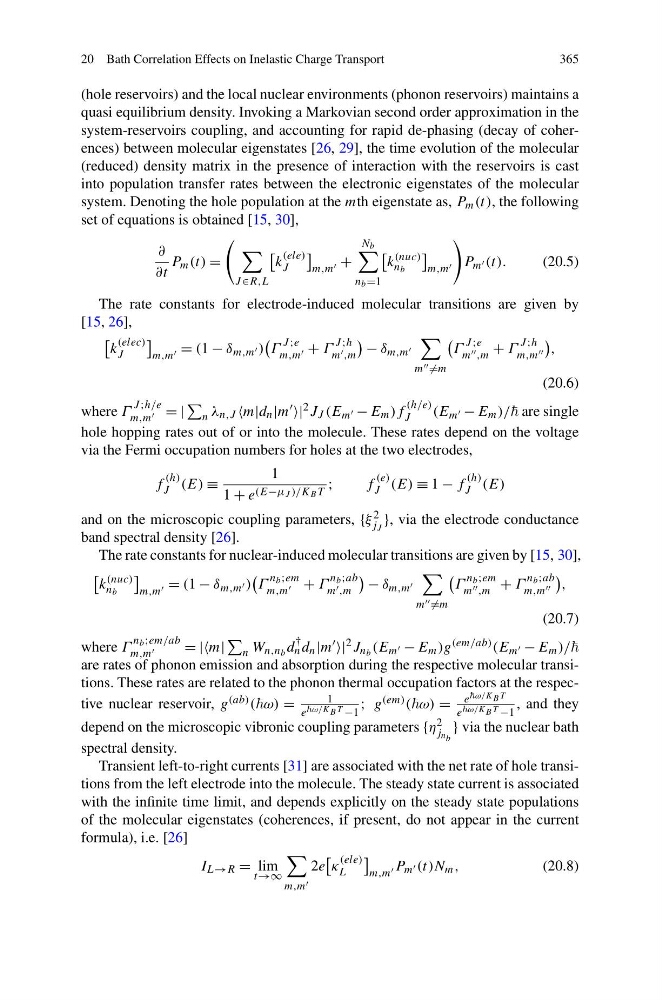
system. Denoting the hole population at the mth eigenstate as, P m (t), the following
set of equations is obtained [15, 30],
∂
∂t
P m (t) =
J ∈R,L
k
(ele)
J
m,m +
N b
n b =1
k
(nuc)
n b
m,m
P m (t).
(20.5)
The rate constants for electrode-induced molecular transitions are given by
[15, 26],
k
(elec)
J
m,m = (1 − δ m,m )
Γ
J ;e
m,m + Γ
J ;h
m ,m
− δ m,m
m =m
Γ
J ;e
m ,m + Γ
J ;h
m,m
,
(20.6)
where Γ
J ;h/e
m,m = |
n λ n,J m|d n |m | 2 J J (E m − E m )f
(h/e)
J
(E m − E m )/ are single
hole hopping rates out of or into the molecule. These rates depend on the voltage
via the Fermi occupation numbers for holes at the two electrodes,
f
(h)
J (E) ≡
1
1 + e (E−μ J )/K B T ;
f
(e)
J (E) ≡ 1 − f
(h)
J (E)
and on the microscopic coupling parameters, {ξ 2
j J
}, via the electrode conductance
band spectral density [26].
The rate constants for nuclear-induced molecular transitions are given by [15, 30],
k
(nuc)
n b
m,m = (1 − δ m,m )
Γ
n b ;em
m,m + Γ
n b ;ab
m ,m
− δ m,m
m =m
Γ
n b ;em
m ,m + Γ
n b ;ab
m,m
,
(20.7)
where Γ
n b ;em/ab
m,m
= ||m|
n W n,n b d
†
n d n |m | 2 J n b (E m − E m )g (em/ab) (E m − E m )/
are rates of phonon emission and absorption during the respective molecular transitions. These rates are related to the phonon thermal occupation factors at the respective nuclear reservoir, g (ab) (ω) =
1
e ω/K B T −1
; g (em) (ω) =
e ω/K B T
e ω/K B T −1
, and they
depend on the microscopic vibronic coupling parameters {η 2
j n b
} via the nuclear bath
spectral density.
Transient left-to-right currents [31] are associated with the net rate of hole transitions from the left electrode into the molecule. The steady state current is associated
with the infinite time limit, and depends explicitly on the steady state populations
of the molecular eigenstates (coherences, if present, do not appear in the current
formula), i.e. [26]
I L→R = lim
t→∞
m,m
2e
κ
(ele)
L
m,m P m (t)N m ,
(20.8)
365
(hole reservoirs) and the local nuclear environments (phonon reservoirs) maintains a
quasi equilibrium density. Invoking a Markovian second order approximation in the
system-reservoirs coupling, and accounting for rapid de-phasing (decay of coherences) between molecular eigenstates [26, 29], the time evolution of the molecular
(reduced) density matrix in the presence of interaction with the reservoirs is cast
into population transfer rates between the electronic eigenstates of the molecular
system. Denoting the hole population at the mth eigenstate as, P m (t), the following
set of equations is obtained [15, 30],
∂
∂t
P m (t) =
J ∈R,L
k
(ele)
J
m,m +
N b
n b =1
k
(nuc)
n b
m,m
P m (t).
(20.5)
The rate constants for electrode-induced molecular transitions are given by
[15, 26],
k
(elec)
J
m,m = (1 − δ m,m )
Γ
J ;e
m,m + Γ
J ;h
m ,m
− δ m,m
m =m
Γ
J ;e
m ,m + Γ
J ;h
m,m
,
(20.6)
where Γ
J ;h/e
m,m = |
n λ n,J m|d n |m | 2 J J (E m − E m )f
(h/e)
J
(E m − E m )/ are single
hole hopping rates out of or into the molecule. These rates depend on the voltage
via the Fermi occupation numbers for holes at the two electrodes,
f
(h)
J (E) ≡
1
1 + e (E−μ J )/K B T ;
f
(e)
J (E) ≡ 1 − f
(h)
J (E)
and on the microscopic coupling parameters, {ξ 2
j J
}, via the electrode conductance
band spectral density [26].
The rate constants for nuclear-induced molecular transitions are given by [15, 30],
k
(nuc)
n b
m,m = (1 − δ m,m )
Γ
n b ;em
m,m + Γ
n b ;ab
m ,m
− δ m,m
m =m
Γ
n b ;em
m ,m + Γ
n b ;ab
m,m
,
(20.7)
where Γ
n b ;em/ab
m,m
= ||m|
n W n,n b d
†
n d n |m | 2 J n b (E m − E m )g (em/ab) (E m − E m )/
are rates of phonon emission and absorption during the respective molecular transitions. These rates are related to the phonon thermal occupation factors at the respective nuclear reservoir, g (ab) (ω) =
1
e ω/K B T −1
; g (em) (ω) =
e ω/K B T
e ω/K B T −1
, and they
depend on the microscopic vibronic coupling parameters {η 2
j n b
} via the nuclear bath
spectral density.
Transient left-to-right currents [31] are associated with the net rate of hole transitions from the left electrode into the molecule. The steady state current is associated
with the infinite time limit, and depends explicitly on the steady state populations
of the molecular eigenstates (coherences, if present, do not appear in the current
formula), i.e. [26]
I L→R = lim
t→∞
m,m
2e
κ
(ele)
L
m,m P m (t)N m ,
(20.8)