

18 On Converse Piezoelectricity
337
¯
μ ze = ¯
μ KSV
= −
i
K
j
k
u j (k, r)
∂
∂k
u j (k, r)
= −
1
K
jm
k
e
ikma
pq
C
∗
qj (k)
χ q0 |z − ma|χ pm
charge
+ iχ q0 |χ pm
d
dk
current
C pj (k).
(18.14)
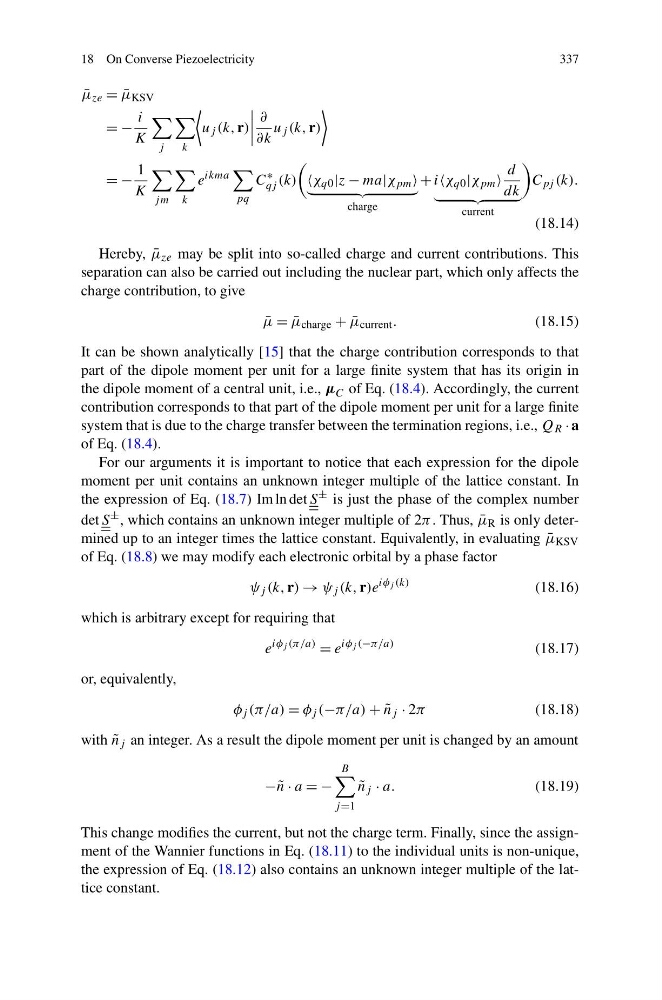
Hereby, ¯
μ ze may be split into so-called charge and current contributions. This
separation can also be carried out including the nuclear part, which only affects the
charge contribution, to give
¯
μ = ¯
μ charge + ¯
μ current .
(18.15)
It can be shown analytically [15] that the charge contribution corresponds to that
part of the dipole moment per unit for a large finite system that has its origin in
the dipole moment of a central unit, i.e., μ C of Eq. (18.4). Accordingly, the current
contribution corresponds to that part of the dipole moment per unit for a large finite
system that is due to the charge transfer between the termination regions, i.e., Q R · a
of Eq. (18.4).
For our arguments it is important to notice that each expression for the dipole
moment per unit contains an unknown integer multiple of the lattice constant. In
the expression of Eq. (18.7) Im ln det S ± is just the phase of the complex number
det S ± , which contains an unknown integer multiple of 2π . Thus, ¯
μ R is only determined up to an integer times the lattice constant. Equivalently, in evaluating ¯
μ KSV
of Eq. (18.8) we may modify each electronic orbital by a phase factor
ψ j (k, r) → ψ j (k, r)e
iφ j (k)
(18.16)
which is arbitrary except for requiring that
e
iφ j (π/a)
= e
iφ j (−π/a)
(18.17)
or, equivalently,
φ j (π/a) = φ j (−π/a) + ˜
n j · 2π
(18.18)
with ˜
n j an integer. As a result the dipole moment per unit is changed by an amount
− ˜
n · a = −
B
j =1
˜
n j · a.
(18.19)
This change modifies the current, but not the charge term. Finally, since the assignment of the Wannier functions in Eq. (18.11) to the individual units is non-unique,
the expression of Eq. (18.12) also contains an unknown integer multiple of the lattice constant.
337
¯
μ ze = ¯
μ KSV
= −
i
K
j
k
u j (k, r)
∂
∂k
u j (k, r)
= −
1
K
jm
k
e
ikma
pq
C
∗
qj (k)
χ q0 |z − ma|χ pm
charge
+ iχ q0 |χ pm
d
dk
current
C pj (k).
(18.14)
Hereby, ¯
μ ze may be split into so-called charge and current contributions. This
separation can also be carried out including the nuclear part, which only affects the
charge contribution, to give
¯
μ = ¯
μ charge + ¯
μ current .
(18.15)
It can be shown analytically [15] that the charge contribution corresponds to that
part of the dipole moment per unit for a large finite system that has its origin in
the dipole moment of a central unit, i.e., μ C of Eq. (18.4). Accordingly, the current
contribution corresponds to that part of the dipole moment per unit for a large finite
system that is due to the charge transfer between the termination regions, i.e., Q R · a
of Eq. (18.4).
For our arguments it is important to notice that each expression for the dipole
moment per unit contains an unknown integer multiple of the lattice constant. In
the expression of Eq. (18.7) Im ln det S ± is just the phase of the complex number
det S ± , which contains an unknown integer multiple of 2π . Thus, ¯
μ R is only determined up to an integer times the lattice constant. Equivalently, in evaluating ¯
μ KSV
of Eq. (18.8) we may modify each electronic orbital by a phase factor
ψ j (k, r) → ψ j (k, r)e
iφ j (k)
(18.16)
which is arbitrary except for requiring that
e
iφ j (π/a)
= e
iφ j (−π/a)
(18.17)
or, equivalently,
φ j (π/a) = φ j (−π/a) + ˜
n j · 2π
(18.18)
with ˜
n j an integer. As a result the dipole moment per unit is changed by an amount
− ˜
n · a = −
B
j =1
˜
n j · a.
(18.19)
This change modifies the current, but not the charge term. Finally, since the assignment of the Wannier functions in Eq. (18.11) to the individual units is non-unique,
the expression of Eq. (18.12) also contains an unknown integer multiple of the lattice constant.