

336
M. Springborg et al.
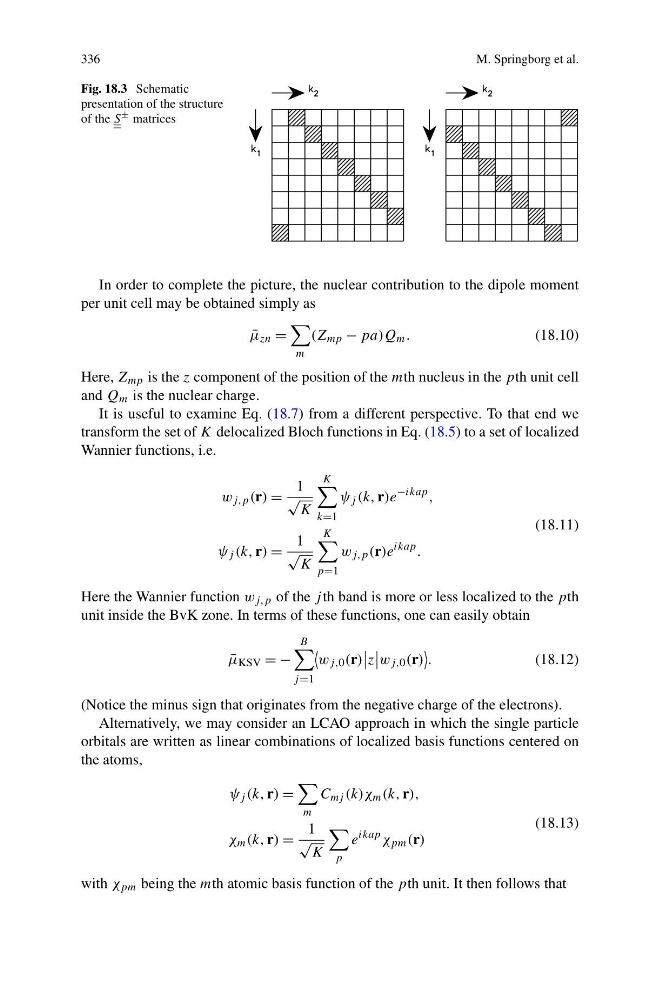
Fig. 18.3 Schematic
presentation of the structure
of the S ± matrices
In order to complete the picture, the nuclear contribution to the dipole moment
per unit cell may be obtained simply as
¯
μ zn =
m
(Z mp − pa)Q m .
(18.10)
Here, Z mp is the z component of the position of the mth nucleus in the pth unit cell
and Q m is the nuclear charge.
It is useful to examine Eq. (18.7) from a different perspective. To that end we
transform the set of K delocalized Bloch functions in Eq. (18.5) to a set of localized
Wannier functions, i.e.
w j,p (r) =
1
√
K
K
k=1
ψ j (k, r)e
−ikap ,
ψ j (k, r) =
1
√
K
K
p=1
w j,p (r)e
ikap .
(18.11)
Here the Wannier function w j,p of the j th band is more or less localized to the pth
unit inside the BvK zone. In terms of these functions, one can easily obtain
¯
μ KSV = −
B
j =1
w j,0 (r)
z
w j,0 (r)
.
(18.12)
(Notice the minus sign that originates from the negative charge of the electrons).
Alternatively, we may consider an LCAO approach in which the single particle
orbitals are written as linear combinations of localized basis functions centered on
the atoms,
ψ j (k, r) =
m
C mj (k)χ m (k, r),
χ m (k, r) =
1
√
K
p
e
ikap χ pm (r)
(18.13)
with χ pm being the mth atomic basis function of the pth unit. It then follows that
M. Springborg et al.
Fig. 18.3 Schematic
presentation of the structure
of the S ± matrices
In order to complete the picture, the nuclear contribution to the dipole moment
per unit cell may be obtained simply as
¯
μ zn =
m
(Z mp − pa)Q m .
(18.10)
Here, Z mp is the z component of the position of the mth nucleus in the pth unit cell
and Q m is the nuclear charge.
It is useful to examine Eq. (18.7) from a different perspective. To that end we
transform the set of K delocalized Bloch functions in Eq. (18.5) to a set of localized
Wannier functions, i.e.
w j,p (r) =
1
√
K
K
k=1
ψ j (k, r)e
−ikap ,
ψ j (k, r) =
1
√
K
K
p=1
w j,p (r)e
ikap .
(18.11)
Here the Wannier function w j,p of the j th band is more or less localized to the pth
unit inside the BvK zone. In terms of these functions, one can easily obtain
¯
μ KSV = −
B
j =1
w j,0 (r)
z
w j,0 (r)
.
(18.12)
(Notice the minus sign that originates from the negative charge of the electrons).
Alternatively, we may consider an LCAO approach in which the single particle
orbitals are written as linear combinations of localized basis functions centered on
the atoms,
ψ j (k, r) =
m
C mj (k)χ m (k, r),
χ m (k, r) =
1
√
K
p
e
ikap χ pm (r)
(18.13)
with χ pm being the mth atomic basis function of the pth unit. It then follows that