

18 On Converse Piezoelectricity
335
calculation one considers only a finite set of K equidistant k values, which is equivalent to assuming that the properties are periodic with the periodicity Ka—i.e. they
have the symmetry of the Born von Kármán (BvK) zone. This is clearly not the case
for the dipole moment operator in the scalar interaction potential. Thus, one must
consider an alternative approach.
About 20 years ago alternative formulations allowing for calculation of the dipole
moment per unit cell, based on an operator that has (i) the BvK periodicity and
(ii) approaches the position operator as the size of the BvK zone approaches infinity,
began to appear. Working expressions were initially proposed within the so-called
modern theory of polarization [9, 11, 12]; later they were formally developed and
generalized from other points of view [13, 14] (see also [15, 16]).
In the description provided here we concentrate on the component of the total
dipole moment per unit cell along the chain (z) direction and separate it into an
electronic and a nuclear contribution,
¯
μ z = ¯
μ zn + ¯
μ ze .
(18.6)
For an independent particle model, the electronic contribution can be written either
as [11]
¯
μ ze = ¯
μ R ≡ −
a
2π
Im ln det S
+
=
a
2π
Im ln det S
−
(18.7)
or [9, 12]
¯
μ ze = ¯
μ KSV ≡ −
i
K
K
k=1
B
j =1
u j (k, r)
∂
∂k
u j (k, r)
= −
i
K
K
k=1
B
j =1
e
−ikz ψ j (k, r)
∂
∂k
e
−ikz ψ j (k, r)
,
(18.8)
where B is the number of occupied bands and spin degeneracy is not assumed. These
expressions are valid only for systems with an energy gap between occupied and
unoccupied orbitals, i.e., semiconductors and insulators; metals will be discussed
briefly in Sect. 18.4.
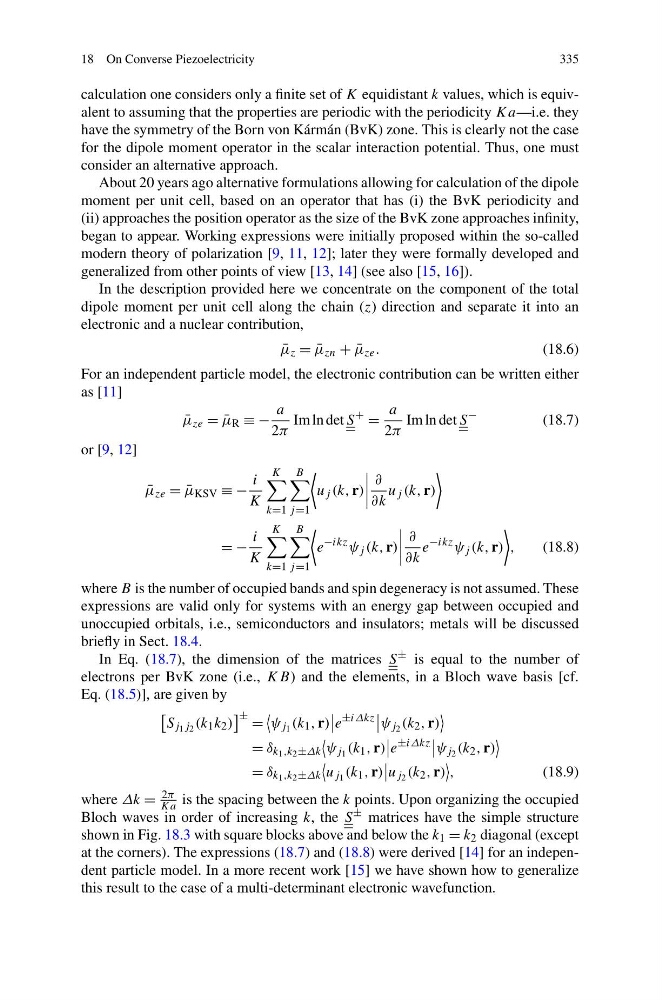
In Eq. (18.7), the dimension of the matrices S ± is equal to the number of
electrons per BvK zone (i.e., KB) and the elements, in a Bloch wave basis [cf.
Eq. (18.5)], are given by
S j 1 j 2 (k 1 k 2 )
± =
ψ j 1 (k 1 , r)
e
±iΔkz
ψ j 2 (k 2 , r)
= δ k 1 ,k 2 ±Δk
ψ j 1 (k 1 , r)
e
±iΔkz
ψ j 2 (k 2 , r)
= δ k 1 ,k 2 ±Δk
u j 1 (k 1 , r)
u j 2 (k 2 , r)
,
(18.9)
where Δk =
2π
Ka is the spacing between the k points. Upon organizing the occupied
Bloch waves in order of increasing k, the S ± matrices have the simple structure
shown in Fig. 18.3 with square blocks above and below the k 1 = k 2 diagonal (except
at the corners). The expressions (18.7) and (18.8) were derived [14] for an independent particle model. In a more recent work [15] we have shown how to generalize
this result to the case of a multi-determinant electronic wavefunction.
335
calculation one considers only a finite set of K equidistant k values, which is equivalent to assuming that the properties are periodic with the periodicity Ka—i.e. they
have the symmetry of the Born von Kármán (BvK) zone. This is clearly not the case
for the dipole moment operator in the scalar interaction potential. Thus, one must
consider an alternative approach.
About 20 years ago alternative formulations allowing for calculation of the dipole
moment per unit cell, based on an operator that has (i) the BvK periodicity and
(ii) approaches the position operator as the size of the BvK zone approaches infinity,
began to appear. Working expressions were initially proposed within the so-called
modern theory of polarization [9, 11, 12]; later they were formally developed and
generalized from other points of view [13, 14] (see also [15, 16]).
In the description provided here we concentrate on the component of the total
dipole moment per unit cell along the chain (z) direction and separate it into an
electronic and a nuclear contribution,
¯
μ z = ¯
μ zn + ¯
μ ze .
(18.6)
For an independent particle model, the electronic contribution can be written either
as [11]
¯
μ ze = ¯
μ R ≡ −
a
2π
Im ln det S
+
=
a
2π
Im ln det S
−
(18.7)
or [9, 12]
¯
μ ze = ¯
μ KSV ≡ −
i
K
K
k=1
B
j =1
u j (k, r)
∂
∂k
u j (k, r)
= −
i
K
K
k=1
B
j =1
e
−ikz ψ j (k, r)
∂
∂k
e
−ikz ψ j (k, r)
,
(18.8)
where B is the number of occupied bands and spin degeneracy is not assumed. These
expressions are valid only for systems with an energy gap between occupied and
unoccupied orbitals, i.e., semiconductors and insulators; metals will be discussed
briefly in Sect. 18.4.
In Eq. (18.7), the dimension of the matrices S ± is equal to the number of
electrons per BvK zone (i.e., KB) and the elements, in a Bloch wave basis [cf.
Eq. (18.5)], are given by
S j 1 j 2 (k 1 k 2 )
± =
ψ j 1 (k 1 , r)
e
±iΔkz
ψ j 2 (k 2 , r)
= δ k 1 ,k 2 ±Δk
ψ j 1 (k 1 , r)
e
±iΔkz
ψ j 2 (k 2 , r)
= δ k 1 ,k 2 ±Δk
u j 1 (k 1 , r)
u j 2 (k 2 , r)
,
(18.9)
where Δk =
2π
Ka is the spacing between the k points. Upon organizing the occupied
Bloch waves in order of increasing k, the S ± matrices have the simple structure
shown in Fig. 18.3 with square blocks above and below the k 1 = k 2 diagonal (except
at the corners). The expressions (18.7) and (18.8) were derived [14] for an independent particle model. In a more recent work [15] we have shown how to generalize
this result to the case of a multi-determinant electronic wavefunction.