

334
M. Springborg et al.
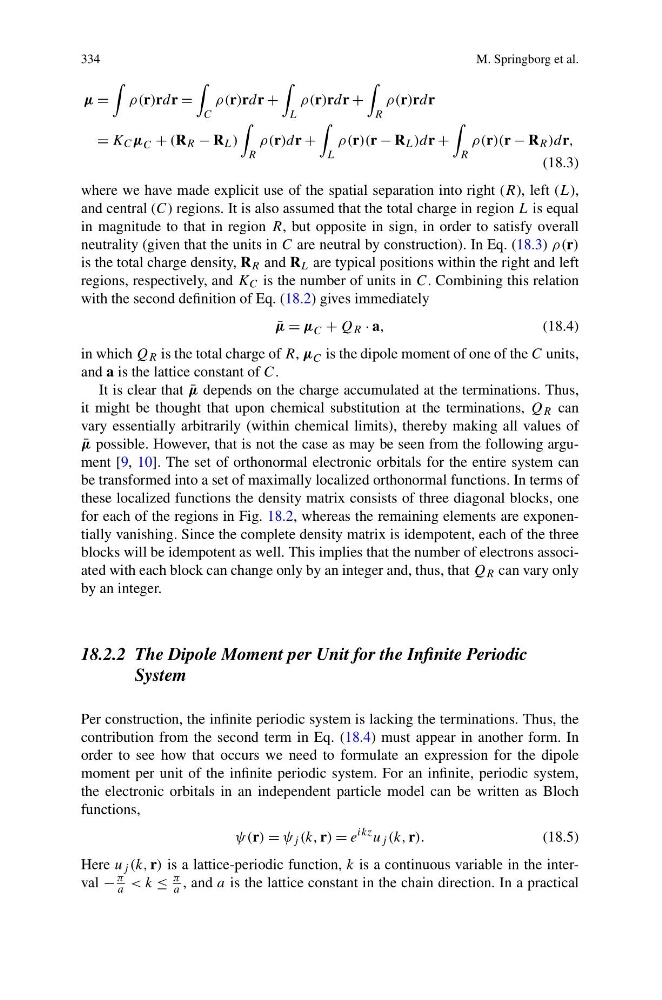
μ =
ρ(r)rdr =
C
ρ(r)rdr +
L
ρ(r)rdr +
R
ρ(r)rdr
= K C μ C + (R R − R L )
R
ρ(r)dr +
L
ρ(r)(r − R L )dr +
R
ρ(r)(r − R R )dr,
(18.3)
where we have made explicit use of the spatial separation into right (R), left (L),
and central (C) regions. It is also assumed that the total charge in region L is equal
in magnitude to that in region R, but opposite in sign, in order to satisfy overall
neutrality (given that the units in C are neutral by construction). In Eq. (18.3) ρ(r)
is the total charge density, R R and R L are typical positions within the right and left
regions, respectively, and K C is the number of units in C. Combining this relation
with the second definition of Eq. (18.2) gives immediately
¯
μ = μ C + Q R · a,
(18.4)
in which Q R is the total charge of R, μ C is the dipole moment of one of the C units,
and a is the lattice constant of C.
It is clear that ¯
μ depends on the charge accumulated at the terminations. Thus,
it might be thought that upon chemical substitution at the terminations, Q R can
vary essentially arbitrarily (within chemical limits), thereby making all values of
¯
μ possible. However, that is not the case as may be seen from the following argument [9, 10]. The set of orthonormal electronic orbitals for the entire system can
be transformed into a set of maximally localized orthonormal functions. In terms of
these localized functions the density matrix consists of three diagonal blocks, one
for each of the regions in Fig. 18.2, whereas the remaining elements are exponentially vanishing. Since the complete density matrix is idempotent, each of the three
blocks will be idempotent as well. This implies that the number of electrons associated with each block can change only by an integer and, thus, that Q R can vary only
by an integer.
18.2.2 The Dipole Moment per Unit for the Infinite Periodic
System
Per construction, the infinite periodic system is lacking the terminations. Thus, the
contribution from the second term in Eq. (18.4) must appear in another form. In
order to see how that occurs we need to formulate an expression for the dipole
moment per unit of the infinite periodic system. For an infinite, periodic system,
the electronic orbitals in an independent particle model can be written as Bloch
functions,
ψ(r) = ψ j (k, r) = e
ikz u j (k, r).
(18.5)
Here u j (k, r) is a lattice-periodic function, k is a continuous variable in the interval −
π
a < k ≤
π
a , and a is the lattice constant in the chain direction. In a practical
M. Springborg et al.
μ =
ρ(r)rdr =
C
ρ(r)rdr +
L
ρ(r)rdr +
R
ρ(r)rdr
= K C μ C + (R R − R L )
R
ρ(r)dr +
L
ρ(r)(r − R L )dr +
R
ρ(r)(r − R R )dr,
(18.3)
where we have made explicit use of the spatial separation into right (R), left (L),
and central (C) regions. It is also assumed that the total charge in region L is equal
in magnitude to that in region R, but opposite in sign, in order to satisfy overall
neutrality (given that the units in C are neutral by construction). In Eq. (18.3) ρ(r)
is the total charge density, R R and R L are typical positions within the right and left
regions, respectively, and K C is the number of units in C. Combining this relation
with the second definition of Eq. (18.2) gives immediately
¯
μ = μ C + Q R · a,
(18.4)
in which Q R is the total charge of R, μ C is the dipole moment of one of the C units,
and a is the lattice constant of C.
It is clear that ¯
μ depends on the charge accumulated at the terminations. Thus,
it might be thought that upon chemical substitution at the terminations, Q R can
vary essentially arbitrarily (within chemical limits), thereby making all values of
¯
μ possible. However, that is not the case as may be seen from the following argument [9, 10]. The set of orthonormal electronic orbitals for the entire system can
be transformed into a set of maximally localized orthonormal functions. In terms of
these localized functions the density matrix consists of three diagonal blocks, one
for each of the regions in Fig. 18.2, whereas the remaining elements are exponentially vanishing. Since the complete density matrix is idempotent, each of the three
blocks will be idempotent as well. This implies that the number of electrons associated with each block can change only by an integer and, thus, that Q R can vary only
by an integer.
18.2.2 The Dipole Moment per Unit for the Infinite Periodic
System
Per construction, the infinite periodic system is lacking the terminations. Thus, the
contribution from the second term in Eq. (18.4) must appear in another form. In
order to see how that occurs we need to formulate an expression for the dipole
moment per unit of the infinite periodic system. For an infinite, periodic system,
the electronic orbitals in an independent particle model can be written as Bloch
functions,
ψ(r) = ψ j (k, r) = e
ikz u j (k, r).
(18.5)
Here u j (k, r) is a lattice-periodic function, k is a continuous variable in the interval −
π
a < k ≤
π
a , and a is the lattice constant in the chain direction. In a practical