

18 On Converse Piezoelectricity
333
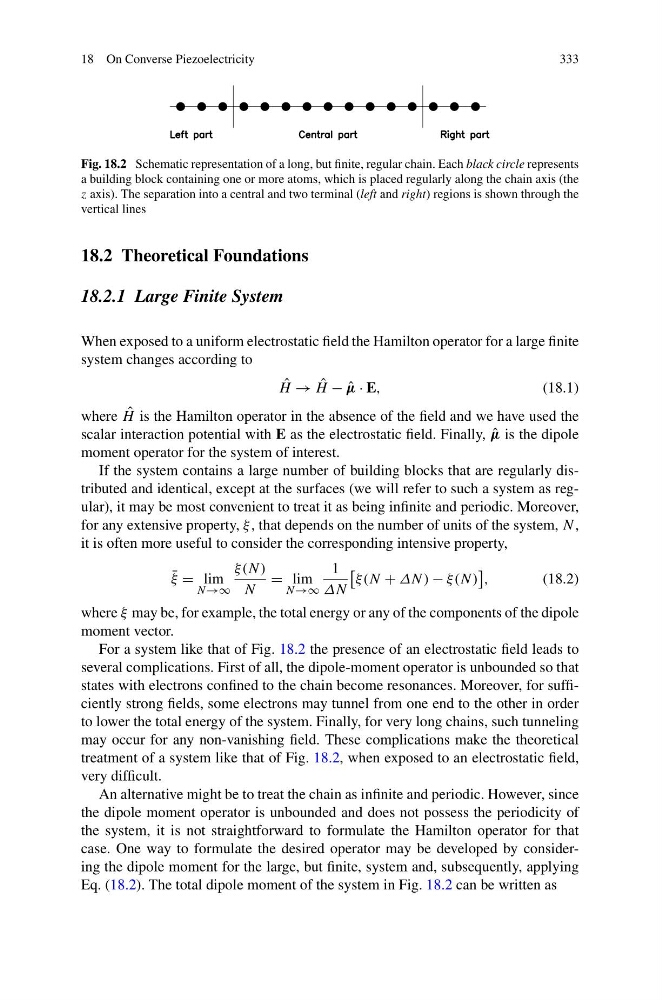
Fig. 18.2 Schematic representation of a long, but finite, regular chain. Each black circle represents
a building block containing one or more atoms, which is placed regularly along the chain axis (the
z axis). The separation into a central and two terminal (left and right) regions is shown through the
vertical lines
18.2 Theoretical Foundations
18.2.1 Large Finite System
When exposed to a uniform electrostatic field the Hamilton operator for a large finite
system changes according to
ˆ
H → ˆ
H − ˆ
μ · E,
(18.1)
where ˆ
H is the Hamilton operator in the absence of the field and we have used the
scalar interaction potential with E as the electrostatic field. Finally, ˆ
μ is the dipole
moment operator for the system of interest.
If the system contains a large number of building blocks that are regularly distributed and identical, except at the surfaces (we will refer to such a system as regular), it may be most convenient to treat it as being infinite and periodic. Moreover,
for any extensive property, ξ , that depends on the number of units of the system, N ,
it is often more useful to consider the corresponding intensive property,
¯
ξ = lim
N →∞
ξ(N)
N
= lim
N →∞
1
ΔN
ξ(N + ΔN ) − ξ(N)
,
(18.2)
where ξ may be, for example, the total energy or any of the components of the dipole
moment vector.
For a system like that of Fig. 18.2 the presence of an electrostatic field leads to
several complications. First of all, the dipole-moment operator is unbounded so that
states with electrons confined to the chain become resonances. Moreover, for sufficiently strong fields, some electrons may tunnel from one end to the other in order
to lower the total energy of the system. Finally, for very long chains, such tunneling
may occur for any non-vanishing field. These complications make the theoretical
treatment of a system like that of Fig. 18.2, when exposed to an electrostatic field,
very difficult.
An alternative might be to treat the chain as infinite and periodic. However, since
the dipole moment operator is unbounded and does not possess the periodicity of
the system, it is not straightforward to formulate the Hamilton operator for that
case. One way to formulate the desired operator may be developed by considering the dipole moment for the large, but finite, system and, subsequently, applying
Eq. (18.2). The total dipole moment of the system in Fig. 18.2 can be written as
333
Fig. 18.2 Schematic representation of a long, but finite, regular chain. Each black circle represents
a building block containing one or more atoms, which is placed regularly along the chain axis (the
z axis). The separation into a central and two terminal (left and right) regions is shown through the
vertical lines
18.2 Theoretical Foundations
18.2.1 Large Finite System
When exposed to a uniform electrostatic field the Hamilton operator for a large finite
system changes according to
ˆ
H → ˆ
H − ˆ
μ · E,
(18.1)
where ˆ
H is the Hamilton operator in the absence of the field and we have used the
scalar interaction potential with E as the electrostatic field. Finally, ˆ
μ is the dipole
moment operator for the system of interest.
If the system contains a large number of building blocks that are regularly distributed and identical, except at the surfaces (we will refer to such a system as regular), it may be most convenient to treat it as being infinite and periodic. Moreover,
for any extensive property, ξ , that depends on the number of units of the system, N ,
it is often more useful to consider the corresponding intensive property,
¯
ξ = lim
N →∞
ξ(N)
N
= lim
N →∞
1
ΔN
ξ(N + ΔN ) − ξ(N)
,
(18.2)
where ξ may be, for example, the total energy or any of the components of the dipole
moment vector.
For a system like that of Fig. 18.2 the presence of an electrostatic field leads to
several complications. First of all, the dipole-moment operator is unbounded so that
states with electrons confined to the chain become resonances. Moreover, for sufficiently strong fields, some electrons may tunnel from one end to the other in order
to lower the total energy of the system. Finally, for very long chains, such tunneling
may occur for any non-vanishing field. These complications make the theoretical
treatment of a system like that of Fig. 18.2, when exposed to an electrostatic field,
very difficult.
An alternative might be to treat the chain as infinite and periodic. However, since
the dipole moment operator is unbounded and does not possess the periodicity of
the system, it is not straightforward to formulate the Hamilton operator for that
case. One way to formulate the desired operator may be developed by considering the dipole moment for the large, but finite, system and, subsequently, applying
Eq. (18.2). The total dipole moment of the system in Fig. 18.2 can be written as