

332
M. Springborg et al.
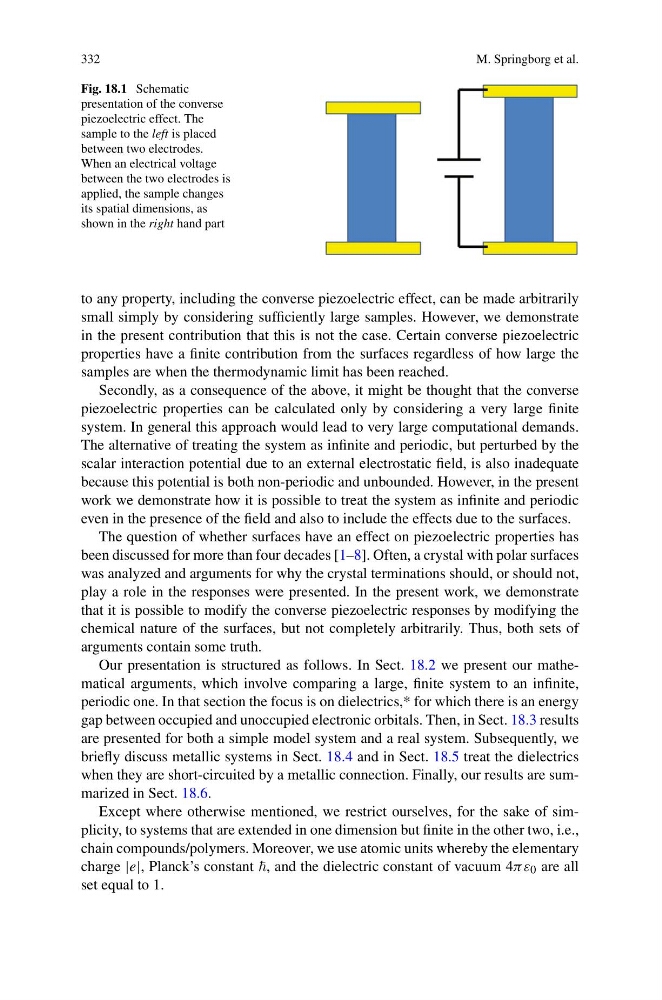
Fig. 18.1 Schematic
presentation of the converse
piezoelectric effect. The
sample to the left is placed
between two electrodes.
When an electrical voltage
between the two electrodes is
applied, the sample changes
its spatial dimensions, as
shown in the right hand part
to any property, including the converse piezoelectric effect, can be made arbitrarily
small simply by considering sufficiently large samples. However, we demonstrate
in the present contribution that this is not the case. Certain converse piezoelectric
properties have a finite contribution from the surfaces regardless of how large the
samples are when the thermodynamic limit has been reached.
Secondly, as a consequence of the above, it might be thought that the converse
piezoelectric properties can be calculated only by considering a very large finite
system. In general this approach would lead to very large computational demands.
The alternative of treating the system as infinite and periodic, but perturbed by the
scalar interaction potential due to an external electrostatic field, is also inadequate
because this potential is both non-periodic and unbounded. However, in the present
work we demonstrate how it is possible to treat the system as infinite and periodic
even in the presence of the field and also to include the effects due to the surfaces.
The question of whether surfaces have an effect on piezoelectric properties has
been discussed for more than four decades [1–8]. Often, a crystal with polar surfaces
was analyzed and arguments for why the crystal terminations should, or should not,
play a role in the responses were presented. In the present work, we demonstrate
that it is possible to modify the converse piezoelectric responses by modifying the
chemical nature of the surfaces, but not completely arbitrarily. Thus, both sets of
arguments contain some truth.
Our presentation is structured as follows. In Sect. 18.2 we present our mathematical arguments, which involve comparing a large, finite system to an infinite,
periodic one. In that section the focus is on dielectrics,* for which there is an energy
gap between occupied and unoccupied electronic orbitals. Then, in Sect. 18.3 results
are presented for both a simple model system and a real system. Subsequently, we
briefly discuss metallic systems in Sect. 18.4 and in Sect. 18.5 treat the dielectrics
when they are short-circuited by a metallic connection. Finally, our results are summarized in Sect. 18.6.
Except where otherwise mentioned, we restrict ourselves, for the sake of simplicity, to systems that are extended in one dimension but finite in the other two, i.e.,
chain compounds/polymers. Moreover, we use atomic units whereby the elementary
charge |e|, Planck’s constant , and the dielectric constant of vacuum 4πε 0 are all
set equal to 1.
M. Springborg et al.
Fig. 18.1 Schematic
presentation of the converse
piezoelectric effect. The
sample to the left is placed
between two electrodes.
When an electrical voltage
between the two electrodes is
applied, the sample changes
its spatial dimensions, as
shown in the right hand part
to any property, including the converse piezoelectric effect, can be made arbitrarily
small simply by considering sufficiently large samples. However, we demonstrate
in the present contribution that this is not the case. Certain converse piezoelectric
properties have a finite contribution from the surfaces regardless of how large the
samples are when the thermodynamic limit has been reached.
Secondly, as a consequence of the above, it might be thought that the converse
piezoelectric properties can be calculated only by considering a very large finite
system. In general this approach would lead to very large computational demands.
The alternative of treating the system as infinite and periodic, but perturbed by the
scalar interaction potential due to an external electrostatic field, is also inadequate
because this potential is both non-periodic and unbounded. However, in the present
work we demonstrate how it is possible to treat the system as infinite and periodic
even in the presence of the field and also to include the effects due to the surfaces.
The question of whether surfaces have an effect on piezoelectric properties has
been discussed for more than four decades [1–8]. Often, a crystal with polar surfaces
was analyzed and arguments for why the crystal terminations should, or should not,
play a role in the responses were presented. In the present work, we demonstrate
that it is possible to modify the converse piezoelectric responses by modifying the
chemical nature of the surfaces, but not completely arbitrarily. Thus, both sets of
arguments contain some truth.
Our presentation is structured as follows. In Sect. 18.2 we present our mathematical arguments, which involve comparing a large, finite system to an infinite,
periodic one. In that section the focus is on dielectrics,* for which there is an energy
gap between occupied and unoccupied electronic orbitals. Then, in Sect. 18.3 results
are presented for both a simple model system and a real system. Subsequently, we
briefly discuss metallic systems in Sect. 18.4 and in Sect. 18.5 treat the dielectrics
when they are short-circuited by a metallic connection. Finally, our results are summarized in Sect. 18.6.
Except where otherwise mentioned, we restrict ourselves, for the sake of simplicity, to systems that are extended in one dimension but finite in the other two, i.e.,
chain compounds/polymers. Moreover, we use atomic units whereby the elementary
charge |e|, Planck’s constant , and the dielectric constant of vacuum 4πε 0 are all
set equal to 1.