

314
T. Ishimoto and M. Tachikawa
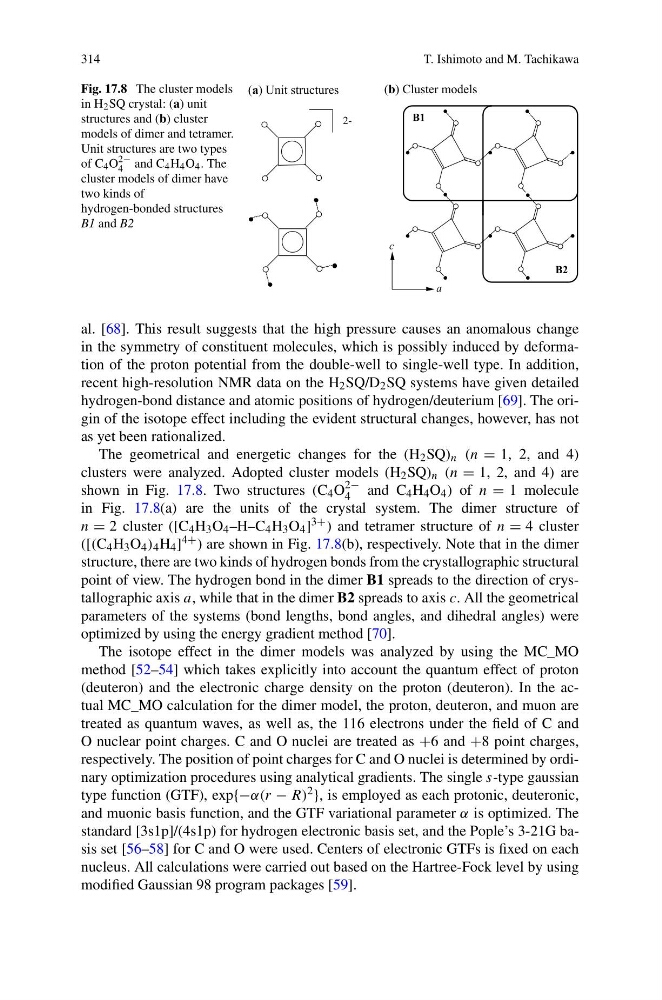
Fig. 17.8 The cluster models
in H 2 SQ crystal: (a) unit
structures and (b) cluster
models of dimer and tetramer.
Unit structures are two types
of C 4 O
2−
4 and C 4 H 4 O 4 . The
cluster models of dimer have
two kinds of
hydrogen-bonded structures
B1 and B2
al. [68]. This result suggests that the high pressure causes an anomalous change
in the symmetry of constituent molecules, which is possibly induced by deformation of the proton potential from the double-well to single-well type. In addition,
recent high-resolution NMR data on the H 2 SQ/D 2 SQ systems have given detailed
hydrogen-bond distance and atomic positions of hydrogen/deuterium [69]. The origin of the isotope effect including the evident structural changes, however, has not
as yet been rationalized.
The geometrical and energetic changes for the (H 2 SQ) n (n = 1, 2, and 4)
clusters were analyzed. Adopted cluster models (H 2 SQ) n (n = 1, 2, and 4) are
shown in Fig. 17.8. Two structures (C 4 O
2−
4 and C 4 H 4 O 4 ) of n = 1 molecule
in Fig. 17.8(a) are the units of the crystal system. The dimer structure of
n = 2 cluster ([C 4 H 3 O 4 –H–C 4 H 3 O 4 ] 3+ ) and tetramer structure of n = 4 cluster
([(C 4 H 3 O 4 ) 4 H 4 ] 4+ ) are shown in Fig. 17.8(b), respectively. Note that in the dimer
structure, there are two kinds of hydrogen bonds from the crystallographic structural
point of view. The hydrogen bond in the dimer B1 spreads to the direction of crystallographic axis a, while that in the dimer B2 spreads to axis c. All the geometrical
parameters of the systems (bond lengths, bond angles, and dihedral angles) were
optimized by using the energy gradient method [70].
The isotope effect in the dimer models was analyzed by using the MC_MO
method [52–54] which takes explicitly into account the quantum effect of proton
(deuteron) and the electronic charge density on the proton (deuteron). In the actual MC_MO calculation for the dimer model, the proton, deuteron, and muon are
treated as quantum waves, as well as, the 116 electrons under the field of C and
O nuclear point charges. C and O nuclei are treated as +6 and +8 point charges,
respectively. The position of point charges for C and O nuclei is determined by ordinary optimization procedures using analytical gradients. The single s-type gaussian
type function (GTF), exp{−α(r − R) 2 }, is employed as each protonic, deuteronic,
and muonic basis function, and the GTF variational parameter α is optimized. The
standard [3s1p]/(4s1p) for hydrogen electronic basis set, and the Pople’s 3-21G basis set [56–58] for C and O were used. Centers of electronic GTFs is fixed on each
nucleus. All calculations were carried out based on the Hartree-Fock level by using
modified Gaussian 98 program packages [59].
T. Ishimoto and M. Tachikawa
Fig. 17.8 The cluster models
in H 2 SQ crystal: (a) unit
structures and (b) cluster
models of dimer and tetramer.
Unit structures are two types
of C 4 O
2−
4 and C 4 H 4 O 4 . The
cluster models of dimer have
two kinds of
hydrogen-bonded structures
B1 and B2
al. [68]. This result suggests that the high pressure causes an anomalous change
in the symmetry of constituent molecules, which is possibly induced by deformation of the proton potential from the double-well to single-well type. In addition,
recent high-resolution NMR data on the H 2 SQ/D 2 SQ systems have given detailed
hydrogen-bond distance and atomic positions of hydrogen/deuterium [69]. The origin of the isotope effect including the evident structural changes, however, has not
as yet been rationalized.
The geometrical and energetic changes for the (H 2 SQ) n (n = 1, 2, and 4)
clusters were analyzed. Adopted cluster models (H 2 SQ) n (n = 1, 2, and 4) are
shown in Fig. 17.8. Two structures (C 4 O
2−
4 and C 4 H 4 O 4 ) of n = 1 molecule
in Fig. 17.8(a) are the units of the crystal system. The dimer structure of
n = 2 cluster ([C 4 H 3 O 4 –H–C 4 H 3 O 4 ] 3+ ) and tetramer structure of n = 4 cluster
([(C 4 H 3 O 4 ) 4 H 4 ] 4+ ) are shown in Fig. 17.8(b), respectively. Note that in the dimer
structure, there are two kinds of hydrogen bonds from the crystallographic structural
point of view. The hydrogen bond in the dimer B1 spreads to the direction of crystallographic axis a, while that in the dimer B2 spreads to axis c. All the geometrical
parameters of the systems (bond lengths, bond angles, and dihedral angles) were
optimized by using the energy gradient method [70].
The isotope effect in the dimer models was analyzed by using the MC_MO
method [52–54] which takes explicitly into account the quantum effect of proton
(deuteron) and the electronic charge density on the proton (deuteron). In the actual MC_MO calculation for the dimer model, the proton, deuteron, and muon are
treated as quantum waves, as well as, the 116 electrons under the field of C and
O nuclear point charges. C and O nuclei are treated as +6 and +8 point charges,
respectively. The position of point charges for C and O nuclei is determined by ordinary optimization procedures using analytical gradients. The single s-type gaussian
type function (GTF), exp{−α(r − R) 2 }, is employed as each protonic, deuteronic,
and muonic basis function, and the GTF variational parameter α is optimized. The
standard [3s1p]/(4s1p) for hydrogen electronic basis set, and the Pople’s 3-21G basis set [56–58] for C and O were used. Centers of electronic GTFs is fixed on each
nucleus. All calculations were carried out based on the Hartree-Fock level by using
modified Gaussian 98 program packages [59].