

17 Theoretical Analysis of Phase-Transition Temperature
313
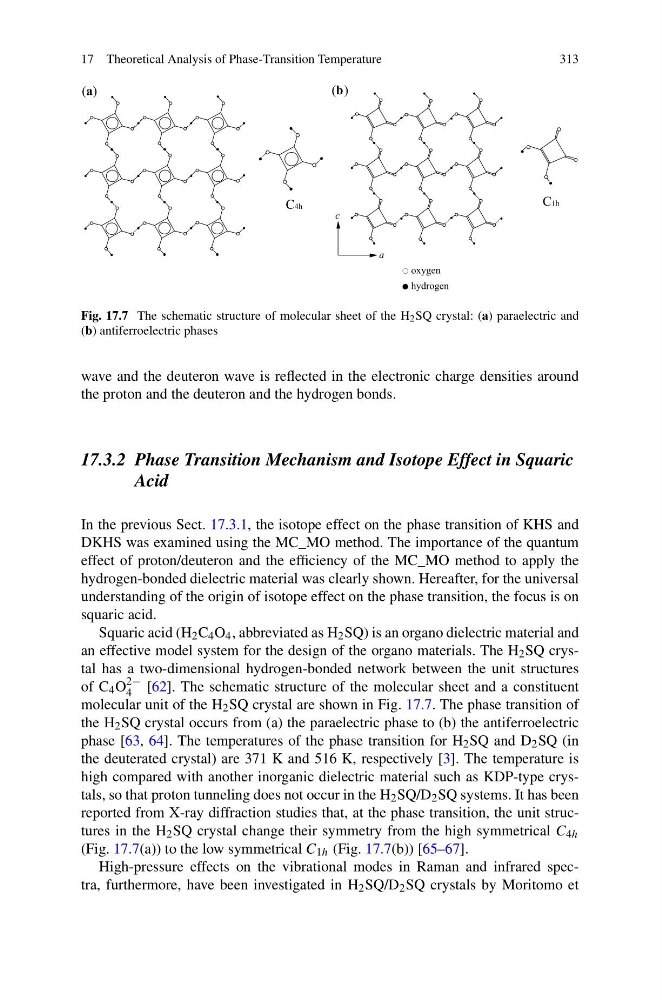
Fig. 17.7 The schematic structure of molecular sheet of the H 2 SQ crystal: (a) paraelectric and
(b) antiferroelectric phases
wave and the deuteron wave is reflected in the electronic charge densities around
the proton and the deuteron and the hydrogen bonds.
17.3.2 Phase Transition Mechanism and Isotope Effect in Squaric
Acid
In the previous Sect. 17.3.1, the isotope effect on the phase transition of KHS and
DKHS was examined using the MC_MO method. The importance of the quantum
effect of proton/deuteron and the efficiency of the MC_MO method to apply the
hydrogen-bonded dielectric material was clearly shown. Hereafter, for the universal
understanding of the origin of isotope effect on the phase transition, the focus is on
squaric acid.
Squaric acid (H 2 C 4 O 4 , abbreviated as H 2 SQ) is an organo dielectric material and
an effective model system for the design of the organo materials. The H 2 SQ crystal has a two-dimensional hydrogen-bonded network between the unit structures
of C 4 O
2−
4 [62]. The schematic structure of the molecular sheet and a constituent
molecular unit of the H 2 SQ crystal are shown in Fig. 17.7. The phase transition of
the H 2 SQ crystal occurs from (a) the paraelectric phase to (b) the antiferroelectric
phase [63, 64]. The temperatures of the phase transition for H 2 SQ and D 2 SQ (in
the deuterated crystal) are 371 K and 516 K, respectively [3]. The temperature is
high compared with another inorganic dielectric material such as KDP-type crystals, so that proton tunneling does not occur in the H 2 SQ/D 2 SQ systems. It has been
reported from X-ray diffraction studies that, at the phase transition, the unit structures in the H 2 SQ crystal change their symmetry from the high symmetrical C 4h
(Fig. 17.7(a)) to the low symmetrical C 1h (Fig. 17.7(b)) [65–67].
High-pressure effects on the vibrational modes in Raman and infrared spectra, furthermore, have been investigated in H 2 SQ/D 2 SQ crystals by Moritomo et
313
Fig. 17.7 The schematic structure of molecular sheet of the H 2 SQ crystal: (a) paraelectric and
(b) antiferroelectric phases
wave and the deuteron wave is reflected in the electronic charge densities around
the proton and the deuteron and the hydrogen bonds.
17.3.2 Phase Transition Mechanism and Isotope Effect in Squaric
Acid
In the previous Sect. 17.3.1, the isotope effect on the phase transition of KHS and
DKHS was examined using the MC_MO method. The importance of the quantum
effect of proton/deuteron and the efficiency of the MC_MO method to apply the
hydrogen-bonded dielectric material was clearly shown. Hereafter, for the universal
understanding of the origin of isotope effect on the phase transition, the focus is on
squaric acid.
Squaric acid (H 2 C 4 O 4 , abbreviated as H 2 SQ) is an organo dielectric material and
an effective model system for the design of the organo materials. The H 2 SQ crystal has a two-dimensional hydrogen-bonded network between the unit structures
of C 4 O
2−
4 [62]. The schematic structure of the molecular sheet and a constituent
molecular unit of the H 2 SQ crystal are shown in Fig. 17.7. The phase transition of
the H 2 SQ crystal occurs from (a) the paraelectric phase to (b) the antiferroelectric
phase [63, 64]. The temperatures of the phase transition for H 2 SQ and D 2 SQ (in
the deuterated crystal) are 371 K and 516 K, respectively [3]. The temperature is
high compared with another inorganic dielectric material such as KDP-type crystals, so that proton tunneling does not occur in the H 2 SQ/D 2 SQ systems. It has been
reported from X-ray diffraction studies that, at the phase transition, the unit structures in the H 2 SQ crystal change their symmetry from the high symmetrical C 4h
(Fig. 17.7(a)) to the low symmetrical C 1h (Fig. 17.7(b)) [65–67].
High-pressure effects on the vibrational modes in Raman and infrared spectra, furthermore, have been investigated in H 2 SQ/D 2 SQ crystals by Moritomo et