

310
T. Ishimoto and M. Tachikawa
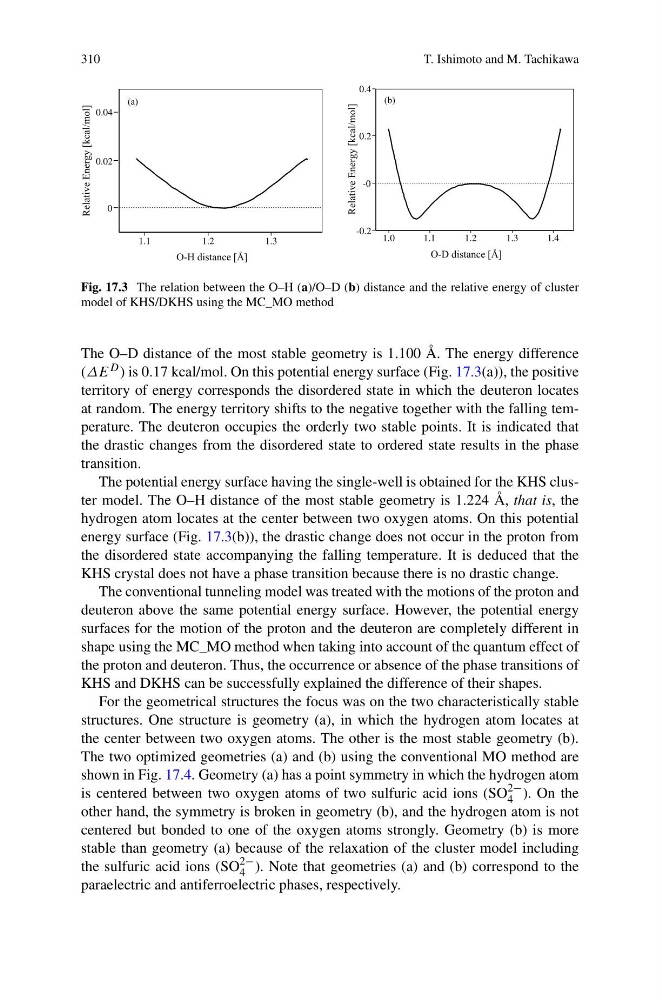
Fig. 17.3 The relation between the O–H (a)/O–D (b) distance and the relative energy of cluster
model of KHS/DKHS using the MC_MO method
The O–D distance of the most stable geometry is 1.100 Å. The energy difference
(ΔE D ) is 0.17 kcal/mol. On this potential energy surface (Fig. 17.3(a)), the positive
territory of energy corresponds the disordered state in which the deuteron locates
at random. The energy territory shifts to the negative together with the falling temperature. The deuteron occupies the orderly two stable points. It is indicated that
the drastic changes from the disordered state to ordered state results in the phase
transition.
The potential energy surface having the single-well is obtained for the KHS cluster model. The O–H distance of the most stable geometry is 1.224 Å, that is, the
hydrogen atom locates at the center between two oxygen atoms. On this potential
energy surface (Fig. 17.3(b)), the drastic change does not occur in the proton from
the disordered state accompanying the falling temperature. It is deduced that the
KHS crystal does not have a phase transition because there is no drastic change.
The conventional tunneling model was treated with the motions of the proton and
deuteron above the same potential energy surface. However, the potential energy
surfaces for the motion of the proton and the deuteron are completely different in
shape using the MC_MO method when taking into account of the quantum effect of
the proton and deuteron. Thus, the occurrence or absence of the phase transitions of
KHS and DKHS can be successfully explained the difference of their shapes.
For the geometrical structures the focus was on the two characteristically stable
structures. One structure is geometry (a), in which the hydrogen atom locates at
the center between two oxygen atoms. The other is the most stable geometry (b).
The two optimized geometries (a) and (b) using the conventional MO method are
shown in Fig. 17.4. Geometry (a) has a point symmetry in which the hydrogen atom
is centered between two oxygen atoms of two sulfuric acid ions (SO
2−
4 ). On the
other hand, the symmetry is broken in geometry (b), and the hydrogen atom is not
centered but bonded to one of the oxygen atoms strongly. Geometry (b) is more
stable than geometry (a) because of the relaxation of the cluster model including
the sulfuric acid ions (SO
2−
4 ). Note that geometries (a) and (b) correspond to the
paraelectric and antiferroelectric phases, respectively.
T. Ishimoto and M. Tachikawa
Fig. 17.3 The relation between the O–H (a)/O–D (b) distance and the relative energy of cluster
model of KHS/DKHS using the MC_MO method
The O–D distance of the most stable geometry is 1.100 Å. The energy difference
(ΔE D ) is 0.17 kcal/mol. On this potential energy surface (Fig. 17.3(a)), the positive
territory of energy corresponds the disordered state in which the deuteron locates
at random. The energy territory shifts to the negative together with the falling temperature. The deuteron occupies the orderly two stable points. It is indicated that
the drastic changes from the disordered state to ordered state results in the phase
transition.
The potential energy surface having the single-well is obtained for the KHS cluster model. The O–H distance of the most stable geometry is 1.224 Å, that is, the
hydrogen atom locates at the center between two oxygen atoms. On this potential
energy surface (Fig. 17.3(b)), the drastic change does not occur in the proton from
the disordered state accompanying the falling temperature. It is deduced that the
KHS crystal does not have a phase transition because there is no drastic change.
The conventional tunneling model was treated with the motions of the proton and
deuteron above the same potential energy surface. However, the potential energy
surfaces for the motion of the proton and the deuteron are completely different in
shape using the MC_MO method when taking into account of the quantum effect of
the proton and deuteron. Thus, the occurrence or absence of the phase transitions of
KHS and DKHS can be successfully explained the difference of their shapes.
For the geometrical structures the focus was on the two characteristically stable
structures. One structure is geometry (a), in which the hydrogen atom locates at
the center between two oxygen atoms. The other is the most stable geometry (b).
The two optimized geometries (a) and (b) using the conventional MO method are
shown in Fig. 17.4. Geometry (a) has a point symmetry in which the hydrogen atom
is centered between two oxygen atoms of two sulfuric acid ions (SO
2−
4 ). On the
other hand, the symmetry is broken in geometry (b), and the hydrogen atom is not
centered but bonded to one of the oxygen atoms strongly. Geometry (b) is more
stable than geometry (a) because of the relaxation of the cluster model including
the sulfuric acid ions (SO
2−
4 ). Note that geometries (a) and (b) correspond to the
paraelectric and antiferroelectric phases, respectively.