

17 Theoretical Analysis of Phase-Transition Temperature
309
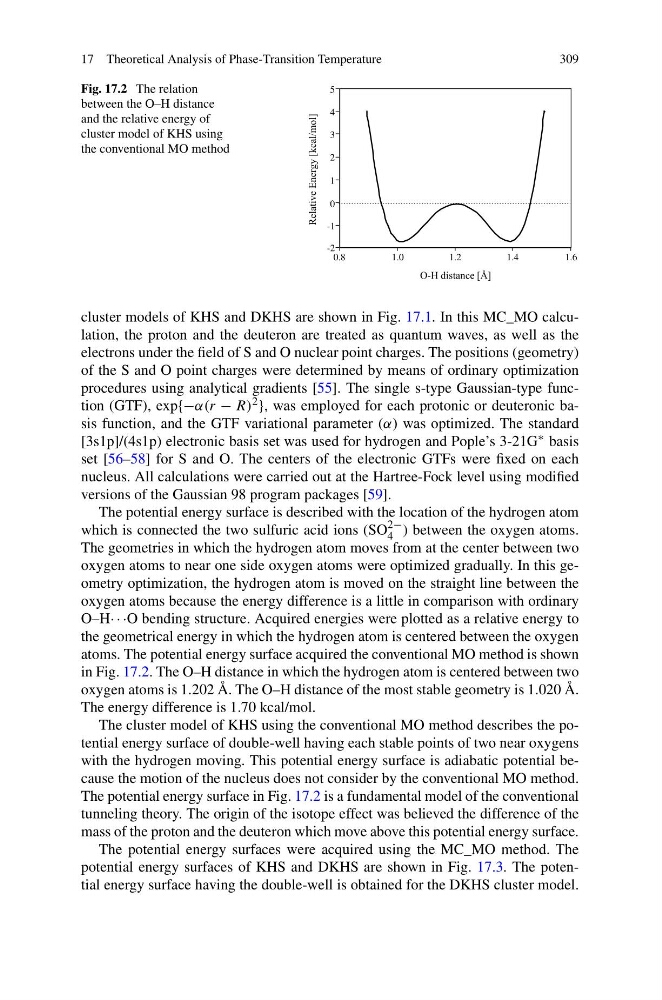
Fig. 17.2 The relation
between the O–H distance
and the relative energy of
cluster model of KHS using
the conventional MO method
cluster models of KHS and DKHS are shown in Fig. 17.1. In this MC_MO calculation, the proton and the deuteron are treated as quantum waves, as well as the
electrons under the field of S and O nuclear point charges. The positions (geometry)
of the S and O point charges were determined by means of ordinary optimization
procedures using analytical gradients [55]. The single s-type Gaussian-type function (GTF), exp{−α(r − R) 2 }, was employed for each protonic or deuteronic basis function, and the GTF variational parameter (α) was optimized. The standard
[3s1p]/(4s1p) electronic basis set was used for hydrogen and Pople’s 3-21G ∗ basis
set [56–58] for S and O. The centers of the electronic GTFs were fixed on each
nucleus. All calculations were carried out at the Hartree-Fock level using modified
versions of the Gaussian 98 program packages [59].
The potential energy surface is described with the location of the hydrogen atom
which is connected the two sulfuric acid ions (SO
2−
4 ) between the oxygen atoms.
The geometries in which the hydrogen atom moves from at the center between two
oxygen atoms to near one side oxygen atoms were optimized gradually. In this geometry optimization, the hydrogen atom is moved on the straight line between the
oxygen atoms because the energy difference is a little in comparison with ordinary
O–H· · ·O bending structure. Acquired energies were plotted as a relative energy to
the geometrical energy in which the hydrogen atom is centered between the oxygen
atoms. The potential energy surface acquired the conventional MO method is shown
in Fig. 17.2. The O–H distance in which the hydrogen atom is centered between two
oxygen atoms is 1.202 Å. The O–H distance of the most stable geometry is 1.020 Å.
The energy difference is 1.70 kcal/mol.
The cluster model of KHS using the conventional MO method describes the potential energy surface of double-well having each stable points of two near oxygens
with the hydrogen moving. This potential energy surface is adiabatic potential because the motion of the nucleus does not consider by the conventional MO method.
The potential energy surface in Fig. 17.2 is a fundamental model of the conventional
tunneling theory. The origin of the isotope effect was believed the difference of the
mass of the proton and the deuteron which move above this potential energy surface.
The potential energy surfaces were acquired using the MC_MO method. The
potential energy surfaces of KHS and DKHS are shown in Fig. 17.3. The potential energy surface having the double-well is obtained for the DKHS cluster model.
309
Fig. 17.2 The relation
between the O–H distance
and the relative energy of
cluster model of KHS using
the conventional MO method
cluster models of KHS and DKHS are shown in Fig. 17.1. In this MC_MO calculation, the proton and the deuteron are treated as quantum waves, as well as the
electrons under the field of S and O nuclear point charges. The positions (geometry)
of the S and O point charges were determined by means of ordinary optimization
procedures using analytical gradients [55]. The single s-type Gaussian-type function (GTF), exp{−α(r − R) 2 }, was employed for each protonic or deuteronic basis function, and the GTF variational parameter (α) was optimized. The standard
[3s1p]/(4s1p) electronic basis set was used for hydrogen and Pople’s 3-21G ∗ basis
set [56–58] for S and O. The centers of the electronic GTFs were fixed on each
nucleus. All calculations were carried out at the Hartree-Fock level using modified
versions of the Gaussian 98 program packages [59].
The potential energy surface is described with the location of the hydrogen atom
which is connected the two sulfuric acid ions (SO
2−
4 ) between the oxygen atoms.
The geometries in which the hydrogen atom moves from at the center between two
oxygen atoms to near one side oxygen atoms were optimized gradually. In this geometry optimization, the hydrogen atom is moved on the straight line between the
oxygen atoms because the energy difference is a little in comparison with ordinary
O–H· · ·O bending structure. Acquired energies were plotted as a relative energy to
the geometrical energy in which the hydrogen atom is centered between the oxygen
atoms. The potential energy surface acquired the conventional MO method is shown
in Fig. 17.2. The O–H distance in which the hydrogen atom is centered between two
oxygen atoms is 1.202 Å. The O–H distance of the most stable geometry is 1.020 Å.
The energy difference is 1.70 kcal/mol.
The cluster model of KHS using the conventional MO method describes the potential energy surface of double-well having each stable points of two near oxygens
with the hydrogen moving. This potential energy surface is adiabatic potential because the motion of the nucleus does not consider by the conventional MO method.
The potential energy surface in Fig. 17.2 is a fundamental model of the conventional
tunneling theory. The origin of the isotope effect was believed the difference of the
mass of the proton and the deuteron which move above this potential energy surface.
The potential energy surfaces were acquired using the MC_MO method. The
potential energy surfaces of KHS and DKHS are shown in Fig. 17.3. The potential energy surface having the double-well is obtained for the DKHS cluster model.