

308
T. Ishimoto and M. Tachikawa
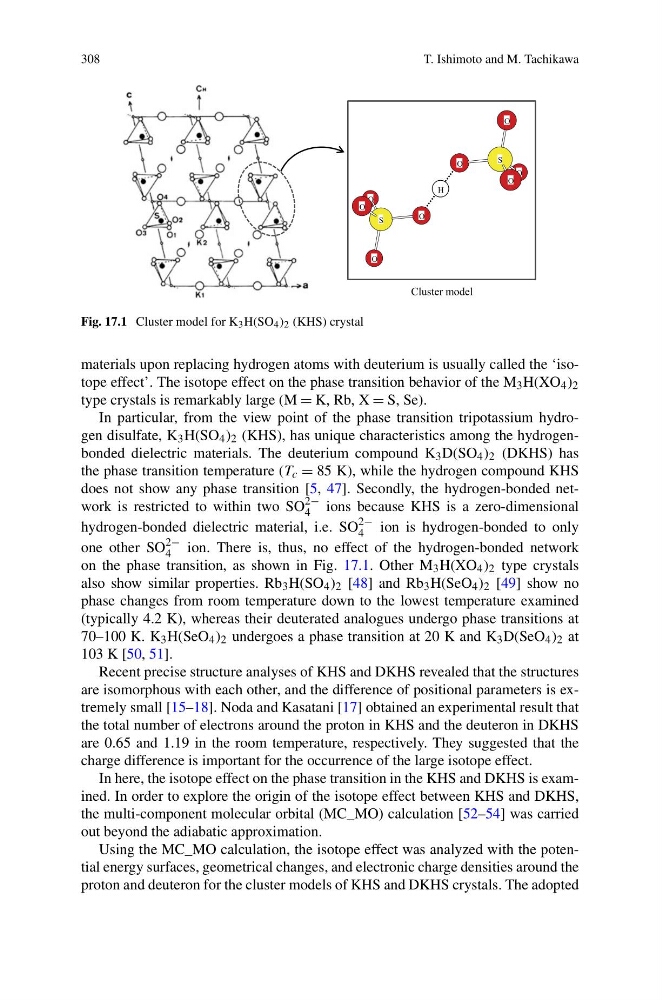
Fig. 17.1 Cluster model for K 3 H(SO 4 ) 2 (KHS) crystal
materials upon replacing hydrogen atoms with deuterium is usually called the ‘isotope effect’. The isotope effect on the phase transition behavior of the M 3 H(XO 4 ) 2
type crystals is remarkably large (M = K, Rb, X = S, Se).
In particular, from the view point of the phase transition tripotassium hydrogen disulfate, K 3 H(SO 4 ) 2 (KHS), has unique characteristics among the hydrogenbonded dielectric materials. The deuterium compound K 3 D(SO 4 ) 2 (DKHS) has
the phase transition temperature (T c = 85 K), while the hydrogen compound KHS
does not show any phase transition [5, 47]. Secondly, the hydrogen-bonded network is restricted to within two SO
2−
4 ions because KHS is a zero-dimensional
hydrogen-bonded dielectric material, i.e. SO
2−
4 ion is hydrogen-bonded to only
one other SO
2−
4 ion. There is, thus, no effect of the hydrogen-bonded network
on the phase transition, as shown in Fig. 17.1. Other M 3 H(XO 4 ) 2 type crystals
also show similar properties. Rb 3 H(SO 4 ) 2 [48] and Rb 3 H(SeO 4 ) 2 [49] show no
phase changes from room temperature down to the lowest temperature examined
(typically 4.2 K), whereas their deuterated analogues undergo phase transitions at
70–100 K. K 3 H(SeO 4 ) 2 undergoes a phase transition at 20 K and K 3 D(SeO 4 ) 2 at
103 K [50, 51].
Recent precise structure analyses of KHS and DKHS revealed that the structures
are isomorphous with each other, and the difference of positional parameters is extremely small [15–18]. Noda and Kasatani [17] obtained an experimental result that
the total number of electrons around the proton in KHS and the deuteron in DKHS
are 0.65 and 1.19 in the room temperature, respectively. They suggested that the
charge difference is important for the occurrence of the large isotope effect.
In here, the isotope effect on the phase transition in the KHS and DKHS is examined. In order to explore the origin of the isotope effect between KHS and DKHS,
the multi-component molecular orbital (MC_MO) calculation [52–54] was carried
out beyond the adiabatic approximation.
Using the MC_MO calculation, the isotope effect was analyzed with the potential energy surfaces, geometrical changes, and electronic charge densities around the
proton and deuteron for the cluster models of KHS and DKHS crystals. The adopted
T. Ishimoto and M. Tachikawa
Fig. 17.1 Cluster model for K 3 H(SO 4 ) 2 (KHS) crystal
materials upon replacing hydrogen atoms with deuterium is usually called the ‘isotope effect’. The isotope effect on the phase transition behavior of the M 3 H(XO 4 ) 2
type crystals is remarkably large (M = K, Rb, X = S, Se).
In particular, from the view point of the phase transition tripotassium hydrogen disulfate, K 3 H(SO 4 ) 2 (KHS), has unique characteristics among the hydrogenbonded dielectric materials. The deuterium compound K 3 D(SO 4 ) 2 (DKHS) has
the phase transition temperature (T c = 85 K), while the hydrogen compound KHS
does not show any phase transition [5, 47]. Secondly, the hydrogen-bonded network is restricted to within two SO
2−
4 ions because KHS is a zero-dimensional
hydrogen-bonded dielectric material, i.e. SO
2−
4 ion is hydrogen-bonded to only
one other SO
2−
4 ion. There is, thus, no effect of the hydrogen-bonded network
on the phase transition, as shown in Fig. 17.1. Other M 3 H(XO 4 ) 2 type crystals
also show similar properties. Rb 3 H(SO 4 ) 2 [48] and Rb 3 H(SeO 4 ) 2 [49] show no
phase changes from room temperature down to the lowest temperature examined
(typically 4.2 K), whereas their deuterated analogues undergo phase transitions at
70–100 K. K 3 H(SeO 4 ) 2 undergoes a phase transition at 20 K and K 3 D(SeO 4 ) 2 at
103 K [50, 51].
Recent precise structure analyses of KHS and DKHS revealed that the structures
are isomorphous with each other, and the difference of positional parameters is extremely small [15–18]. Noda and Kasatani [17] obtained an experimental result that
the total number of electrons around the proton in KHS and the deuteron in DKHS
are 0.65 and 1.19 in the room temperature, respectively. They suggested that the
charge difference is important for the occurrence of the large isotope effect.
In here, the isotope effect on the phase transition in the KHS and DKHS is examined. In order to explore the origin of the isotope effect between KHS and DKHS,
the multi-component molecular orbital (MC_MO) calculation [52–54] was carried
out beyond the adiabatic approximation.
Using the MC_MO calculation, the isotope effect was analyzed with the potential energy surfaces, geometrical changes, and electronic charge densities around the
proton and deuteron for the cluster models of KHS and DKHS crystals. The adopted