

17 Theoretical Analysis of Phase-Transition Temperature
307
f
e φ i = ε i φ i ,
f
e
= 2h
e
+
Ne/2
i
(2J i − K i ) −
Np/2
p
2J p ,
(17.5)
f
p φ p = ε p φ p ,
f
p
= 2h
p
+
Np/2
p
(2J p − K p ) −
Ne/2
i
2J i ,
(17.6)
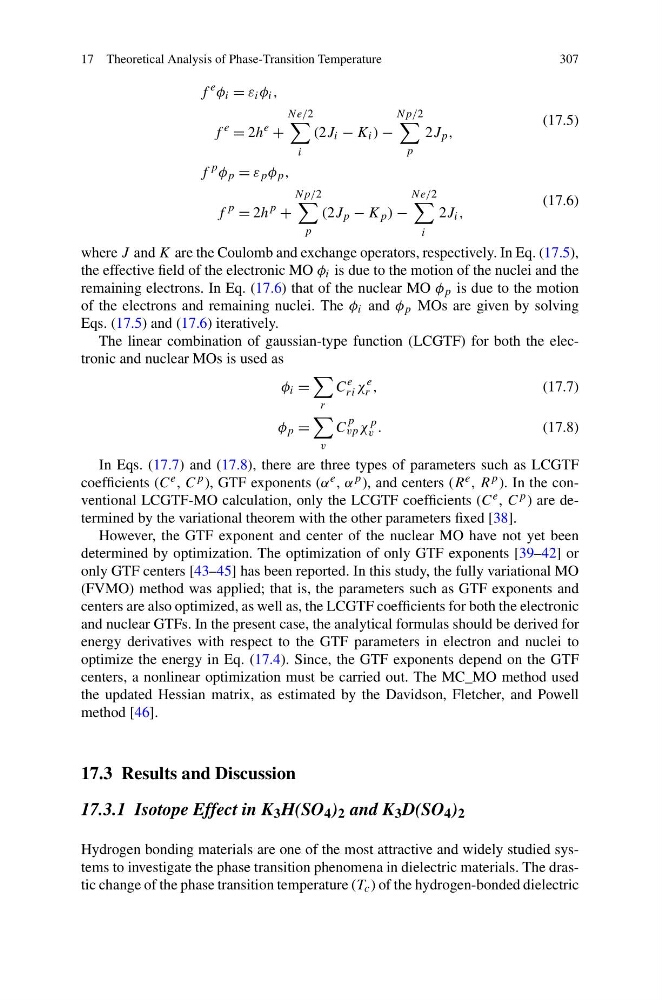
where J and K are the Coulomb and exchange operators, respectively. In Eq. (17.5),
the effective field of the electronic MO φ i is due to the motion of the nuclei and the
remaining electrons. In Eq. (17.6) that of the nuclear MO φ p is due to the motion
of the electrons and remaining nuclei. The φ i and φ p MOs are given by solving
Eqs. (17.5) and (17.6) iteratively.
The linear combination of gaussian-type function (LCGTF) for both the electronic and nuclear MOs is used as
φ i =
r
C
e
ri χ
e
r ,
(17.7)
φ p =
v
C
p
vp χ
p
v .
(17.8)
In Eqs. (17.7) and (17.8), there are three types of parameters such as LCGTF
coefficients (C e , C p ), GTF exponents (α e , α p ), and centers (R e , R p ). In the conventional LCGTF-MO calculation, only the LCGTF coefficients (C e , C p ) are determined by the variational theorem with the other parameters fixed [38].
However, the GTF exponent and center of the nuclear MO have not yet been
determined by optimization. The optimization of only GTF exponents [39–42] or
only GTF centers [43–45] has been reported. In this study, the fully variational MO
(FVMO) method was applied; that is, the parameters such as GTF exponents and
centers are also optimized, as well as, the LCGTF coefficients for both the electronic
and nuclear GTFs. In the present case, the analytical formulas should be derived for
energy derivatives with respect to the GTF parameters in electron and nuclei to
optimize the energy in Eq. (17.4). Since, the GTF exponents depend on the GTF
centers, a nonlinear optimization must be carried out. The MC_MO method used
the updated Hessian matrix, as estimated by the Davidson, Fletcher, and Powell
method [46].
17.3 Results and Discussion
17.3.1 Isotope Effect in K 3 H(SO 4 ) 2 and K 3 D(SO 4 ) 2
Hydrogen bonding materials are one of the most attractive and widely studied systems to investigate the phase transition phenomena in dielectric materials. The drastic change of the phase transition temperature (T c ) of the hydrogen-bonded dielectric
307
f
e φ i = ε i φ i ,
f
e
= 2h
e
+
Ne/2
i
(2J i − K i ) −
Np/2
p
2J p ,
(17.5)
f
p φ p = ε p φ p ,
f
p
= 2h
p
+
Np/2
p
(2J p − K p ) −
Ne/2
i
2J i ,
(17.6)
where J and K are the Coulomb and exchange operators, respectively. In Eq. (17.5),
the effective field of the electronic MO φ i is due to the motion of the nuclei and the
remaining electrons. In Eq. (17.6) that of the nuclear MO φ p is due to the motion
of the electrons and remaining nuclei. The φ i and φ p MOs are given by solving
Eqs. (17.5) and (17.6) iteratively.
The linear combination of gaussian-type function (LCGTF) for both the electronic and nuclear MOs is used as
φ i =
r
C
e
ri χ
e
r ,
(17.7)
φ p =
v
C
p
vp χ
p
v .
(17.8)
In Eqs. (17.7) and (17.8), there are three types of parameters such as LCGTF
coefficients (C e , C p ), GTF exponents (α e , α p ), and centers (R e , R p ). In the conventional LCGTF-MO calculation, only the LCGTF coefficients (C e , C p ) are determined by the variational theorem with the other parameters fixed [38].
However, the GTF exponent and center of the nuclear MO have not yet been
determined by optimization. The optimization of only GTF exponents [39–42] or
only GTF centers [43–45] has been reported. In this study, the fully variational MO
(FVMO) method was applied; that is, the parameters such as GTF exponents and
centers are also optimized, as well as, the LCGTF coefficients for both the electronic
and nuclear GTFs. In the present case, the analytical formulas should be derived for
energy derivatives with respect to the GTF parameters in electron and nuclei to
optimize the energy in Eq. (17.4). Since, the GTF exponents depend on the GTF
centers, a nonlinear optimization must be carried out. The MC_MO method used
the updated Hessian matrix, as estimated by the Davidson, Fletcher, and Powell
method [46].
17.3 Results and Discussion
17.3.1 Isotope Effect in K 3 H(SO 4 ) 2 and K 3 D(SO 4 ) 2
Hydrogen bonding materials are one of the most attractive and widely studied systems to investigate the phase transition phenomena in dielectric materials. The drastic change of the phase transition temperature (T c ) of the hydrogen-bonded dielectric