

306
T. Ishimoto and M. Tachikawa
Schrödinger equation of the electronic Hamiltonian is solved approximately using
the variational method with the nuclei fixed; that is, the motion of the electrons is
evaluated in the field of fixed nuclear charges [33, 34]. This electronic Hamiltonian expresses only electronic states and includes no nuclear kinetic energy operator terms. Based on the Born-Oppenheimer (B.O.) approximation [35], two steps
are necessary to analyze the nuclear motion. First, the electronic Hamiltonian for all
possible nuclear configurations (in principle) is solved to obtain a potential energy
hypersurface, which is then used as an adiabatic potential for the analysis of the nuclear motion. However, this treatment is practicable only di- or tri-atomic molecules
[36, 37].
In order to obtain both the electronic and nuclear wave functions simultaneously,
the total Hamiltonian including the nuclear kinetic-energy operators is used as,
H tot = −
M
p
1
2M p
∇
2
p + H e ,
(17.2)
where the p index refers to the nucleus treated as a quantum wave and M p is the
mass of the pth nuclear particle. For simplicity, one kind of nuclear species is treated
as the quantum mechanical wave and the other nuclei as the point charges. It may
be a better approximation if the lightest nuclei, such as protons, are dealt with as
a quantum wave. Furthermore, in order to obtain better convergence of the total
wavefunction at Hartree-Fock level, the independent-particle approximation for the
electronic and nuclear wavefunction is adopted as
Ψ tot ∼ = Φ
e
0 · Φ
p
0 .
(17.3)
The superscript refers to the type of particles; i.e. e for electrons and p for protons.
The energy of this system after integration of the spin coordinates is given by
E =
N e
i
n
e
i h
e
ii +
N e
i,j
α
e
ij (φ i φ i |φ j φ j ) + β
e
ij (φ i φ j |φ i φ j )
+
N p
i
n
p
p h
p
pp
+
N p
p,q
α
p
pq (φ p φ p |φ q φ q ) + β
p
pq (φ p φ q |φ p φ q )
−
N e
i
N p
p
n
e
i n
p
p (φ i φ i |φ p φ p ),
(17.4)
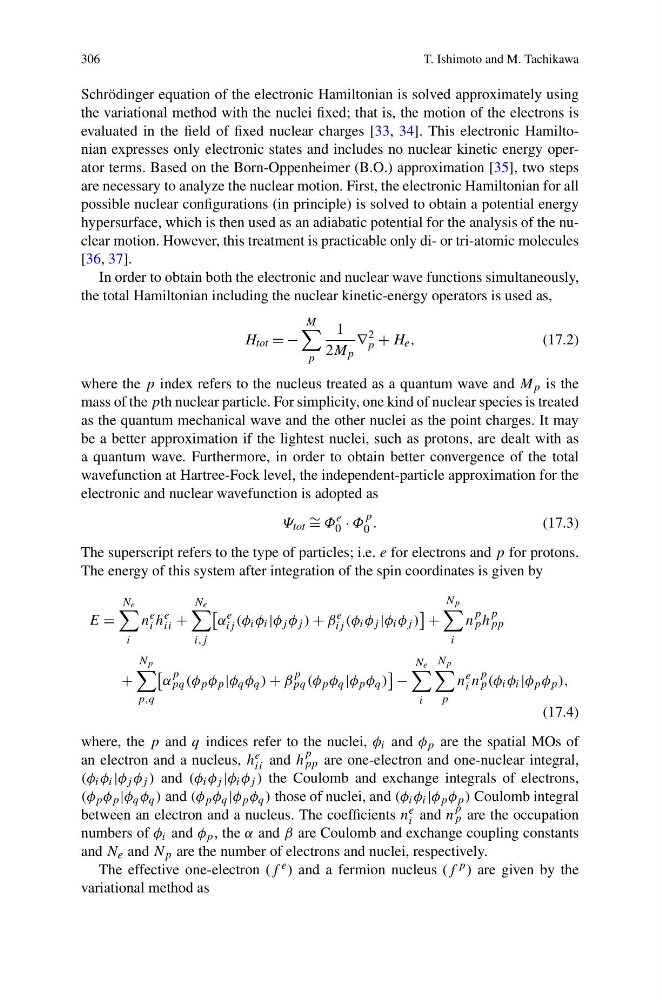
where, the p and q indices refer to the nuclei, φ i and φ p are the spatial MOs of
an electron and a nucleus, h e
ii and h
p
pp are one-electron and one-nuclear integral,
(φ i φ i |φ j φ j ) and (φ i φ j |φ i φ j ) the Coulomb and exchange integrals of electrons,
(φ p φ p |φ q φ q ) and (φ p φ q |φ p φ q ) those of nuclei, and (φ i φ i |φ p φ p ) Coulomb integral
between an electron and a nucleus. The coefficients n e
i and n
p
p are the occupation
numbers of φ i and φ p , the α and β are Coulomb and exchange coupling constants
and N e and N p are the number of electrons and nuclei, respectively.
The effective one-electron (f e ) and a fermion nucleus (f p ) are given by the
variational method as
T. Ishimoto and M. Tachikawa
Schrödinger equation of the electronic Hamiltonian is solved approximately using
the variational method with the nuclei fixed; that is, the motion of the electrons is
evaluated in the field of fixed nuclear charges [33, 34]. This electronic Hamiltonian expresses only electronic states and includes no nuclear kinetic energy operator terms. Based on the Born-Oppenheimer (B.O.) approximation [35], two steps
are necessary to analyze the nuclear motion. First, the electronic Hamiltonian for all
possible nuclear configurations (in principle) is solved to obtain a potential energy
hypersurface, which is then used as an adiabatic potential for the analysis of the nuclear motion. However, this treatment is practicable only di- or tri-atomic molecules
[36, 37].
In order to obtain both the electronic and nuclear wave functions simultaneously,
the total Hamiltonian including the nuclear kinetic-energy operators is used as,
H tot = −
M
p
1
2M p
∇
2
p + H e ,
(17.2)
where the p index refers to the nucleus treated as a quantum wave and M p is the
mass of the pth nuclear particle. For simplicity, one kind of nuclear species is treated
as the quantum mechanical wave and the other nuclei as the point charges. It may
be a better approximation if the lightest nuclei, such as protons, are dealt with as
a quantum wave. Furthermore, in order to obtain better convergence of the total
wavefunction at Hartree-Fock level, the independent-particle approximation for the
electronic and nuclear wavefunction is adopted as
Ψ tot ∼ = Φ
e
0 · Φ
p
0 .
(17.3)
The superscript refers to the type of particles; i.e. e for electrons and p for protons.
The energy of this system after integration of the spin coordinates is given by
E =
N e
i
n
e
i h
e
ii +
N e
i,j
α
e
ij (φ i φ i |φ j φ j ) + β
e
ij (φ i φ j |φ i φ j )
+
N p
i
n
p
p h
p
pp
+
N p
p,q
α
p
pq (φ p φ p |φ q φ q ) + β
p
pq (φ p φ q |φ p φ q )
−
N e
i
N p
p
n
e
i n
p
p (φ i φ i |φ p φ p ),
(17.4)
where, the p and q indices refer to the nuclei, φ i and φ p are the spatial MOs of
an electron and a nucleus, h e
ii and h
p
pp are one-electron and one-nuclear integral,
(φ i φ i |φ j φ j ) and (φ i φ j |φ i φ j ) the Coulomb and exchange integrals of electrons,
(φ p φ p |φ q φ q ) and (φ p φ q |φ p φ q ) those of nuclei, and (φ i φ i |φ p φ p ) Coulomb integral
between an electron and a nucleus. The coefficients n e
i and n
p
p are the occupation
numbers of φ i and φ p , the α and β are Coulomb and exchange coupling constants
and N e and N p are the number of electrons and nuclei, respectively.
The effective one-electron (f e ) and a fermion nucleus (f p ) are given by the
variational method as