

17 Theoretical Analysis of Phase-Transition Temperature
305
bonds. On the other hand, the molecular orbital (MO) and crystal orbital methods
based on the one electron approximation are powerful tools for the electronic structure calculation of molecules and clusters. This method is effective for the detailed
geometry analysis using the potential energy surfaces. Recently, we have proposed
the multi-component MO (MC_MO) method which takes into account the quantum
effect of proton and deuteron directly [26]. Here, the quantum effect can include the
effect of the anharmonicity due to the zero-point vibration induced by the quantum
proton and deuteron. The MC_MO method extends the concept of the conventional
MO method not only to the electrons but also to nucleus. It is a great and important
challenge to elucidate the origin of the isotope effect.
The computational procedure of the multi-component MO method, which can
take into account of the quantum effect of the proton and deuteron directly, is introduced in next section. In Sect. 17.3.1, we show the results of our MC_MO calculation for isotope effect on the phase transition in the K 3 H(SO 4 ) 2 and its deuterated
K 3 D(SO 4 ) 2 in order to theoretically analyze the quantum effect of the proton and
deuteron and to show the efficiency of the MC_MO method. In Sect. 17.3.2, the
origin of the phase transition and the isotope effect in the squaric acid, which is
well known as the organic dielectric material, will be shown through the stabilities,
structures, and cluster size dependency of the unit. The phase transition temperature
(T c ) difference between H 2 SQ and D 2 SQ is theoretically evaluated. In Sect. 17.3.3,
the T c and geometrical changes of the mixed K 3 H 1−x D x (SO 4 ) 2 and (H 1−x D x ) 2 SQ
crystal is discussed. The T c of TKHS and T 2 SQ substituted from hydrogen to tritium
is also predicted. From the above results and discussion, the origin of the isotope effect on the phase transition temperature in hydrogen-bonded dielectric materials is
deduced, as shown in Summary.
17.2 Computational Method
The quantum mechanical description of nuclear motion is a problem of central interest in physics, chemistry, and interdisciplinary fields [27–29]. However, quantum chemical molecular orbital (MO) theory has been developed for the description
of electronic motion in the molecular system. A multi-component MO (MC_MO)
method [26] is proposed to the description of the nuclear motion; that is, both electronic and nuclear wave functions are calculated simultaneously and all the parameters are determined variationally, except for the physical constant [30–32] to express
the ‘optimized nuclear MO’ directly.
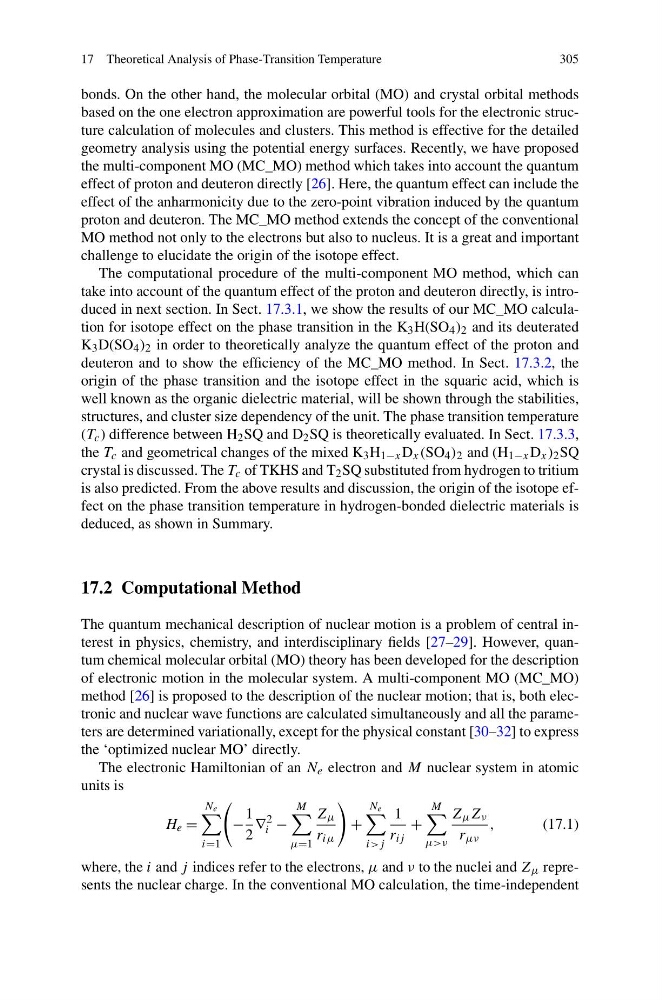
The electronic Hamiltonian of an N e electron and M nuclear system in atomic
units is
H e =
N e
i=1
−
1
2
∇
2
i −
M
μ=1
Z μ
r iμ
+
N e
i>j
1
r ij
+
M
μ>ν
Z μ Z ν
r μν
,
(17.1)
where, the i and j indices refer to the electrons, μ and ν to the nuclei and Z μ represents the nuclear charge. In the conventional MO calculation, the time-independent
305
bonds. On the other hand, the molecular orbital (MO) and crystal orbital methods
based on the one electron approximation are powerful tools for the electronic structure calculation of molecules and clusters. This method is effective for the detailed
geometry analysis using the potential energy surfaces. Recently, we have proposed
the multi-component MO (MC_MO) method which takes into account the quantum
effect of proton and deuteron directly [26]. Here, the quantum effect can include the
effect of the anharmonicity due to the zero-point vibration induced by the quantum
proton and deuteron. The MC_MO method extends the concept of the conventional
MO method not only to the electrons but also to nucleus. It is a great and important
challenge to elucidate the origin of the isotope effect.
The computational procedure of the multi-component MO method, which can
take into account of the quantum effect of the proton and deuteron directly, is introduced in next section. In Sect. 17.3.1, we show the results of our MC_MO calculation for isotope effect on the phase transition in the K 3 H(SO 4 ) 2 and its deuterated
K 3 D(SO 4 ) 2 in order to theoretically analyze the quantum effect of the proton and
deuteron and to show the efficiency of the MC_MO method. In Sect. 17.3.2, the
origin of the phase transition and the isotope effect in the squaric acid, which is
well known as the organic dielectric material, will be shown through the stabilities,
structures, and cluster size dependency of the unit. The phase transition temperature
(T c ) difference between H 2 SQ and D 2 SQ is theoretically evaluated. In Sect. 17.3.3,
the T c and geometrical changes of the mixed K 3 H 1−x D x (SO 4 ) 2 and (H 1−x D x ) 2 SQ
crystal is discussed. The T c of TKHS and T 2 SQ substituted from hydrogen to tritium
is also predicted. From the above results and discussion, the origin of the isotope effect on the phase transition temperature in hydrogen-bonded dielectric materials is
deduced, as shown in Summary.
17.2 Computational Method
The quantum mechanical description of nuclear motion is a problem of central interest in physics, chemistry, and interdisciplinary fields [27–29]. However, quantum chemical molecular orbital (MO) theory has been developed for the description
of electronic motion in the molecular system. A multi-component MO (MC_MO)
method [26] is proposed to the description of the nuclear motion; that is, both electronic and nuclear wave functions are calculated simultaneously and all the parameters are determined variationally, except for the physical constant [30–32] to express
the ‘optimized nuclear MO’ directly.
The electronic Hamiltonian of an N e electron and M nuclear system in atomic
units is
H e =
N e
i=1
−
1
2
∇
2
i −
M
μ=1
Z μ
r iμ
+
N e
i>j
1
r ij
+
M
μ>ν
Z μ Z ν
r μν
,
(17.1)
where, the i and j indices refer to the electrons, μ and ν to the nuclei and Z μ represents the nuclear charge. In the conventional MO calculation, the time-independent