

260
E.F. Sheka
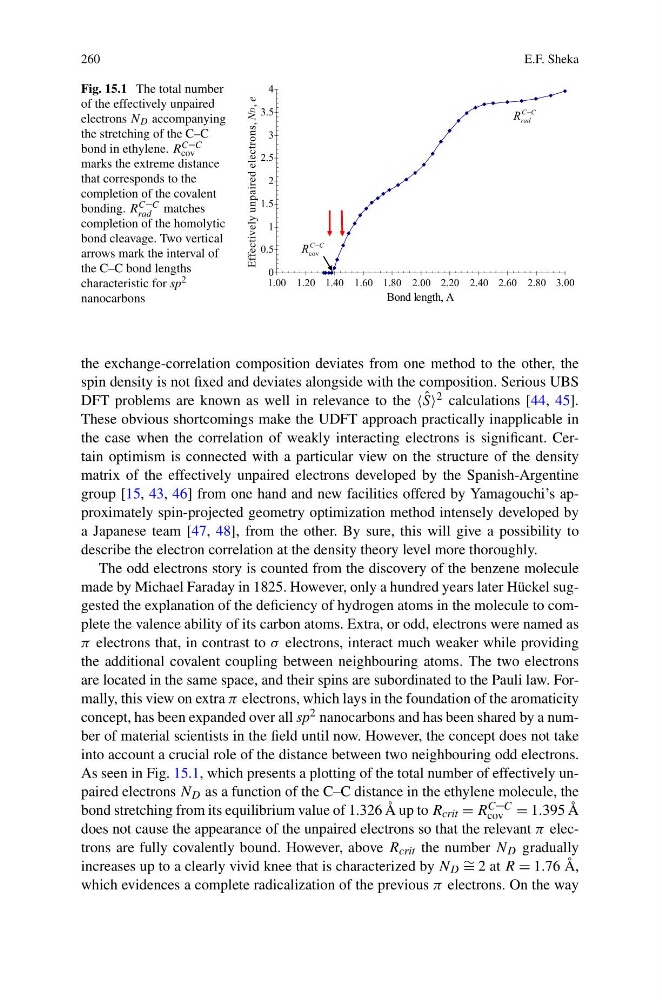
Fig. 15.1 The total number
of the effectively unpaired
electrons N D accompanying
the stretching of the C–C
bond in ethylene. R C–C
cov
marks the extreme distance
that corresponds to the
completion of the covalent
bonding. R
C–C
rad matches
completion of the homolytic
bond cleavage. Two vertical
arrows mark the interval of
the C–C bond lengths
characteristic for sp 2
nanocarbons
the exchange-correlation composition deviates from one method to the other, the
spin density is not fixed and deviates alongside with the composition. Serious UBS
DFT problems are known as well in relevance to the ˆ
S 2 calculations [44, 45].
These obvious shortcomings make the UDFT approach practically inapplicable in
the case when the correlation of weakly interacting electrons is significant. Certain optimism is connected with a particular view on the structure of the density
matrix of the effectively unpaired electrons developed by the Spanish-Argentine
group [15, 43, 46] from one hand and new facilities offered by Yamagouchi’s approximately spin-projected geometry optimization method intensely developed by
a Japanese team [47, 48], from the other. By sure, this will give a possibility to
describe the electron correlation at the density theory level more thoroughly.
The odd electrons story is counted from the discovery of the benzene molecule
made by Michael Faraday in 1825. However, only a hundred years later Hückel suggested the explanation of the deficiency of hydrogen atoms in the molecule to complete the valence ability of its carbon atoms. Extra, or odd, electrons were named as
π electrons that, in contrast to σ electrons, interact much weaker while providing
the additional covalent coupling between neighbouring atoms. The two electrons
are located in the same space, and their spins are subordinated to the Pauli law. Formally, this view on extra π electrons, which lays in the foundation of the aromaticity
concept, has been expanded over all sp 2 nanocarbons and has been shared by a number of material scientists in the field until now. However, the concept does not take
into account a crucial role of the distance between two neighbouring odd electrons.
As seen in Fig. 15.1, which presents a plotting of the total number of effectively unpaired electrons N D as a function of the C–C distance in the ethylene molecule, the
bond stretching from its equilibrium value of 1.326 Å up to R crit = R C–C
cov = 1.395 Å
does not cause the appearance of the unpaired electrons so that the relevant π electrons are fully covalently bound. However, above R crit the number N D gradually
increases up to a clearly vivid knee that is characterized by N D ∼ = 2 at R = 1.76 Å,
which evidences a complete radicalization of the previous π electrons. On the way
E.F. Sheka
Fig. 15.1 The total number
of the effectively unpaired
electrons N D accompanying
the stretching of the C–C
bond in ethylene. R C–C
cov
marks the extreme distance
that corresponds to the
completion of the covalent
bonding. R
C–C
rad matches
completion of the homolytic
bond cleavage. Two vertical
arrows mark the interval of
the C–C bond lengths
characteristic for sp 2
nanocarbons
the exchange-correlation composition deviates from one method to the other, the
spin density is not fixed and deviates alongside with the composition. Serious UBS
DFT problems are known as well in relevance to the ˆ
S 2 calculations [44, 45].
These obvious shortcomings make the UDFT approach practically inapplicable in
the case when the correlation of weakly interacting electrons is significant. Certain optimism is connected with a particular view on the structure of the density
matrix of the effectively unpaired electrons developed by the Spanish-Argentine
group [15, 43, 46] from one hand and new facilities offered by Yamagouchi’s approximately spin-projected geometry optimization method intensely developed by
a Japanese team [47, 48], from the other. By sure, this will give a possibility to
describe the electron correlation at the density theory level more thoroughly.
The odd electrons story is counted from the discovery of the benzene molecule
made by Michael Faraday in 1825. However, only a hundred years later Hückel suggested the explanation of the deficiency of hydrogen atoms in the molecule to complete the valence ability of its carbon atoms. Extra, or odd, electrons were named as
π electrons that, in contrast to σ electrons, interact much weaker while providing
the additional covalent coupling between neighbouring atoms. The two electrons
are located in the same space, and their spins are subordinated to the Pauli law. Formally, this view on extra π electrons, which lays in the foundation of the aromaticity
concept, has been expanded over all sp 2 nanocarbons and has been shared by a number of material scientists in the field until now. However, the concept does not take
into account a crucial role of the distance between two neighbouring odd electrons.
As seen in Fig. 15.1, which presents a plotting of the total number of effectively unpaired electrons N D as a function of the C–C distance in the ethylene molecule, the
bond stretching from its equilibrium value of 1.326 Å up to R crit = R C–C
cov = 1.395 Å
does not cause the appearance of the unpaired electrons so that the relevant π electrons are fully covalently bound. However, above R crit the number N D gradually
increases up to a clearly vivid knee that is characterized by N D ∼ = 2 at R = 1.76 Å,
which evidences a complete radicalization of the previous π electrons. On the way