

15 Molecular Theory of Graphene
259
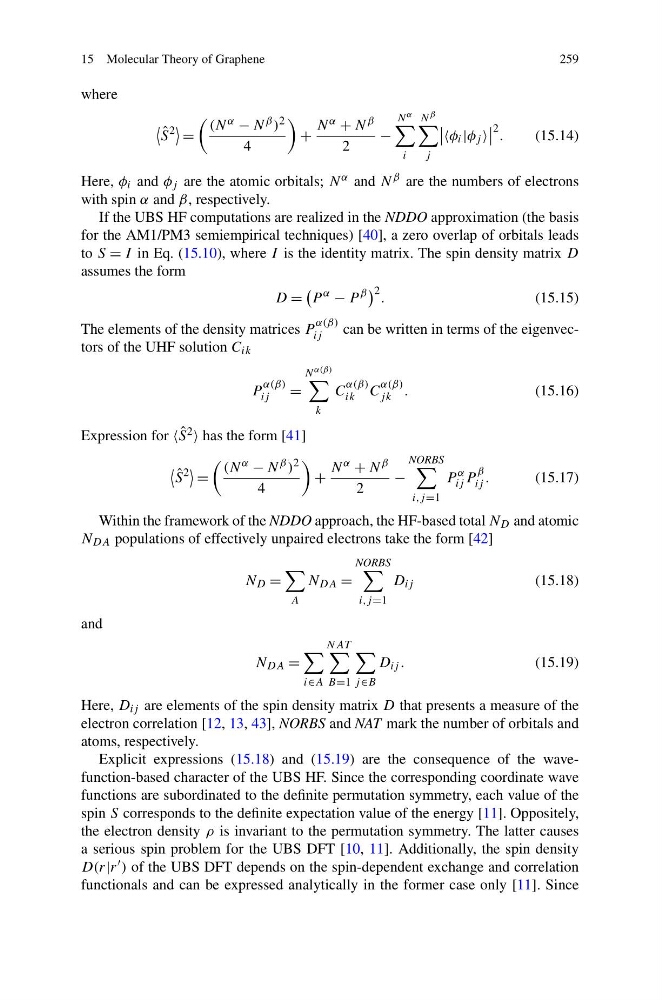
where
ˆ
S
2
=
(N α − N β ) 2
4
+
N α + N β
2
−
N α
i
N β
j
φ i |φ j
2 .
(15.14)
Here, φ i and φ j are the atomic orbitals; N α and N β are the numbers of electrons
with spin α and β, respectively.
If the UBS HF computations are realized in the NDDO approximation (the basis
for the AM1/PM3 semiempirical techniques) [40], a zero overlap of orbitals leads
to S = I in Eq. (15.10), where I is the identity matrix. The spin density matrix D
assumes the form
D =
P
α
− P
β
2 .
(15.15)
The elements of the density matrices P
α(β)
ij
can be written in terms of the eigenvectors of the UHF solution C ik
P
α(β)
ij
=
N α(β)
k
C
α(β)
ik C
α(β)
jk .
(15.16)
Expression for ˆ
S 2 has the form [41]
ˆ
S
2
=
(N α − N β ) 2
4
+
N α + N β
2
−
NORBS
i,j =1
P
α
ij P
β
ij .
(15.17)
Within the framework of the NDDO approach, the HF-based total N D and atomic
N DA populations of effectively unpaired electrons take the form [42]
N D =
A
N DA =
NORBS
i,j =1
D ij
(15.18)
and
N DA =
i∈A
NAT
B=1
j ∈B
D ij .
(15.19)
Here, D ij are elements of the spin density matrix D that presents a measure of the
electron correlation [12, 13, 43], NORBS and NAT mark the number of orbitals and
atoms, respectively.
Explicit expressions (15.18) and (15.19) are the consequence of the wavefunction-based character of the UBS HF. Since the corresponding coordinate wave
functions are subordinated to the definite permutation symmetry, each value of the
spin S corresponds to the definite expectation value of the energy [11]. Oppositely,
the electron density ρ is invariant to the permutation symmetry. The latter causes
a serious spin problem for the UBS DFT [10, 11]. Additionally, the spin density
D(r|r ) of the UBS DFT depends on the spin-dependent exchange and correlation
functionals and can be expressed analytically in the former case only [11]. Since
259
where
ˆ
S
2
=
(N α − N β ) 2
4
+
N α + N β
2
−
N α
i
N β
j
φ i |φ j
2 .
(15.14)
Here, φ i and φ j are the atomic orbitals; N α and N β are the numbers of electrons
with spin α and β, respectively.
If the UBS HF computations are realized in the NDDO approximation (the basis
for the AM1/PM3 semiempirical techniques) [40], a zero overlap of orbitals leads
to S = I in Eq. (15.10), where I is the identity matrix. The spin density matrix D
assumes the form
D =
P
α
− P
β
2 .
(15.15)
The elements of the density matrices P
α(β)
ij
can be written in terms of the eigenvectors of the UHF solution C ik
P
α(β)
ij
=
N α(β)
k
C
α(β)
ik C
α(β)
jk .
(15.16)
Expression for ˆ
S 2 has the form [41]
ˆ
S
2
=
(N α − N β ) 2
4
+
N α + N β
2
−
NORBS
i,j =1
P
α
ij P
β
ij .
(15.17)
Within the framework of the NDDO approach, the HF-based total N D and atomic
N DA populations of effectively unpaired electrons take the form [42]
N D =
A
N DA =
NORBS
i,j =1
D ij
(15.18)
and
N DA =
i∈A
NAT
B=1
j ∈B
D ij .
(15.19)
Here, D ij are elements of the spin density matrix D that presents a measure of the
electron correlation [12, 13, 43], NORBS and NAT mark the number of orbitals and
atoms, respectively.
Explicit expressions (15.18) and (15.19) are the consequence of the wavefunction-based character of the UBS HF. Since the corresponding coordinate wave
functions are subordinated to the definite permutation symmetry, each value of the
spin S corresponds to the definite expectation value of the energy [11]. Oppositely,
the electron density ρ is invariant to the permutation symmetry. The latter causes
a serious spin problem for the UBS DFT [10, 11]. Additionally, the spin density
D(r|r ) of the UBS DFT depends on the spin-dependent exchange and correlation
functionals and can be expressed analytically in the former case only [11]. Since