

258
E.F. Sheka
Answer 3 Odd electrons correlation is controlled by lengths of C–C bonds.
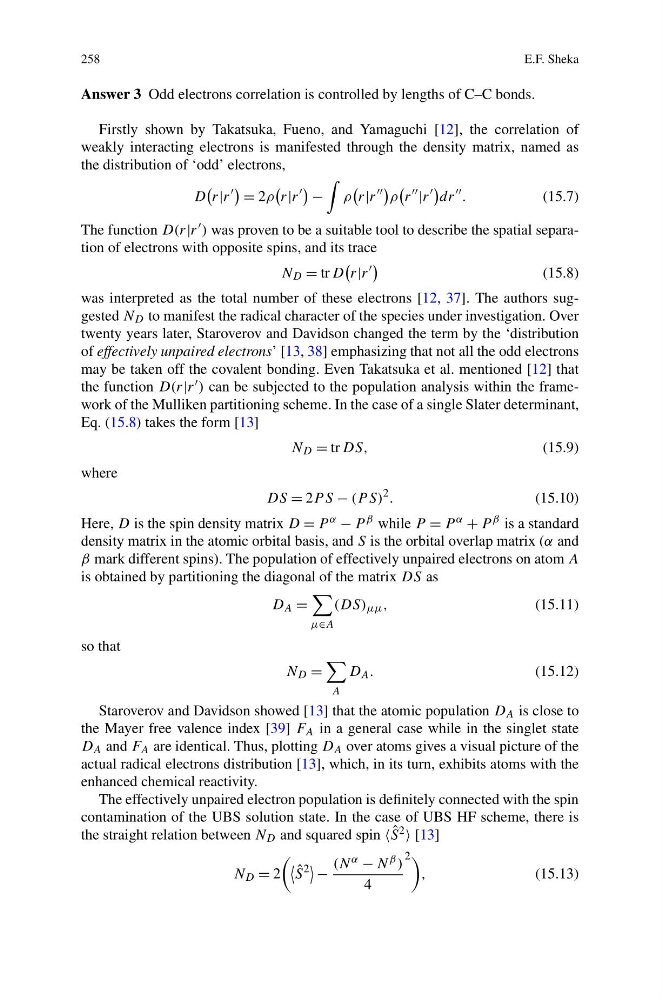
Firstly shown by Takatsuka, Fueno, and Yamaguchi [12], the correlation of
weakly interacting electrons is manifested through the density matrix, named as
the distribution of ‘odd’ electrons,
D
r|r
= 2ρ
r|r
−
ρ
r|r
ρ
r
|r
dr
.
(15.7)
The function D(r|r ) was proven to be a suitable tool to describe the spatial separation of electrons with opposite spins, and its trace
N D = tr D
r|r
(15.8)
was interpreted as the total number of these electrons [12, 37]. The authors suggested N D to manifest the radical character of the species under investigation. Over
twenty years later, Staroverov and Davidson changed the term by the ‘distribution
of effectively unpaired electrons’ [13, 38] emphasizing that not all the odd electrons
may be taken off the covalent bonding. Even Takatsuka et al. mentioned [12] that
the function D(r|r ) can be subjected to the population analysis within the framework of the Mulliken partitioning scheme. In the case of a single Slater determinant,
Eq. (15.8) takes the form [13]
N D = tr DS,
(15.9)
where
DS = 2P S − (P S)
2 .
(15.10)
Here, D is the spin density matrix D = P α − P β while P = P α + P β is a standard
density matrix in the atomic orbital basis, and S is the orbital overlap matrix (α and
β mark different spins). The population of effectively unpaired electrons on atom A
is obtained by partitioning the diagonal of the matrix DS as
D A =
μ∈A
(DS) μμ ,
(15.11)
so that
N D =
A
D A .
(15.12)
Staroverov and Davidson showed [13] that the atomic population D A is close to
the Mayer free valence index [39] F A in a general case while in the singlet state
D A and F A are identical. Thus, plotting D A over atoms gives a visual picture of the
actual radical electrons distribution [13], which, in its turn, exhibits atoms with the
enhanced chemical reactivity.
The effectively unpaired electron population is definitely connected with the spin
contamination of the UBS solution state. In the case of UBS HF scheme, there is
the straight relation between N D and squared spin ˆ
S 2 [13]
N D = 2
ˆ
S
2
−
(N α − N β )
4
2
,
(15.13)
E.F. Sheka
Answer 3 Odd electrons correlation is controlled by lengths of C–C bonds.
Firstly shown by Takatsuka, Fueno, and Yamaguchi [12], the correlation of
weakly interacting electrons is manifested through the density matrix, named as
the distribution of ‘odd’ electrons,
D
r|r
= 2ρ
r|r
−
ρ
r|r
ρ
r
|r
dr
.
(15.7)
The function D(r|r ) was proven to be a suitable tool to describe the spatial separation of electrons with opposite spins, and its trace
N D = tr D
r|r
(15.8)
was interpreted as the total number of these electrons [12, 37]. The authors suggested N D to manifest the radical character of the species under investigation. Over
twenty years later, Staroverov and Davidson changed the term by the ‘distribution
of effectively unpaired electrons’ [13, 38] emphasizing that not all the odd electrons
may be taken off the covalent bonding. Even Takatsuka et al. mentioned [12] that
the function D(r|r ) can be subjected to the population analysis within the framework of the Mulliken partitioning scheme. In the case of a single Slater determinant,
Eq. (15.8) takes the form [13]
N D = tr DS,
(15.9)
where
DS = 2P S − (P S)
2 .
(15.10)
Here, D is the spin density matrix D = P α − P β while P = P α + P β is a standard
density matrix in the atomic orbital basis, and S is the orbital overlap matrix (α and
β mark different spins). The population of effectively unpaired electrons on atom A
is obtained by partitioning the diagonal of the matrix DS as
D A =
μ∈A
(DS) μμ ,
(15.11)
so that
N D =
A
D A .
(15.12)
Staroverov and Davidson showed [13] that the atomic population D A is close to
the Mayer free valence index [39] F A in a general case while in the singlet state
D A and F A are identical. Thus, plotting D A over atoms gives a visual picture of the
actual radical electrons distribution [13], which, in its turn, exhibits atoms with the
enhanced chemical reactivity.
The effectively unpaired electron population is definitely connected with the spin
contamination of the UBS solution state. In the case of UBS HF scheme, there is
the straight relation between N D and squared spin ˆ
S 2 [13]
N D = 2
ˆ
S
2
−
(N α − N β )
4
2
,
(15.13)