

15 Molecular Theory of Graphene
261
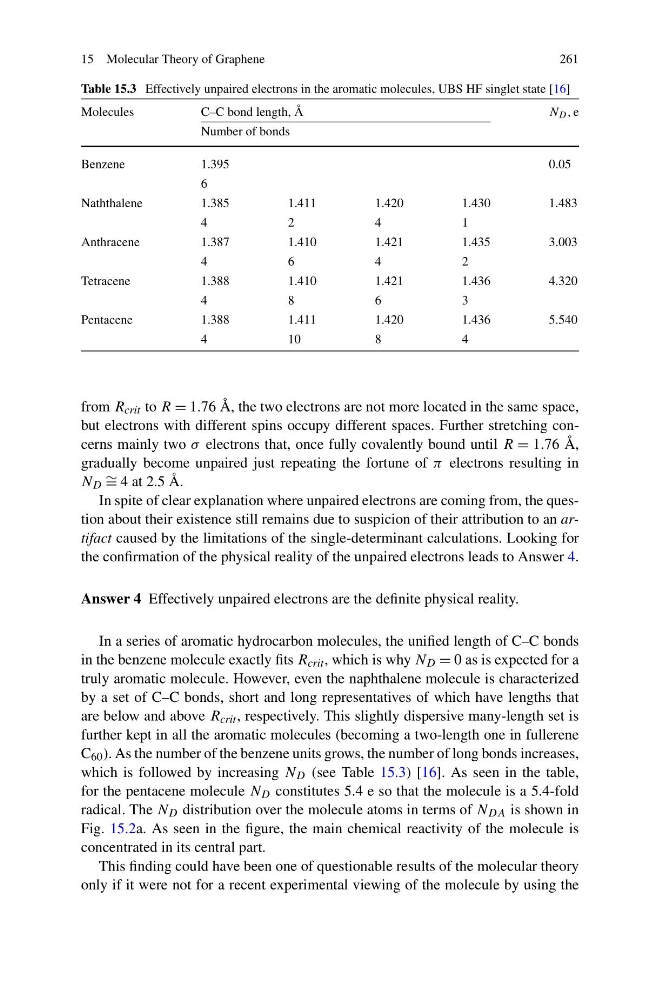
Table 15.3 Effectively unpaired electrons in the aromatic molecules, UBS HF singlet state [16]
Molecules
C–C bond length, Å
N D , e
Number of bonds
Benzene
1.395
0.05
6
Naththalene
1.385
1.411
1.420
1.430
1.483
4
2
4
1
Anthracene
1.387
1.410
1.421
1.435
3.003
4
6
4
2
Tetracene
1.388
1.410
1.421
1.436
4.320
4
8
6
3
Pentacene
1.388
1.411
1.420
1.436
5.540
4
1 0
8
4
from R crit to R = 1.76 Å, the two electrons are not more located in the same space,
but electrons with different spins occupy different spaces. Further stretching concerns mainly two σ electrons that, once fully covalently bound until R = 1.76 Å,
gradually become unpaired just repeating the fortune of π electrons resulting in
N D ∼ = 4 at 2.5 Å.
In spite of clear explanation where unpaired electrons are coming from, the question about their existence still remains due to suspicion of their attribution to an artifact caused by the limitations of the single-determinant calculations. Looking for
the confirmation of the physical reality of the unpaired electrons leads to Answer 4.
Answer 4 Effectively unpaired electrons are the definite physical reality.
In a series of aromatic hydrocarbon molecules, the unified length of C–C bonds
in the benzene molecule exactly fits R crit , which is why N D = 0 as is expected for a
truly aromatic molecule. However, even the naphthalene molecule is characterized
by a set of C–C bonds, short and long representatives of which have lengths that
are below and above R crit , respectively. This slightly dispersive many-length set is
further kept in all the aromatic molecules (becoming a two-length one in fullerene
C 60 ). As the number of the benzene units grows, the number of long bonds increases,
which is followed by increasing N D (see Table 15.3) [16]. As seen in the table,
for the pentacene molecule N D constitutes 5.4 e so that the molecule is a 5.4-fold
radical. The N D distribution over the molecule atoms in terms of N DA is shown in
Fig. 15.2a. As seen in the figure, the main chemical reactivity of the molecule is
concentrated in its central part.
This finding could have been one of questionable results of the molecular theory
only if it were not for a recent experimental viewing of the molecule by using the
261
Table 15.3 Effectively unpaired electrons in the aromatic molecules, UBS HF singlet state [16]
Molecules
C–C bond length, Å
N D , e
Number of bonds
Benzene
1.395
0.05
6
Naththalene
1.385
1.411
1.420
1.430
1.483
4
2
4
1
Anthracene
1.387
1.410
1.421
1.435
3.003
4
6
4
2
Tetracene
1.388
1.410
1.421
1.436
4.320
4
8
6
3
Pentacene
1.388
1.411
1.420
1.436
5.540
4
1 0
8
4
from R crit to R = 1.76 Å, the two electrons are not more located in the same space,
but electrons with different spins occupy different spaces. Further stretching concerns mainly two σ electrons that, once fully covalently bound until R = 1.76 Å,
gradually become unpaired just repeating the fortune of π electrons resulting in
N D ∼ = 4 at 2.5 Å.
In spite of clear explanation where unpaired electrons are coming from, the question about their existence still remains due to suspicion of their attribution to an artifact caused by the limitations of the single-determinant calculations. Looking for
the confirmation of the physical reality of the unpaired electrons leads to Answer 4.
Answer 4 Effectively unpaired electrons are the definite physical reality.
In a series of aromatic hydrocarbon molecules, the unified length of C–C bonds
in the benzene molecule exactly fits R crit , which is why N D = 0 as is expected for a
truly aromatic molecule. However, even the naphthalene molecule is characterized
by a set of C–C bonds, short and long representatives of which have lengths that
are below and above R crit , respectively. This slightly dispersive many-length set is
further kept in all the aromatic molecules (becoming a two-length one in fullerene
C 60 ). As the number of the benzene units grows, the number of long bonds increases,
which is followed by increasing N D (see Table 15.3) [16]. As seen in the table,
for the pentacene molecule N D constitutes 5.4 e so that the molecule is a 5.4-fold
radical. The N D distribution over the molecule atoms in terms of N DA is shown in
Fig. 15.2a. As seen in the figure, the main chemical reactivity of the molecule is
concentrated in its central part.
This finding could have been one of questionable results of the molecular theory
only if it were not for a recent experimental viewing of the molecule by using the