

14 A Theoretical Study on Proton Conduction Mechanism in BaZrO 3 Perovskite
243
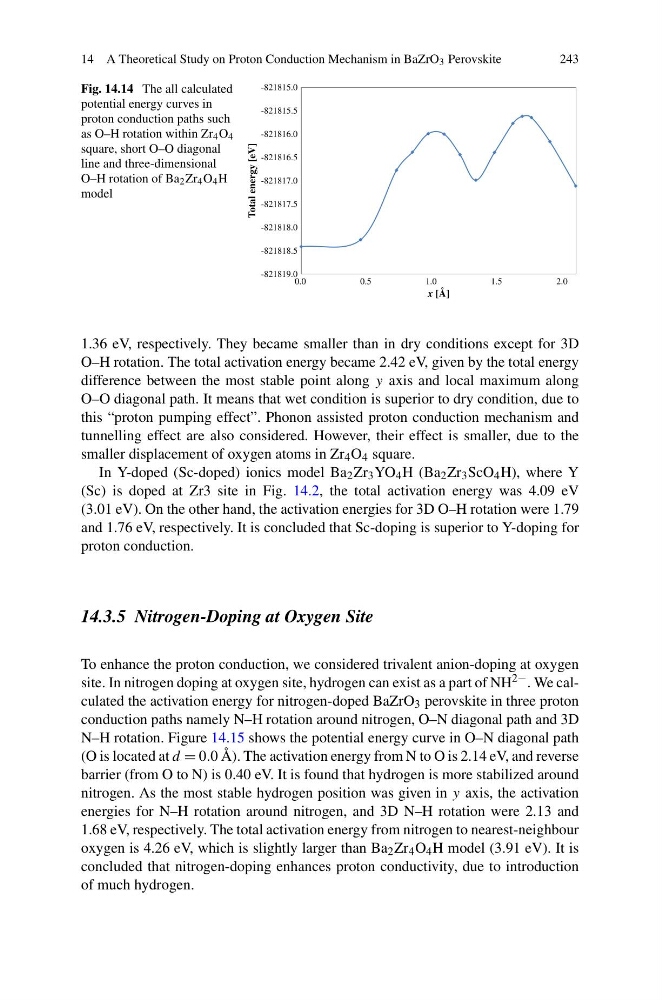
Fig. 14.14 The all calculated
potential energy curves in
proton conduction paths such
as O–H rotation within Zr 4 O 4
square, short O–O diagonal
line and three-dimensional
O–H rotation of Ba 2 Zr 4 O 4 H
model
1.36 eV, respectively. They became smaller than in dry conditions except for 3D
O–H rotation. The total activation energy became 2.42 eV, given by the total energy
difference between the most stable point along y axis and local maximum along
O–O diagonal path. It means that wet condition is superior to dry condition, due to
this “proton pumping effect”. Phonon assisted proton conduction mechanism and
tunnelling effect are also considered. However, their effect is smaller, due to the
smaller displacement of oxygen atoms in Zr 4 O 4 square.
In Y-doped (Sc-doped) ionics model Ba 2 Zr 3 YO 4 H (Ba 2 Zr 3 ScO 4 H), where Y
(Sc) is doped at Zr3 site in Fig. 14.2, the total activation energy was 4.09 eV
(3.01 eV). On the other hand, the activation energies for 3D O–H rotation were 1.79
and 1.76 eV, respectively. It is concluded that Sc-doping is superior to Y-doping for
proton conduction.
14.3.5 Nitrogen-Doping at Oxygen Site
To enhance the proton conduction, we considered trivalent anion-doping at oxygen
site. In nitrogen doping at oxygen site, hydrogen can exist as a part of NH 2− . We calculated the activation energy for nitrogen-doped BaZrO 3 perovskite in three proton
conduction paths namely N–H rotation around nitrogen, O–N diagonal path and 3D
N–H rotation. Figure 14.15 shows the potential energy curve in O–N diagonal path
(O is located at d = 0.0 Å). The activation energy from N to O is 2.14 eV, and reverse
barrier (from O to N) is 0.40 eV. It is found that hydrogen is more stabilized around
nitrogen. As the most stable hydrogen position was given in y axis, the activation
energies for N–H rotation around nitrogen, and 3D N–H rotation were 2.13 and
1.68 eV, respectively. The total activation energy from nitrogen to nearest-neighbour
oxygen is 4.26 eV, which is slightly larger than Ba 2 Zr 4 O 4 H model (3.91 eV). It is
concluded that nitrogen-doping enhances proton conductivity, due to introduction
of much hydrogen.
243
Fig. 14.14 The all calculated
potential energy curves in
proton conduction paths such
as O–H rotation within Zr 4 O 4
square, short O–O diagonal
line and three-dimensional
O–H rotation of Ba 2 Zr 4 O 4 H
model
1.36 eV, respectively. They became smaller than in dry conditions except for 3D
O–H rotation. The total activation energy became 2.42 eV, given by the total energy
difference between the most stable point along y axis and local maximum along
O–O diagonal path. It means that wet condition is superior to dry condition, due to
this “proton pumping effect”. Phonon assisted proton conduction mechanism and
tunnelling effect are also considered. However, their effect is smaller, due to the
smaller displacement of oxygen atoms in Zr 4 O 4 square.
In Y-doped (Sc-doped) ionics model Ba 2 Zr 3 YO 4 H (Ba 2 Zr 3 ScO 4 H), where Y
(Sc) is doped at Zr3 site in Fig. 14.2, the total activation energy was 4.09 eV
(3.01 eV). On the other hand, the activation energies for 3D O–H rotation were 1.79
and 1.76 eV, respectively. It is concluded that Sc-doping is superior to Y-doping for
proton conduction.
14.3.5 Nitrogen-Doping at Oxygen Site
To enhance the proton conduction, we considered trivalent anion-doping at oxygen
site. In nitrogen doping at oxygen site, hydrogen can exist as a part of NH 2− . We calculated the activation energy for nitrogen-doped BaZrO 3 perovskite in three proton
conduction paths namely N–H rotation around nitrogen, O–N diagonal path and 3D
N–H rotation. Figure 14.15 shows the potential energy curve in O–N diagonal path
(O is located at d = 0.0 Å). The activation energy from N to O is 2.14 eV, and reverse
barrier (from O to N) is 0.40 eV. It is found that hydrogen is more stabilized around
nitrogen. As the most stable hydrogen position was given in y axis, the activation
energies for N–H rotation around nitrogen, and 3D N–H rotation were 2.13 and
1.68 eV, respectively. The total activation energy from nitrogen to nearest-neighbour
oxygen is 4.26 eV, which is slightly larger than Ba 2 Zr 4 O 4 H model (3.91 eV). It is
concluded that nitrogen-doping enhances proton conductivity, due to introduction
of much hydrogen.