

244
T. Onishi and T. Helgaker
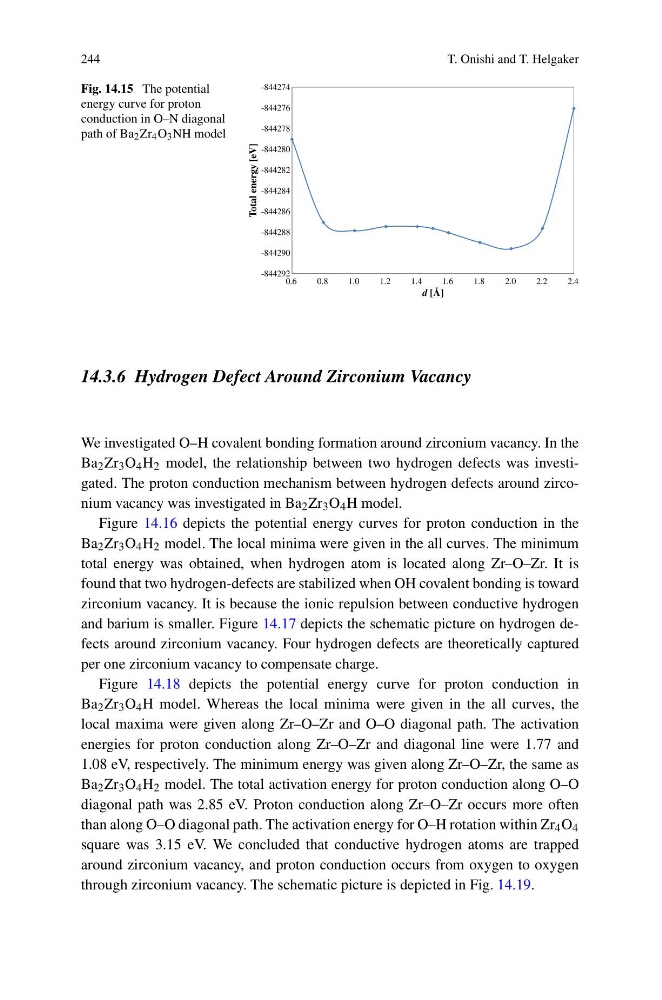
Fig. 14.15 The potential
energy curve for proton
conduction in O–N diagonal
path of Ba 2 Zr 4 O 3 NH model
14.3.6 Hydrogen Defect Around Zirconium Vacancy
We investigated O–H covalent bonding formation around zirconium vacancy. In the
Ba 2 Zr 3 O 4 H 2 model, the relationship between two hydrogen defects was investigated. The proton conduction mechanism between hydrogen defects around zirconium vacancy was investigated in Ba 2 Zr 3 O 4 H model.
Figure 14.16 depicts the potential energy curves for proton conduction in the
Ba 2 Zr 3 O 4 H 2 model. The local minima were given in the all curves. The minimum
total energy was obtained, when hydrogen atom is located along Zr–O–Zr. It is
found that two hydrogen-defects are stabilized when OH covalent bonding is toward
zirconium vacancy. It is because the ionic repulsion between conductive hydrogen
and barium is smaller. Figure 14.17 depicts the schematic picture on hydrogen defects around zirconium vacancy. Four hydrogen defects are theoretically captured
per one zirconium vacancy to compensate charge.
Figure 14.18 depicts the potential energy curve for proton conduction in
Ba 2 Zr 3 O 4 H model. Whereas the local minima were given in the all curves, the
local maxima were given along Zr–O–Zr and O–O diagonal path. The activation
energies for proton conduction along Zr–O–Zr and diagonal line were 1.77 and
1.08 eV, respectively. The minimum energy was given along Zr–O–Zr, the same as
Ba 2 Zr 3 O 4 H 2 model. The total activation energy for proton conduction along O–O
diagonal path was 2.85 eV. Proton conduction along Zr–O–Zr occurs more often
than along O–O diagonal path. The activation energy for O–H rotation within Zr 4 O 4
square was 3.15 eV. We concluded that conductive hydrogen atoms are trapped
around zirconium vacancy, and proton conduction occurs from oxygen to oxygen
through zirconium vacancy. The schematic picture is depicted in Fig. 14.19.
T. Onishi and T. Helgaker
Fig. 14.15 The potential
energy curve for proton
conduction in O–N diagonal
path of Ba 2 Zr 4 O 3 NH model
14.3.6 Hydrogen Defect Around Zirconium Vacancy
We investigated O–H covalent bonding formation around zirconium vacancy. In the
Ba 2 Zr 3 O 4 H 2 model, the relationship between two hydrogen defects was investigated. The proton conduction mechanism between hydrogen defects around zirconium vacancy was investigated in Ba 2 Zr 3 O 4 H model.
Figure 14.16 depicts the potential energy curves for proton conduction in the
Ba 2 Zr 3 O 4 H 2 model. The local minima were given in the all curves. The minimum
total energy was obtained, when hydrogen atom is located along Zr–O–Zr. It is
found that two hydrogen-defects are stabilized when OH covalent bonding is toward
zirconium vacancy. It is because the ionic repulsion between conductive hydrogen
and barium is smaller. Figure 14.17 depicts the schematic picture on hydrogen defects around zirconium vacancy. Four hydrogen defects are theoretically captured
per one zirconium vacancy to compensate charge.
Figure 14.18 depicts the potential energy curve for proton conduction in
Ba 2 Zr 3 O 4 H model. Whereas the local minima were given in the all curves, the
local maxima were given along Zr–O–Zr and O–O diagonal path. The activation
energies for proton conduction along Zr–O–Zr and diagonal line were 1.77 and
1.08 eV, respectively. The minimum energy was given along Zr–O–Zr, the same as
Ba 2 Zr 3 O 4 H 2 model. The total activation energy for proton conduction along O–O
diagonal path was 2.85 eV. Proton conduction along Zr–O–Zr occurs more often
than along O–O diagonal path. The activation energy for O–H rotation within Zr 4 O 4
square was 3.15 eV. We concluded that conductive hydrogen atoms are trapped
around zirconium vacancy, and proton conduction occurs from oxygen to oxygen
through zirconium vacancy. The schematic picture is depicted in Fig. 14.19.