

224
T. Onishi
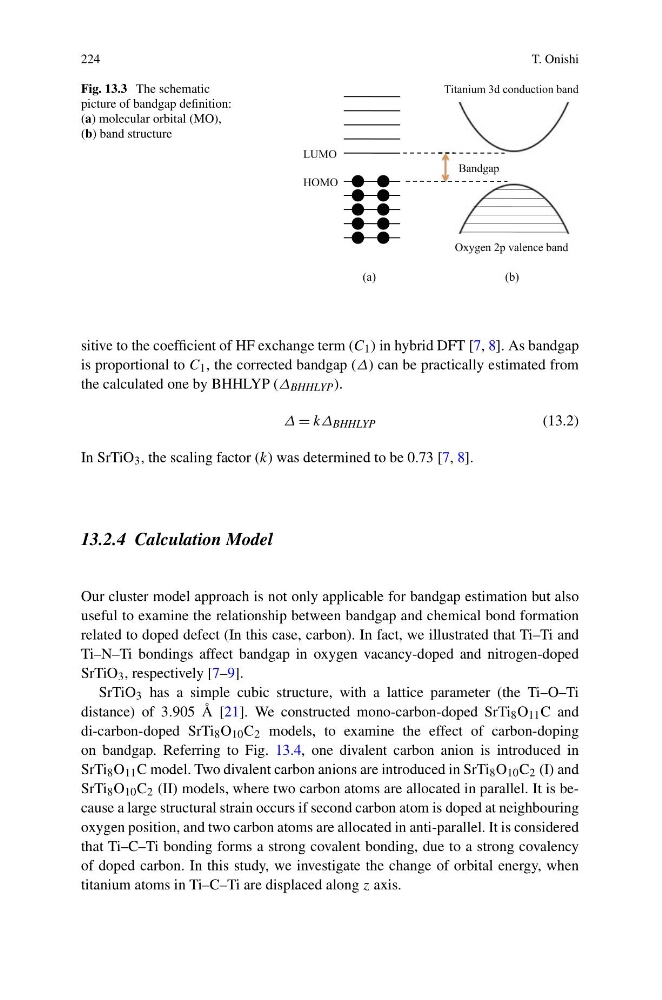
Fig. 13.3 The schematic
picture of bandgap definition:
(a) molecular orbital (MO),
(b) band structure
sitive to the coefficient of HF exchange term (C 1 ) in hybrid DFT [7, 8]. As bandgap
is proportional to C 1 , the corrected bandgap (Δ) can be practically estimated from
the calculated one by BHHLYP (Δ BHHLYP ).
Δ = kΔ BHHLYP
(13.2)
In SrTiO 3 , the scaling factor (k) was determined to be 0.73 [7, 8].
13.2.4 Calculation Model
Our cluster model approach is not only applicable for bandgap estimation but also
useful to examine the relationship between bandgap and chemical bond formation
related to doped defect (In this case, carbon). In fact, we illustrated that Ti–Ti and
Ti–N–Ti bondings affect bandgap in oxygen vacancy-doped and nitrogen-doped
SrTiO 3 , respectively [7–9].
SrTiO 3 has a simple cubic structure, with a lattice parameter (the Ti–O–Ti
distance) of 3.905 Å [21]. We constructed mono-carbon-doped SrTi 8 O 11 C and
di-carbon-doped SrTi 8 O 10 C 2 models, to examine the effect of carbon-doping
on bandgap. Referring to Fig. 13.4, one divalent carbon anion is introduced in
SrTi 8 O 11 C model. Two divalent carbon anions are introduced in SrTi 8 O 10 C 2 (I) and
SrTi 8 O 10 C 2 (II) models, where two carbon atoms are allocated in parallel. It is because a large structural strain occurs if second carbon atom is doped at neighbouring
oxygen position, and two carbon atoms are allocated in anti-parallel. It is considered
that Ti–C–Ti bonding forms a strong covalent bonding, due to a strong covalency
of doped carbon. In this study, we investigate the change of orbital energy, when
titanium atoms in Ti–C–Ti are displaced along z axis.
T. Onishi
Fig. 13.3 The schematic
picture of bandgap definition:
(a) molecular orbital (MO),
(b) band structure
sitive to the coefficient of HF exchange term (C 1 ) in hybrid DFT [7, 8]. As bandgap
is proportional to C 1 , the corrected bandgap (Δ) can be practically estimated from
the calculated one by BHHLYP (Δ BHHLYP ).
Δ = kΔ BHHLYP
(13.2)
In SrTiO 3 , the scaling factor (k) was determined to be 0.73 [7, 8].
13.2.4 Calculation Model
Our cluster model approach is not only applicable for bandgap estimation but also
useful to examine the relationship between bandgap and chemical bond formation
related to doped defect (In this case, carbon). In fact, we illustrated that Ti–Ti and
Ti–N–Ti bondings affect bandgap in oxygen vacancy-doped and nitrogen-doped
SrTiO 3 , respectively [7–9].
SrTiO 3 has a simple cubic structure, with a lattice parameter (the Ti–O–Ti
distance) of 3.905 Å [21]. We constructed mono-carbon-doped SrTi 8 O 11 C and
di-carbon-doped SrTi 8 O 10 C 2 models, to examine the effect of carbon-doping
on bandgap. Referring to Fig. 13.4, one divalent carbon anion is introduced in
SrTi 8 O 11 C model. Two divalent carbon anions are introduced in SrTi 8 O 10 C 2 (I) and
SrTi 8 O 10 C 2 (II) models, where two carbon atoms are allocated in parallel. It is because a large structural strain occurs if second carbon atom is doped at neighbouring
oxygen position, and two carbon atoms are allocated in anti-parallel. It is considered
that Ti–C–Ti bonding forms a strong covalent bonding, due to a strong covalency
of doped carbon. In this study, we investigate the change of orbital energy, when
titanium atoms in Ti–C–Ti are displaced along z axis.