

13 Visible-Light Photo-Catalytic Activity in Carbon-Doped Perovskite
223
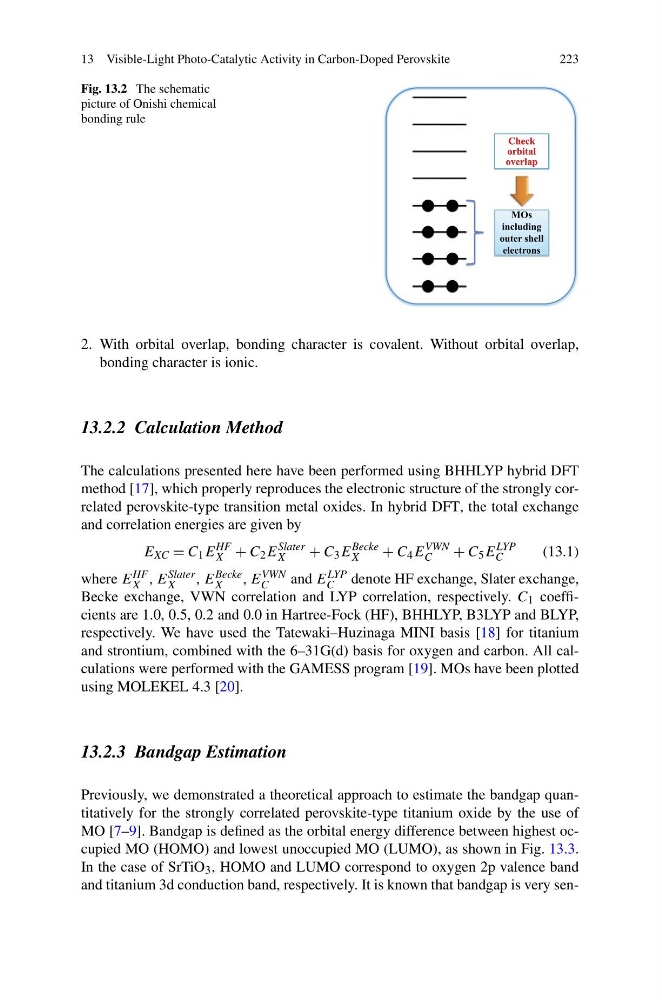
Fig. 13.2 The schematic
picture of Onishi chemical
bonding rule
2. With orbital overlap, bonding character is covalent. Without orbital overlap,
bonding character is ionic.
13.2.2 Calculation Method
The calculations presented here have been performed using BHHLYP hybrid DFT
method [17], which properly reproduces the electronic structure of the strongly correlated perovskite-type transition metal oxides. In hybrid DFT, the total exchange
and correlation energies are given by
E XC = C 1 E
HF
X + C 2 E
Slater
X
+ C 3 E
Becke
X
+ C 4 E
VWN
C
+ C 5 E
LYP
C
(13.1)
where E HF
X , E Slater
X
, E Becke
X
, E VWN
C
and E LYP
C denote HF exchange, Slater exchange,
Becke exchange, VWN correlation and LYP correlation, respectively. C 1 coefficients are 1.0, 0.5, 0.2 and 0.0 in Hartree-Fock (HF), BHHLYP, B3LYP and BLYP,
respectively. We have used the Tatewaki–Huzinaga MINI basis [18] for titanium
and strontium, combined with the 6–31G(d) basis for oxygen and carbon. All calculations were performed with the GAMESS program [19]. MOs have been plotted
using MOLEKEL 4.3 [20].
13.2.3 Bandgap Estimation
Previously, we demonstrated a theoretical approach to estimate the bandgap quantitatively for the strongly correlated perovskite-type titanium oxide by the use of
MO [7–9]. Bandgap is defined as the orbital energy difference between highest occupied MO (HOMO) and lowest unoccupied MO (LUMO), as shown in Fig. 13.3.
In the case of SrTiO 3 , HOMO and LUMO correspond to oxygen 2p valence band
and titanium 3d conduction band, respectively. It is known that bandgap is very sen-
223
Fig. 13.2 The schematic
picture of Onishi chemical
bonding rule
2. With orbital overlap, bonding character is covalent. Without orbital overlap,
bonding character is ionic.
13.2.2 Calculation Method
The calculations presented here have been performed using BHHLYP hybrid DFT
method [17], which properly reproduces the electronic structure of the strongly correlated perovskite-type transition metal oxides. In hybrid DFT, the total exchange
and correlation energies are given by
E XC = C 1 E
HF
X + C 2 E
Slater
X
+ C 3 E
Becke
X
+ C 4 E
VWN
C
+ C 5 E
LYP
C
(13.1)
where E HF
X , E Slater
X
, E Becke
X
, E VWN
C
and E LYP
C denote HF exchange, Slater exchange,
Becke exchange, VWN correlation and LYP correlation, respectively. C 1 coefficients are 1.0, 0.5, 0.2 and 0.0 in Hartree-Fock (HF), BHHLYP, B3LYP and BLYP,
respectively. We have used the Tatewaki–Huzinaga MINI basis [18] for titanium
and strontium, combined with the 6–31G(d) basis for oxygen and carbon. All calculations were performed with the GAMESS program [19]. MOs have been plotted
using MOLEKEL 4.3 [20].
13.2.3 Bandgap Estimation
Previously, we demonstrated a theoretical approach to estimate the bandgap quantitatively for the strongly correlated perovskite-type titanium oxide by the use of
MO [7–9]. Bandgap is defined as the orbital energy difference between highest occupied MO (HOMO) and lowest unoccupied MO (LUMO), as shown in Fig. 13.3.
In the case of SrTiO 3 , HOMO and LUMO correspond to oxygen 2p valence band
and titanium 3d conduction band, respectively. It is known that bandgap is very sen-