

222
T. Onishi
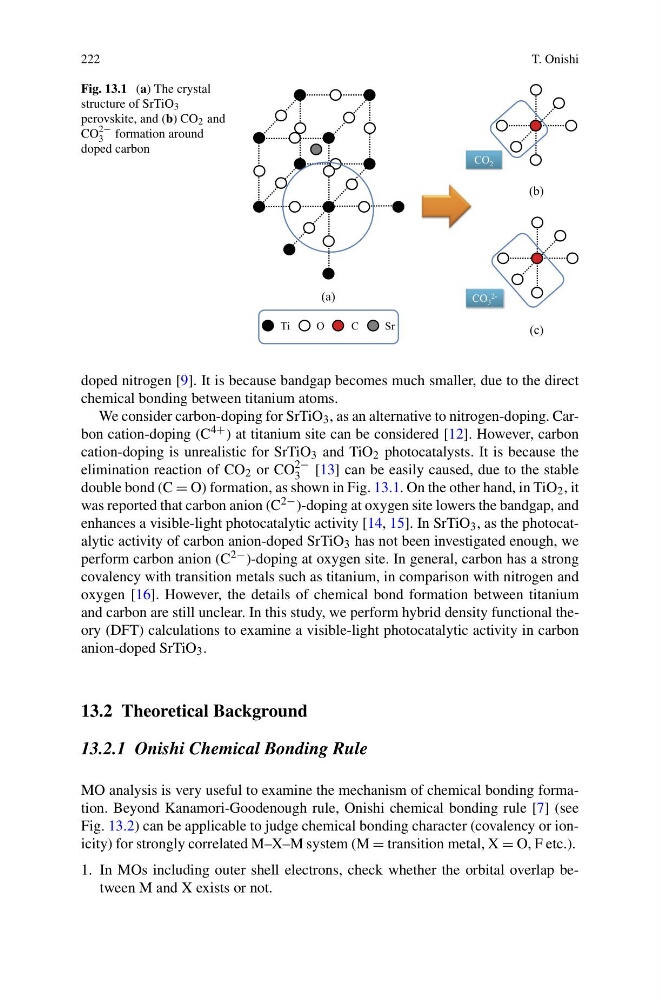
Fig. 13.1 (a) The crystal
structure of SrTiO 3
perovskite, and (b) CO 2 and
CO
2−
3 formation around
doped carbon
doped nitrogen [9]. It is because bandgap becomes much smaller, due to the direct
chemical bonding between titanium atoms.
We consider carbon-doping for SrTiO 3 , as an alternative to nitrogen-doping. Carbon cation-doping (C 4+ ) at titanium site can be considered [12]. However, carbon
cation-doping is unrealistic for SrTiO 3 and TiO 2 photocatalysts. It is because the
elimination reaction of CO 2 or CO
2−
3 [13] can be easily caused, due to the stable
double bond (C = O) formation, as shown in Fig. 13.1. On the other hand, in TiO 2 , it
was reported that carbon anion (C 2− )-doping at oxygen site lowers the bandgap, and
enhances a visible-light photocatalytic activity [14, 15]. In SrTiO 3 , as the photocatalytic activity of carbon anion-doped SrTiO 3 has not been investigated enough, we
perform carbon anion (C 2− )-doping at oxygen site. In general, carbon has a strong
covalency with transition metals such as titanium, in comparison with nitrogen and
oxygen [16]. However, the details of chemical bond formation between titanium
and carbon are still unclear. In this study, we perform hybrid density functional theory (DFT) calculations to examine a visible-light photocatalytic activity in carbon
anion-doped SrTiO 3 .
13.2 Theoretical Background
13.2.1 Onishi Chemical Bonding Rule
MO analysis is very useful to examine the mechanism of chemical bonding formation. Beyond Kanamori-Goodenough rule, Onishi chemical bonding rule [7] (see
Fig. 13.2) can be applicable to judge chemical bonding character (covalency or ionicity) for strongly correlated M–X–M system (M = transition metal, X = O, F etc.).
1. In MOs including outer shell electrons, check whether the orbital overlap between M and X exists or not.
T. Onishi
Fig. 13.1 (a) The crystal
structure of SrTiO 3
perovskite, and (b) CO 2 and
CO
2−
3 formation around
doped carbon
doped nitrogen [9]. It is because bandgap becomes much smaller, due to the direct
chemical bonding between titanium atoms.
We consider carbon-doping for SrTiO 3 , as an alternative to nitrogen-doping. Carbon cation-doping (C 4+ ) at titanium site can be considered [12]. However, carbon
cation-doping is unrealistic for SrTiO 3 and TiO 2 photocatalysts. It is because the
elimination reaction of CO 2 or CO
2−
3 [13] can be easily caused, due to the stable
double bond (C = O) formation, as shown in Fig. 13.1. On the other hand, in TiO 2 , it
was reported that carbon anion (C 2− )-doping at oxygen site lowers the bandgap, and
enhances a visible-light photocatalytic activity [14, 15]. In SrTiO 3 , as the photocatalytic activity of carbon anion-doped SrTiO 3 has not been investigated enough, we
perform carbon anion (C 2− )-doping at oxygen site. In general, carbon has a strong
covalency with transition metals such as titanium, in comparison with nitrogen and
oxygen [16]. However, the details of chemical bond formation between titanium
and carbon are still unclear. In this study, we perform hybrid density functional theory (DFT) calculations to examine a visible-light photocatalytic activity in carbon
anion-doped SrTiO 3 .
13.2 Theoretical Background
13.2.1 Onishi Chemical Bonding Rule
MO analysis is very useful to examine the mechanism of chemical bonding formation. Beyond Kanamori-Goodenough rule, Onishi chemical bonding rule [7] (see
Fig. 13.2) can be applicable to judge chemical bonding character (covalency or ionicity) for strongly correlated M–X–M system (M = transition metal, X = O, F etc.).
1. In MOs including outer shell electrons, check whether the orbital overlap between M and X exists or not.