

12 Hydrogen in Light-Metal Cage Assemblies: Towards a Nanofoam Storage
217
Fig. 12.5 Optimized geometries of endohedral H@Be 6 and two HBe 6 isomers
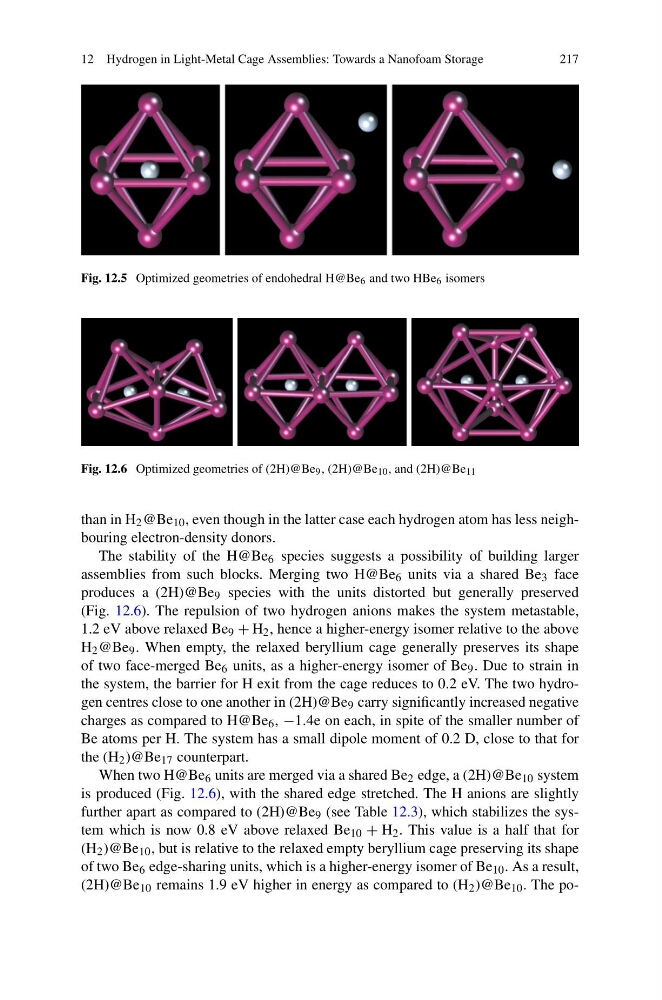
Fig. 12.6 Optimized geometries of (2H)@Be 9 , (2H)@Be 10 , and (2H)@Be 11
than in H 2 @Be 10 , even though in the latter case each hydrogen atom has less neighbouring electron-density donors.
The stability of the H@Be 6 species suggests a possibility of building larger
assemblies from such blocks. Merging two H@Be 6 units via a shared Be 3 face
produces a (2H)@Be 9 species with the units distorted but generally preserved
(Fig. 12.6). The repulsion of two hydrogen anions makes the system metastable,
1.2 eV above relaxed Be 9 + H 2 , hence a higher-energy isomer relative to the above
H 2 @Be 9 . When empty, the relaxed beryllium cage generally preserves its shape
of two face-merged Be 6 units, as a higher-energy isomer of Be 9 . Due to strain in
the system, the barrier for H exit from the cage reduces to 0.2 eV. The two hydrogen centres close to one another in (2H)@Be 9 carry significantly increased negative
charges as compared to H@Be 6 , −1.4e on each, in spite of the smaller number of
Be atoms per H. The system has a small dipole moment of 0.2 D, close to that for
the (H 2 )@Be 17 counterpart.
When two H@Be 6 units are merged via a shared Be 2 edge, a (2H)@Be 10 system
is produced (Fig. 12.6), with the shared edge stretched. The H anions are slightly
further apart as compared to (2H)@Be 9 (see Table 12.3), which stabilizes the system which is now 0.8 eV above relaxed Be 10 + H 2 . This value is a half that for
(H 2 )@Be 10 , but is relative to the relaxed empty beryllium cage preserving its shape
of two Be 6 edge-sharing units, which is a higher-energy isomer of Be 10 . As a result,
(2H)@Be 10 remains 1.9 eV higher in energy as compared to (H 2 )@Be 10 . The po-
217
Fig. 12.5 Optimized geometries of endohedral H@Be 6 and two HBe 6 isomers
Fig. 12.6 Optimized geometries of (2H)@Be 9 , (2H)@Be 10 , and (2H)@Be 11
than in H 2 @Be 10 , even though in the latter case each hydrogen atom has less neighbouring electron-density donors.
The stability of the H@Be 6 species suggests a possibility of building larger
assemblies from such blocks. Merging two H@Be 6 units via a shared Be 3 face
produces a (2H)@Be 9 species with the units distorted but generally preserved
(Fig. 12.6). The repulsion of two hydrogen anions makes the system metastable,
1.2 eV above relaxed Be 9 + H 2 , hence a higher-energy isomer relative to the above
H 2 @Be 9 . When empty, the relaxed beryllium cage generally preserves its shape
of two face-merged Be 6 units, as a higher-energy isomer of Be 9 . Due to strain in
the system, the barrier for H exit from the cage reduces to 0.2 eV. The two hydrogen centres close to one another in (2H)@Be 9 carry significantly increased negative
charges as compared to H@Be 6 , −1.4e on each, in spite of the smaller number of
Be atoms per H. The system has a small dipole moment of 0.2 D, close to that for
the (H 2 )@Be 17 counterpart.
When two H@Be 6 units are merged via a shared Be 2 edge, a (2H)@Be 10 system
is produced (Fig. 12.6), with the shared edge stretched. The H anions are slightly
further apart as compared to (2H)@Be 9 (see Table 12.3), which stabilizes the system which is now 0.8 eV above relaxed Be 10 + H 2 . This value is a half that for
(H 2 )@Be 10 , but is relative to the relaxed empty beryllium cage preserving its shape
of two Be 6 edge-sharing units, which is a higher-energy isomer of Be 10 . As a result,
(2H)@Be 10 remains 1.9 eV higher in energy as compared to (H 2 )@Be 10 . The po-