

218
F.Y. Naumkin and D.J. Wales
Table 12.3 Equilibrium parameters (in eV and Å) and atomic charges (in e) of (kH)@Be n
System
D total
e
a /n; D e
b
R e (H–H) R e (Be–H) R e (Be–Be) q(H)
q(Be)
H@Be 6
1.56; 1.72
1.51
2.13
−0.95 +0.08–0.31
(2H)@Be 9
1.62; −1.19
1.68
1.50–1.72
2.14–2.43
−1.38 +0.15–0.42
(2H)@Be 10 1.71; −0.77
1.95
1.51–1.58
1.96–2.48
−1.26 −0.08–+0.40
(2H)@Be 11 1.94; −1.52
1.71
1.51–2.01
2.01–2.24
−1.21 +0.11–0.35
(3H)@Be 11 1.99; 0.41
1.67
1.52–1.69
1.99–2.32
−1.36 +0.16–0.46
a (kH)@Be n → nBe + H/H 2 /(H + H 2 ) for k = 1/2/3
b (kH)@Be n → Be n + H/H 2 /(H + H 2 ) for k = 1/2/3
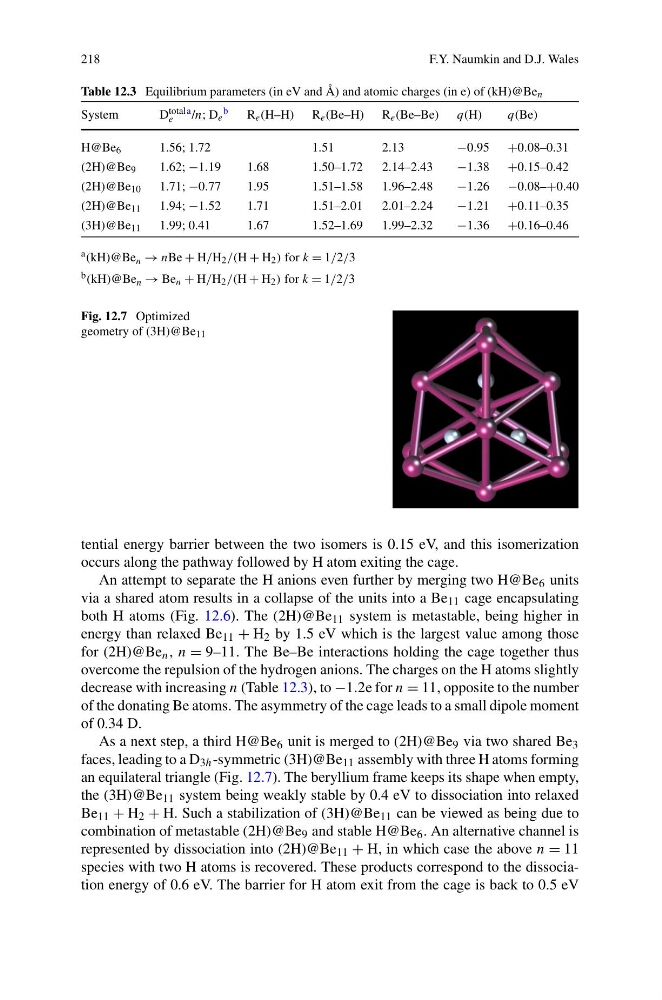
Fig. 12.7 Optimized
geometry of (3H)@Be 11
tential energy barrier between the two isomers is 0.15 eV, and this isomerization
occurs along the pathway followed by H atom exiting the cage.
An attempt to separate the H anions even further by merging two H@Be 6 units
via a shared atom results in a collapse of the units into a Be 11 cage encapsulating
both H atoms (Fig. 12.6). The (2H)@Be 11 system is metastable, being higher in
energy than relaxed Be 11 + H 2 by 1.5 eV which is the largest value among those
for (2H)@Be n , n = 9–11. The Be–Be interactions holding the cage together thus
overcome the repulsion of the hydrogen anions. The charges on the H atoms slightly
decrease with increasing n (Table 12.3), to −1.2e for n = 11, opposite to the number
of the donating Be atoms. The asymmetry of the cage leads to a small dipole moment
of 0.34 D.
As a next step, a third H@Be 6 unit is merged to (2H)@Be 9 via two shared Be 3
faces, leading to a D 3h -symmetric (3H)@Be 11 assembly with three H atoms forming
an equilateral triangle (Fig. 12.7). The beryllium frame keeps its shape when empty,
the (3H)@Be 11 system being weakly stable by 0.4 eV to dissociation into relaxed
Be 11 + H 2 + H. Such a stabilization of (3H)@Be 11 can be viewed as being due to
combination of metastable (2H)@Be 9 and stable H@Be 6 . An alternative channel is
represented by dissociation into (2H)@Be 11 + H, in which case the above n = 11
species with two H atoms is recovered. These products correspond to the dissociation energy of 0.6 eV. The barrier for H atom exit from the cage is back to 0.5 eV
F.Y. Naumkin and D.J. Wales
Table 12.3 Equilibrium parameters (in eV and Å) and atomic charges (in e) of (kH)@Be n
System
D total
e
a /n; D e
b
R e (H–H) R e (Be–H) R e (Be–Be) q(H)
q(Be)
H@Be 6
1.56; 1.72
1.51
2.13
−0.95 +0.08–0.31
(2H)@Be 9
1.62; −1.19
1.68
1.50–1.72
2.14–2.43
−1.38 +0.15–0.42
(2H)@Be 10 1.71; −0.77
1.95
1.51–1.58
1.96–2.48
−1.26 −0.08–+0.40
(2H)@Be 11 1.94; −1.52
1.71
1.51–2.01
2.01–2.24
−1.21 +0.11–0.35
(3H)@Be 11 1.99; 0.41
1.67
1.52–1.69
1.99–2.32
−1.36 +0.16–0.46
a (kH)@Be n → nBe + H/H 2 /(H + H 2 ) for k = 1/2/3
b (kH)@Be n → Be n + H/H 2 /(H + H 2 ) for k = 1/2/3
Fig. 12.7 Optimized
geometry of (3H)@Be 11
tential energy barrier between the two isomers is 0.15 eV, and this isomerization
occurs along the pathway followed by H atom exiting the cage.
An attempt to separate the H anions even further by merging two H@Be 6 units
via a shared atom results in a collapse of the units into a Be 11 cage encapsulating
both H atoms (Fig. 12.6). The (2H)@Be 11 system is metastable, being higher in
energy than relaxed Be 11 + H 2 by 1.5 eV which is the largest value among those
for (2H)@Be n , n = 9–11. The Be–Be interactions holding the cage together thus
overcome the repulsion of the hydrogen anions. The charges on the H atoms slightly
decrease with increasing n (Table 12.3), to −1.2e for n = 11, opposite to the number
of the donating Be atoms. The asymmetry of the cage leads to a small dipole moment
of 0.34 D.
As a next step, a third H@Be 6 unit is merged to (2H)@Be 9 via two shared Be 3
faces, leading to a D 3h -symmetric (3H)@Be 11 assembly with three H atoms forming
an equilateral triangle (Fig. 12.7). The beryllium frame keeps its shape when empty,
the (3H)@Be 11 system being weakly stable by 0.4 eV to dissociation into relaxed
Be 11 + H 2 + H. Such a stabilization of (3H)@Be 11 can be viewed as being due to
combination of metastable (2H)@Be 9 and stable H@Be 6 . An alternative channel is
represented by dissociation into (2H)@Be 11 + H, in which case the above n = 11
species with two H atoms is recovered. These products correspond to the dissociation energy of 0.6 eV. The barrier for H atom exit from the cage is back to 0.5 eV