

216
F.Y. Naumkin and D.J. Wales
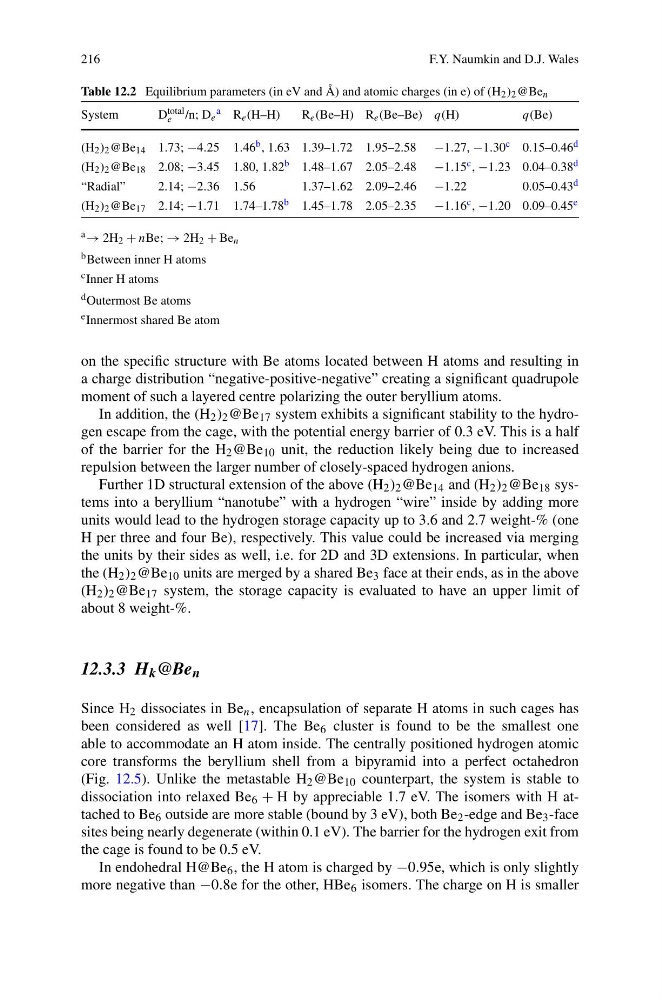
Table 12.2 Equilibrium parameters (in eV and Å) and atomic charges (in e) of (H 2 ) 2 @Be n
System
D total
e /n; D e
a R e (H–H)
R e (Be–H) R e (Be–Be) q(H)
q(Be)
(H 2 ) 2 @Be 14 1.73; −4.25 1.46 b , 1.63 1.39–1.72 1.95–2.58 −1.27, −1.30 c 0.15–0.46 d
(H 2 ) 2 @Be 18 2.08; −3.45 1.80, 1.82 b 1.48–1.67 2.05–2.48 −1.15 c , −1.23 0.04–0.38 d
“Radial”
2.14; −2.36 1.56
1.37–1.62 2.09–2.46 −1.22
0.05–0.43 d
(H 2 ) 2 @Be 17 2.14; −1.71 1.74–1.78 b 1.45–1.78 2.05–2.35 −1.16 c , −1.20 0.09–0.45 e
a → 2H 2 + nBe; → 2H 2 + Be n
b Between inner H atoms
c Inner H atoms
d Outermost Be atoms
e Innermost shared Be atom
on the specific structure with Be atoms located between H atoms and resulting in
a charge distribution “negative-positive-negative” creating a significant quadrupole
moment of such a layered centre polarizing the outer beryllium atoms.
In addition, the (H 2 ) 2 @Be 17 system exhibits a significant stability to the hydrogen escape from the cage, with the potential energy barrier of 0.3 eV. This is a half
of the barrier for the H 2 @Be 10 unit, the reduction likely being due to increased
repulsion between the larger number of closely-spaced hydrogen anions.
Further 1D structural extension of the above (H 2 ) 2 @Be 14 and (H 2 ) 2 @Be 18 systems into a beryllium “nanotube” with a hydrogen “wire” inside by adding more
units would lead to the hydrogen storage capacity up to 3.6 and 2.7 weight-% (one
H per three and four Be), respectively. This value could be increased via merging
the units by their sides as well, i.e. for 2D and 3D extensions. In particular, when
the (H 2 ) 2 @Be 10 units are merged by a shared Be 3 face at their ends, as in the above
(H 2 ) 2 @Be 17 system, the storage capacity is evaluated to have an upper limit of
about 8 weight-%.
12.3.3 H k @Be n
Since H 2 dissociates in Be n , encapsulation of separate H atoms in such cages has
been considered as well [17]. The Be 6 cluster is found to be the smallest one
able to accommodate an H atom inside. The centrally positioned hydrogen atomic
core transforms the beryllium shell from a bipyramid into a perfect octahedron
(Fig. 12.5). Unlike the metastable H 2 @Be 10 counterpart, the system is stable to
dissociation into relaxed Be 6 + H by appreciable 1.7 eV. The isomers with H attached to Be 6 outside are more stable (bound by 3 eV), both Be 2 -edge and Be 3 -face
sites being nearly degenerate (within 0.1 eV). The barrier for the hydrogen exit from
the cage is found to be 0.5 eV.
In endohedral H@Be 6 , the H atom is charged by −0.95e, which is only slightly
more negative than −0.8e for the other, HBe 6 isomers. The charge on H is smaller
F.Y. Naumkin and D.J. Wales
Table 12.2 Equilibrium parameters (in eV and Å) and atomic charges (in e) of (H 2 ) 2 @Be n
System
D total
e /n; D e
a R e (H–H)
R e (Be–H) R e (Be–Be) q(H)
q(Be)
(H 2 ) 2 @Be 14 1.73; −4.25 1.46 b , 1.63 1.39–1.72 1.95–2.58 −1.27, −1.30 c 0.15–0.46 d
(H 2 ) 2 @Be 18 2.08; −3.45 1.80, 1.82 b 1.48–1.67 2.05–2.48 −1.15 c , −1.23 0.04–0.38 d
“Radial”
2.14; −2.36 1.56
1.37–1.62 2.09–2.46 −1.22
0.05–0.43 d
(H 2 ) 2 @Be 17 2.14; −1.71 1.74–1.78 b 1.45–1.78 2.05–2.35 −1.16 c , −1.20 0.09–0.45 e
a → 2H 2 + nBe; → 2H 2 + Be n
b Between inner H atoms
c Inner H atoms
d Outermost Be atoms
e Innermost shared Be atom
on the specific structure with Be atoms located between H atoms and resulting in
a charge distribution “negative-positive-negative” creating a significant quadrupole
moment of such a layered centre polarizing the outer beryllium atoms.
In addition, the (H 2 ) 2 @Be 17 system exhibits a significant stability to the hydrogen escape from the cage, with the potential energy barrier of 0.3 eV. This is a half
of the barrier for the H 2 @Be 10 unit, the reduction likely being due to increased
repulsion between the larger number of closely-spaced hydrogen anions.
Further 1D structural extension of the above (H 2 ) 2 @Be 14 and (H 2 ) 2 @Be 18 systems into a beryllium “nanotube” with a hydrogen “wire” inside by adding more
units would lead to the hydrogen storage capacity up to 3.6 and 2.7 weight-% (one
H per three and four Be), respectively. This value could be increased via merging
the units by their sides as well, i.e. for 2D and 3D extensions. In particular, when
the (H 2 ) 2 @Be 10 units are merged by a shared Be 3 face at their ends, as in the above
(H 2 ) 2 @Be 17 system, the storage capacity is evaluated to have an upper limit of
about 8 weight-%.
12.3.3 H k @Be n
Since H 2 dissociates in Be n , encapsulation of separate H atoms in such cages has
been considered as well [17]. The Be 6 cluster is found to be the smallest one
able to accommodate an H atom inside. The centrally positioned hydrogen atomic
core transforms the beryllium shell from a bipyramid into a perfect octahedron
(Fig. 12.5). Unlike the metastable H 2 @Be 10 counterpart, the system is stable to
dissociation into relaxed Be 6 + H by appreciable 1.7 eV. The isomers with H attached to Be 6 outside are more stable (bound by 3 eV), both Be 2 -edge and Be 3 -face
sites being nearly degenerate (within 0.1 eV). The barrier for the hydrogen exit from
the cage is found to be 0.5 eV.
In endohedral H@Be 6 , the H atom is charged by −0.95e, which is only slightly
more negative than −0.8e for the other, HBe 6 isomers. The charge on H is smaller