

12 Hydrogen in Light-Metal Cage Assemblies: Towards a Nanofoam Storage
215
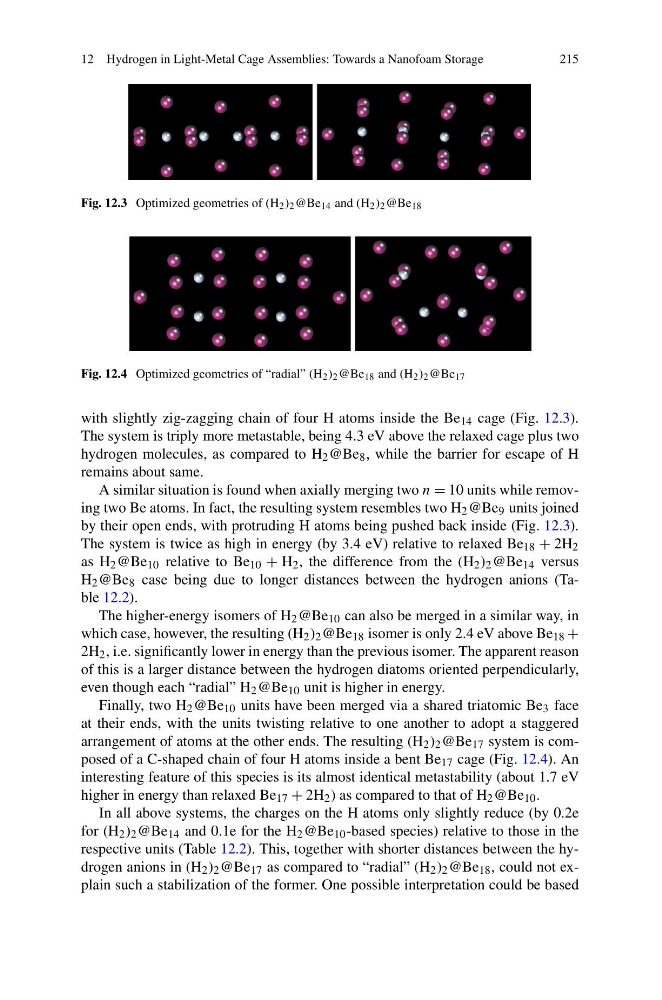
Fig. 12.3 Optimized geometries of (H 2 ) 2 @Be 14 and (H 2 ) 2 @Be 18
Fig. 12.4 Optimized geometries of “radial” (H 2 ) 2 @Be 18 and (H 2 ) 2 @Be 17
with slightly zig-zagging chain of four H atoms inside the Be 14 cage (Fig. 12.3).
The system is triply more metastable, being 4.3 eV above the relaxed cage plus two
hydrogen molecules, as compared to H 2 @Be 8 , while the barrier for escape of H
remains about same.
A similar situation is found when axially merging two n = 10 units while removing two Be atoms. In fact, the resulting system resembles two H 2 @Be 9 units joined
by their open ends, with protruding H atoms being pushed back inside (Fig. 12.3).
The system is twice as high in energy (by 3.4 eV) relative to relaxed Be 18 + 2H 2
as H 2 @Be 10 relative to Be 10 + H 2 , the difference from the (H 2 ) 2 @Be 14 versus
H 2 @Be 8 case being due to longer distances between the hydrogen anions (Table 12.2).
The higher-energy isomers of H 2 @Be 10 can also be merged in a similar way, in
which case, however, the resulting (H 2 ) 2 @Be 18 isomer is only 2.4 eV above Be 18 +
2H 2 , i.e. significantly lower in energy than the previous isomer. The apparent reason
of this is a larger distance between the hydrogen diatoms oriented perpendicularly,
even though each “radial” H 2 @Be 10 unit is higher in energy.
Finally, two H 2 @Be 10 units have been merged via a shared triatomic Be 3 face
at their ends, with the units twisting relative to one another to adopt a staggered
arrangement of atoms at the other ends. The resulting (H 2 ) 2 @Be 17 system is composed of a C-shaped chain of four H atoms inside a bent Be 17 cage (Fig. 12.4). An
interesting feature of this species is its almost identical metastability (about 1.7 eV
higher in energy than relaxed Be 17 + 2H 2 ) as compared to that of H 2 @Be 10 .
In all above systems, the charges on the H atoms only slightly reduce (by 0.2e
for (H 2 ) 2 @Be 14 and 0.1e for the H 2 @Be 10 -based species) relative to those in the
respective units (Table 12.2). This, together with shorter distances between the hydrogen anions in (H 2 ) 2 @Be 17 as compared to “radial” (H 2 ) 2 @Be 18 , could not explain such a stabilization of the former. One possible interpretation could be based
215
Fig. 12.3 Optimized geometries of (H 2 ) 2 @Be 14 and (H 2 ) 2 @Be 18
Fig. 12.4 Optimized geometries of “radial” (H 2 ) 2 @Be 18 and (H 2 ) 2 @Be 17
with slightly zig-zagging chain of four H atoms inside the Be 14 cage (Fig. 12.3).
The system is triply more metastable, being 4.3 eV above the relaxed cage plus two
hydrogen molecules, as compared to H 2 @Be 8 , while the barrier for escape of H
remains about same.
A similar situation is found when axially merging two n = 10 units while removing two Be atoms. In fact, the resulting system resembles two H 2 @Be 9 units joined
by their open ends, with protruding H atoms being pushed back inside (Fig. 12.3).
The system is twice as high in energy (by 3.4 eV) relative to relaxed Be 18 + 2H 2
as H 2 @Be 10 relative to Be 10 + H 2 , the difference from the (H 2 ) 2 @Be 14 versus
H 2 @Be 8 case being due to longer distances between the hydrogen anions (Table 12.2).
The higher-energy isomers of H 2 @Be 10 can also be merged in a similar way, in
which case, however, the resulting (H 2 ) 2 @Be 18 isomer is only 2.4 eV above Be 18 +
2H 2 , i.e. significantly lower in energy than the previous isomer. The apparent reason
of this is a larger distance between the hydrogen diatoms oriented perpendicularly,
even though each “radial” H 2 @Be 10 unit is higher in energy.
Finally, two H 2 @Be 10 units have been merged via a shared triatomic Be 3 face
at their ends, with the units twisting relative to one another to adopt a staggered
arrangement of atoms at the other ends. The resulting (H 2 ) 2 @Be 17 system is composed of a C-shaped chain of four H atoms inside a bent Be 17 cage (Fig. 12.4). An
interesting feature of this species is its almost identical metastability (about 1.7 eV
higher in energy than relaxed Be 17 + 2H 2 ) as compared to that of H 2 @Be 10 .
In all above systems, the charges on the H atoms only slightly reduce (by 0.2e
for (H 2 ) 2 @Be 14 and 0.1e for the H 2 @Be 10 -based species) relative to those in the
respective units (Table 12.2). This, together with shorter distances between the hydrogen anions in (H 2 ) 2 @Be 17 as compared to “radial” (H 2 ) 2 @Be 18 , could not explain such a stabilization of the former. One possible interpretation could be based