

204
Y.-W. Huang et al.
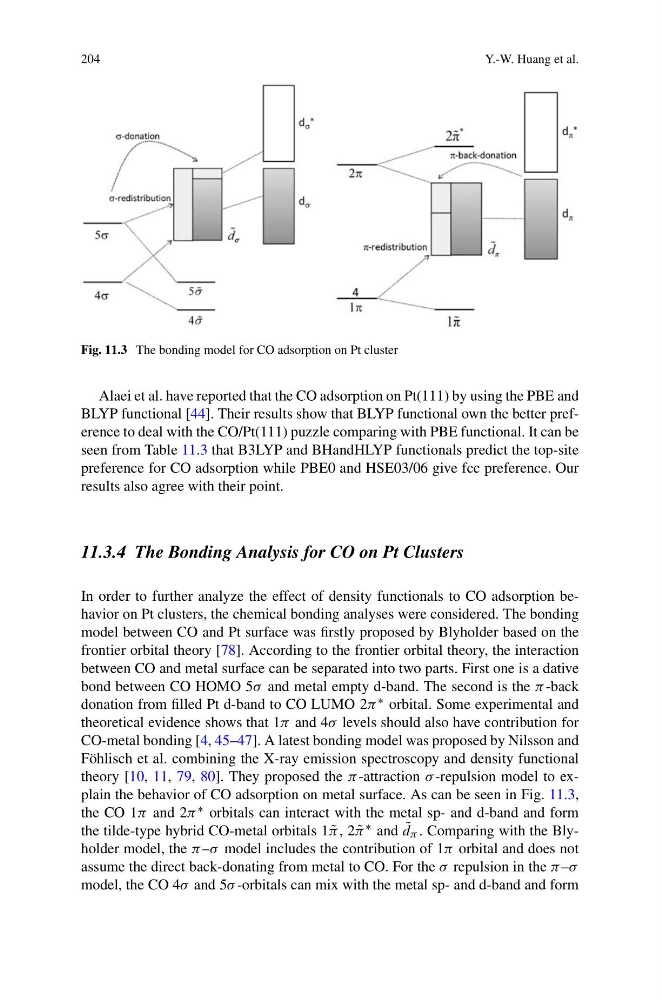
Fig. 11.3 The bonding model for CO adsorption on Pt cluster
Alaei et al. have reported that the CO adsorption on Pt(111) by using the PBE and
BLYP functional [44]. Their results show that BLYP functional own the better preference to deal with the CO/Pt(111) puzzle comparing with PBE functional. It can be
seen from Table 11.3 that B3LYP and BHandHLYP functionals predict the top-site
preference for CO adsorption while PBE0 and HSE03/06 give fcc preference. Our
results also agree with their point.
11.3.4 The Bonding Analysis for CO on Pt Clusters
In order to further analyze the effect of density functionals to CO adsorption behavior on Pt clusters, the chemical bonding analyses were considered. The bonding
model between CO and Pt surface was firstly proposed by Blyholder based on the
frontier orbital theory [78]. According to the frontier orbital theory, the interaction
between CO and metal surface can be separated into two parts. First one is a dative
bond between CO HOMO 5σ and metal empty d-band. The second is the π -back
donation from filled Pt d-band to CO LUMO 2π ∗ orbital. Some experimental and
theoretical evidence shows that 1π and 4σ levels should also have contribution for
CO-metal bonding [4, 45–47]. A latest bonding model was proposed by Nilsson and
Föhlisch et al. combining the X-ray emission spectroscopy and density functional
theory [10, 11, 79, 80]. They proposed the π -attraction σ -repulsion model to explain the behavior of CO adsorption on metal surface. As can be seen in Fig. 11.3,
the CO 1π and 2π ∗ orbitals can interact with the metal sp- and d-band and form
the tilde-type hybrid CO-metal orbitals 1 ˜
π , 2 ˜
π ∗ and ˜
d π . Comparing with the Blyholder model, the π –σ model includes the contribution of 1π orbital and does not
assume the direct back-donating from metal to CO. For the σ repulsion in the π –σ
model, the CO 4σ and 5σ -orbitals can mix with the metal sp- and d-band and form
Y.-W. Huang et al.
Fig. 11.3 The bonding model for CO adsorption on Pt cluster
Alaei et al. have reported that the CO adsorption on Pt(111) by using the PBE and
BLYP functional [44]. Their results show that BLYP functional own the better preference to deal with the CO/Pt(111) puzzle comparing with PBE functional. It can be
seen from Table 11.3 that B3LYP and BHandHLYP functionals predict the top-site
preference for CO adsorption while PBE0 and HSE03/06 give fcc preference. Our
results also agree with their point.
11.3.4 The Bonding Analysis for CO on Pt Clusters
In order to further analyze the effect of density functionals to CO adsorption behavior on Pt clusters, the chemical bonding analyses were considered. The bonding
model between CO and Pt surface was firstly proposed by Blyholder based on the
frontier orbital theory [78]. According to the frontier orbital theory, the interaction
between CO and metal surface can be separated into two parts. First one is a dative
bond between CO HOMO 5σ and metal empty d-band. The second is the π -back
donation from filled Pt d-band to CO LUMO 2π ∗ orbital. Some experimental and
theoretical evidence shows that 1π and 4σ levels should also have contribution for
CO-metal bonding [4, 45–47]. A latest bonding model was proposed by Nilsson and
Föhlisch et al. combining the X-ray emission spectroscopy and density functional
theory [10, 11, 79, 80]. They proposed the π -attraction σ -repulsion model to explain the behavior of CO adsorption on metal surface. As can be seen in Fig. 11.3,
the CO 1π and 2π ∗ orbitals can interact with the metal sp- and d-band and form
the tilde-type hybrid CO-metal orbitals 1 ˜
π , 2 ˜
π ∗ and ˜
d π . Comparing with the Blyholder model, the π –σ model includes the contribution of 1π orbital and does not
assume the direct back-donating from metal to CO. For the σ repulsion in the π –σ
model, the CO 4σ and 5σ -orbitals can mix with the metal sp- and d-band and form