

11 An Evaluation of Density Functional Theory for CO Adsorption on Pt(111)
205
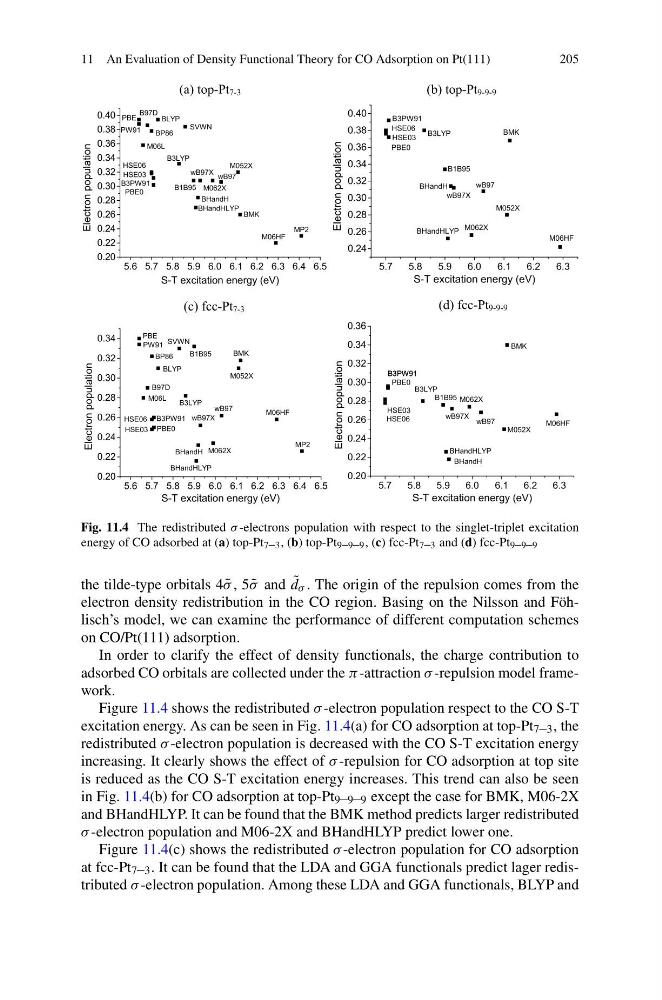
Fig. 11.4 The redistributed σ -electrons population with respect to the singlet-triplet excitation
energy of CO adsorbed at (a) top-Pt 7–3 , (b) top-Pt 9–9–9 , (c) fcc-Pt 7–3 and (d) fcc-Pt 9–9–9
the tilde-type orbitals 4 ˜
σ , 5 ˜
σ and ˜
d σ . The origin of the repulsion comes from the
electron density redistribution in the CO region. Basing on the Nilsson and Föhlisch’s model, we can examine the performance of different computation schemes
on CO/Pt(111) adsorption.
In order to clarify the effect of density functionals, the charge contribution to
adsorbed CO orbitals are collected under the π -attraction σ -repulsion model framework.
Figure 11.4 shows the redistributed σ -electron population respect to the CO S-T
excitation energy. As can be seen in Fig. 11.4(a) for CO adsorption at top-Pt 7–3 , the
redistributed σ -electron population is decreased with the CO S-T excitation energy
increasing. It clearly shows the effect of σ -repulsion for CO adsorption at top site
is reduced as the CO S-T excitation energy increases. This trend can also be seen
in Fig. 11.4(b) for CO adsorption at top-Pt 9–9–9 except the case for BMK, M06-2X
and BHandHLYP. It can be found that the BMK method predicts larger redistributed
σ -electron population and M06-2X and BHandHLYP predict lower one.
Figure 11.4(c) shows the redistributed σ -electron population for CO adsorption
at fcc-Pt 7–3 . It can be found that the LDA and GGA functionals predict lager redistributed σ -electron population. Among these LDA and GGA functionals, BLYP and
205
Fig. 11.4 The redistributed σ -electrons population with respect to the singlet-triplet excitation
energy of CO adsorbed at (a) top-Pt 7–3 , (b) top-Pt 9–9–9 , (c) fcc-Pt 7–3 and (d) fcc-Pt 9–9–9
the tilde-type orbitals 4 ˜
σ , 5 ˜
σ and ˜
d σ . The origin of the repulsion comes from the
electron density redistribution in the CO region. Basing on the Nilsson and Föhlisch’s model, we can examine the performance of different computation schemes
on CO/Pt(111) adsorption.
In order to clarify the effect of density functionals, the charge contribution to
adsorbed CO orbitals are collected under the π -attraction σ -repulsion model framework.
Figure 11.4 shows the redistributed σ -electron population respect to the CO S-T
excitation energy. As can be seen in Fig. 11.4(a) for CO adsorption at top-Pt 7–3 , the
redistributed σ -electron population is decreased with the CO S-T excitation energy
increasing. It clearly shows the effect of σ -repulsion for CO adsorption at top site
is reduced as the CO S-T excitation energy increases. This trend can also be seen
in Fig. 11.4(b) for CO adsorption at top-Pt 9–9–9 except the case for BMK, M06-2X
and BHandHLYP. It can be found that the BMK method predicts larger redistributed
σ -electron population and M06-2X and BHandHLYP predict lower one.
Figure 11.4(c) shows the redistributed σ -electron population for CO adsorption
at fcc-Pt 7–3 . It can be found that the LDA and GGA functionals predict lager redistributed σ -electron population. Among these LDA and GGA functionals, BLYP and