

11 An Evaluation of Density Functional Theory for CO Adsorption on Pt(111)
203
Table 11.3 The adsorption energies for CO on Pt 9–9–9 by using 14 hybrid density functional
theories
Level
Method
E TOP
E FCC
E TOP–FCC
Hybrid
M06HF
−1.37
−0.41
−0.96
Hybrid
BMK
−1.40
−1.21
−0.19
Hybrid
M052X
−1.35
−1.15
−0.20
Hybrid
wB97
−1.32
−1.12
−0.20
Hybrid
M062X
−1.29
−1.29
0.00
Hybrid
wB97X
−1.26
−1.23
−0.03
Hybrid
BHandH
−1.96
−1.95
−0.01
Hybrid
BHandHLYP
−1.01
−0.81
−0.20
Hybrid
B1B95
−1.44
−1.61
0.17
Hybrid
B3LYP
−1.13
−1.12
−0.01
Hybrid
PBE0
−1.53
−1.70
0.17
Hybrid
B3PW91
−1.33
−1.47
0.14
Hybrid
HSE03
−1.46
−1.61
0.15
Hybrid
HSE06
−1.47
−1.61
0.14
BLYP and B97D are 0.12 and 0.03 eV, respectively, smaller than those for other
GGA and meta-GGA functionals. For the hybrid functionals with low ratio of HF
exchange energy, the energy differences between top and fcc sites are increased
comparing with those at GGA level. It can also be found that the energy difference between top and fcc sites for B3LYP method is smaller than those for other
functionals with low ratio of HF exchange energy. When increasing the ratio of HF
exchange energy more than 40 %, half of the 8 DFT schemes, i.e., M06HF, BMK,
wB97 and M062X functionals, give the correct site preference of CO adsorption.
In order to further check the effects of geometry relaxation, the symmetryconstrained optimization was adopted for CO on Pt 7–3 [77], which the Pt 7–3 cluster
can be freely relaxed but still maintains the C 3V symmetry. The results show that
adsorption energies are −1.30 and −1.59 eV for CO adsorption at top and fcc sites,
respectively by using B3LYP functional, and −1.83 and −1.04 eV for CO adsorption at top and fcc, respectively by using BMK functional. It can be found that the
site preference is still not changed when considering the effect of geometry relaxation.
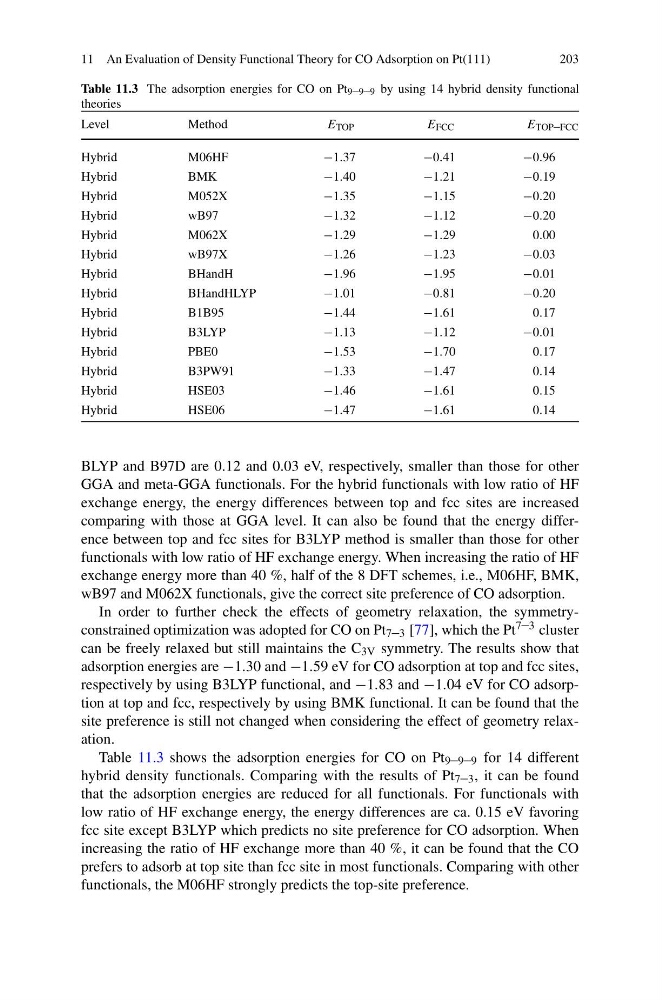
Table 11.3 shows the adsorption energies for CO on Pt 9–9–9 for 14 different
hybrid density functionals. Comparing with the results of Pt 7–3 , it can be found
that the adsorption energies are reduced for all functionals. For functionals with
low ratio of HF exchange energy, the energy differences are ca. 0.15 eV favoring
fcc site except B3LYP which predicts no site preference for CO adsorption. When
increasing the ratio of HF exchange more than 40 %, it can be found that the CO
prefers to adsorb at top site than fcc site in most functionals. Comparing with other
functionals, the M06HF strongly predicts the top-site preference.
203
Table 11.3 The adsorption energies for CO on Pt 9–9–9 by using 14 hybrid density functional
theories
Level
Method
E TOP
E FCC
E TOP–FCC
Hybrid
M06HF
−1.37
−0.41
−0.96
Hybrid
BMK
−1.40
−1.21
−0.19
Hybrid
M052X
−1.35
−1.15
−0.20
Hybrid
wB97
−1.32
−1.12
−0.20
Hybrid
M062X
−1.29
−1.29
0.00
Hybrid
wB97X
−1.26
−1.23
−0.03
Hybrid
BHandH
−1.96
−1.95
−0.01
Hybrid
BHandHLYP
−1.01
−0.81
−0.20
Hybrid
B1B95
−1.44
−1.61
0.17
Hybrid
B3LYP
−1.13
−1.12
−0.01
Hybrid
PBE0
−1.53
−1.70
0.17
Hybrid
B3PW91
−1.33
−1.47
0.14
Hybrid
HSE03
−1.46
−1.61
0.15
Hybrid
HSE06
−1.47
−1.61
0.14
BLYP and B97D are 0.12 and 0.03 eV, respectively, smaller than those for other
GGA and meta-GGA functionals. For the hybrid functionals with low ratio of HF
exchange energy, the energy differences between top and fcc sites are increased
comparing with those at GGA level. It can also be found that the energy difference between top and fcc sites for B3LYP method is smaller than those for other
functionals with low ratio of HF exchange energy. When increasing the ratio of HF
exchange energy more than 40 %, half of the 8 DFT schemes, i.e., M06HF, BMK,
wB97 and M062X functionals, give the correct site preference of CO adsorption.
In order to further check the effects of geometry relaxation, the symmetryconstrained optimization was adopted for CO on Pt 7–3 [77], which the Pt 7–3 cluster
can be freely relaxed but still maintains the C 3V symmetry. The results show that
adsorption energies are −1.30 and −1.59 eV for CO adsorption at top and fcc sites,
respectively by using B3LYP functional, and −1.83 and −1.04 eV for CO adsorption at top and fcc, respectively by using BMK functional. It can be found that the
site preference is still not changed when considering the effect of geometry relaxation.
Table 11.3 shows the adsorption energies for CO on Pt 9–9–9 for 14 different
hybrid density functionals. Comparing with the results of Pt 7–3 , it can be found
that the adsorption energies are reduced for all functionals. For functionals with
low ratio of HF exchange energy, the energy differences are ca. 0.15 eV favoring
fcc site except B3LYP which predicts no site preference for CO adsorption. When
increasing the ratio of HF exchange more than 40 %, it can be found that the CO
prefers to adsorb at top site than fcc site in most functionals. Comparing with other
functionals, the M06HF strongly predicts the top-site preference.